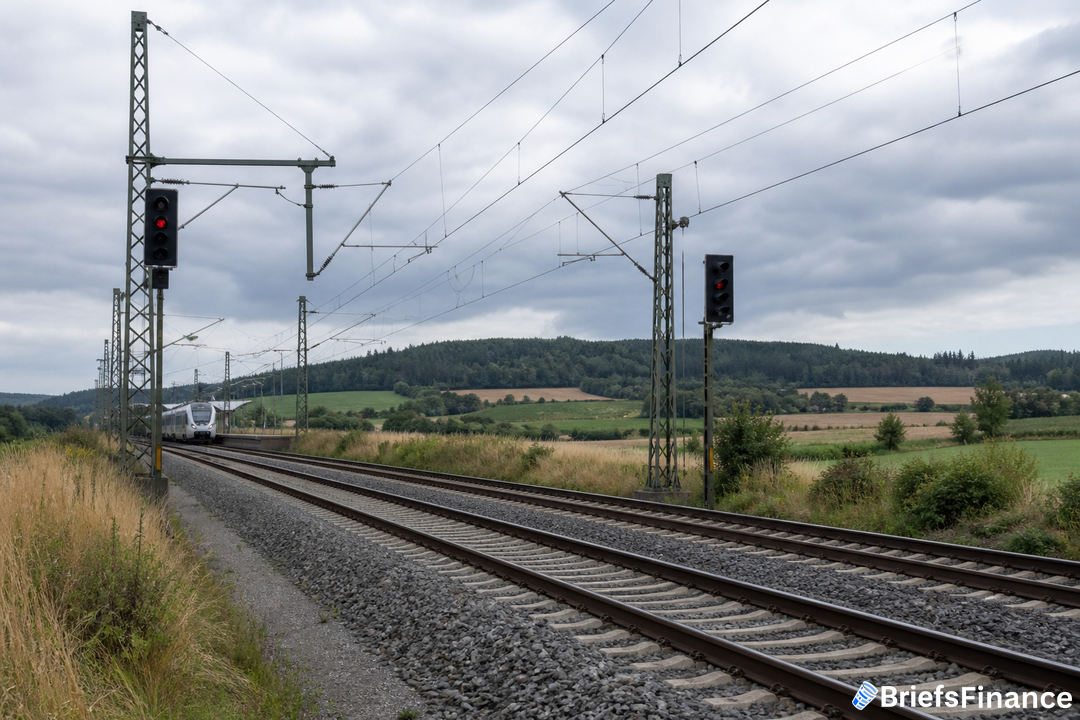
Deutsche Bahn swapped out a 1899 signal box in Mühldorf am Inn last year, yet close to 20% of its interlockings still run on mechanics.
According to Siemens Mobility's CEO, digital signaling combined with automated driving could boost network capacity by about 30%, and ICE trains already generate around 1 billion data points per day.
Germany trails on ETCS rollout, while Austria just signed €2.6 billion in signaling contracts, about €1.3 billion of which went to Siemens Mobility.
A 19th-century signal box meets 21st-century trains
If you rode from Munich toward Austria until recently, part of your safety hinged on a signal station that went live in 1899 during Kaiser Wilhelm II's reign. Inside that small-house-sized hut in Mühldorf am Inn, operators hauled on heavy levers and cranks connected via cabling to points and signals so trains wouldn't collide.
That 126-year-old setup was finally replaced with electronics at the end of last year. Even so, nearly one in five of Germany's interlockings is still mechanical, a stark reminder of how modern rolling stock is outpacing the rails beneath it. Siemens Mobility CEO Michael Peter argues that digitizing the network would open up capacity without laying new track. "That's the big debate in Germany today: how do we increase throughput on the existing lines so that we have buffers again and can keep to the timetable better," he said. "It's all about punctuality and for that you need end-to-end technology."
Trains as data centers on wheels
Today's flagship ICE looks more like a rolling server room: about 1,000 sensors generate roughly 1 billion data points every day, according to Peter. Siemens Mobility's managed fleets travel around 1 million kilometers daily (621,370 miles), which is roughly comparable to almost three trips to the Moon. That stream lets software watch fleet health and catch odd behavior before parts actually fail. The company has also built remote startup capability, so a train can leave a depot and reach its first stop on its own, braking automatically if it finds something in the way.
The payoff would be smoother flows across a congested network. Right now, punctuality is rough. In September, a little more than half of Deutsche Bahn's long distance services pulled in within six minutes of schedule. Last year, the company logged an average of 6,831 infrastructure-related delays per day.
Germany's rails are a patchwork assembled over more than a century, with roughly 100 different interlocking types that make upkeep harder and slow any move to a single digital playbook. "We have far too many mixed-bag situations on the railroad when it comes to digitization," said Dirk Flege, managing director at industry group Allianz pro Schiene. "There's far too little standardization, far too few standardized interfaces."
The technology to change that exists. Much of the safety logic that lives in local cabinets can be shifted to standardized processors in data centers. Trackside equipment would still be there, but centralized software could clear routes and issue commands to switches and signals.
A key building block is the European Train Control System, a common standard that tells drivers how far and how fast they may go. Within the European Rail Traffic Management System, its counterpart Automated Train Operation subsequently manages when to accelerate, cruise, and brake. Add AI on top and dispatching gets smarter, from easing a train because the next block is busy to moving another to the front after a delay, then rebalancing traffic back toward the plan.
Germany is early in this shift. By the end of 2025, just 683 kilometers of the more than 33,000 kilometer network were outfitted with ETCS. Neighbors set a high bar: Switzerland has used the system network-wide since 2018, and France, Spain, Italy, Austria and Switzerland all enjoy strong reputations for fast, reliable high-speed rail.
Money, momentum, and what to watch
The rollout is harder because vehicles and tracks must be upgraded together. Deutsche Bahn even scrapped its previous ETCS migration approach in summer 2025, citing industry limits on equipping trains at the planned pace and uncertain federal funding at the time. Since then, over €10 billion has been earmarked for rail digitization out of a €500 billion national infrastructure fund.
Progress is uneven, though. Some aging mechanical or relay gear is still being swapped for older-style electronic interlockings instead of the newest, standardized networked systems.
There is momentum elsewhere. In the past month, Austria signed framework agreements totaling €2.6 billion ($2.9 billion) to upgrade signaling nationwide, with about €1.3 billion awarded to Siemens Mobility, part of Munich-based Siemens AG. For everyday travelers and taxpayers, the takeaway is simple: if Germany can standardize and digitize at scale, trains can run closer together and stay on time more often, without miles of new track. That means fewer missed connections and more predictable commutes, which is the payoff most of us actually care about.
Anthropic has gone public at a valuation of about $1.5 trillion, while Amazon went public in 1997 at around $440 million. Anthropic has about $33 billion in revenue this year and no profit, and investors are paying more than 40 times its sales, against about 3 times for Amazon. Briefs Finance CEO Jaspreet Singh says nobody knows what comes next, and that long-term investors use downturns to buy instead of panic selling.
Tech stocks are selling off because investors don't know who will lead Nvidia, the company that has been funding the AI industry and selling it chips.
Inflation has the Federal Reserve planning to raise interest rates, with a hike expected in December, and that puts pressure on homebuyers, private equity and the $40 trillion national debt.
Briefs Finance CEO Jaspreet Singh says nobody has a crystal ball, so his rules are to buy when markets are low, hold long term and invest only what you're willing to lose.
The national debt is above $40 trillion, and the Federal Reserve has gone from sending Washington its profits to losing money.
President Trump's four-part plan leans on shorter-term debt, stablecoin companies buying Treasuries, a bigger balance sheet and government stakes in private companies.
The goal is to outgrow the debt, not pay it off, so Jaspreet Singh points investors to the seven industries where Washington wants growth.
The Fed makes its next rate decision on December 9 and is now talking about jumbo interest rate hikes of 0.5%, though one in December looks unlikely.
Washington will pay a record $1.05 trillion in interest this year on $40 trillion of debt, and that debt resets at higher rates as the Fed hikes.
Jaspreet Singh's five moves are to pay down variable-rate debt, earn interest on your savings, know which stocks feel the pressure, look at value and hedge.
Margin debt, the money investors borrow to buy stocks, is at a record of around 4.6% of GDP, up from 3.9% in 2021.
ETF money has more than tripled in five years to 7% of GDP, while corporate buybacks and 401(k) money sit below their earlier peaks.
Margin calls and panic selling can make the next downturn deeper, so Jaspreet Singh keeps buying broad market funds and says most investors should skip margin debt.
Jensen Huang is out at Nvidia over affairs with multiple people, and the company he founded has been the bank of American AI, with about $30 billion into OpenAI and $10 billion into Anthropic.
A hotter-than-expected inflation report has Fed officials talking about a possible 0.5% hike in December, and gold, silver, and bitcoin fell on the news.
President Trump said the US may not need a deal with Iran, keeping oil prices and inflation risk high. Jaspreet Singh breaks down what it all means for AI stocks and your portfolio.
Stocks are booming at the fastest pace in years, jobless claims just hit a 57-year low, and most investors still feel like nobody is hiring.
The Fed is protecting the dollar over the economy, oil swings on every Iran headline, and a few AI companies are carrying an S&P 500 where four of five stocks sit in a correction.
Jaspreet Singh explains why circular financing between Nvidia, OpenAI, Anthropic, and SpaceX rhymes with 2008's house of cards, and how his three investing pillars handle a stock market bubble.
The Fed has raised rates, cut them, then raised them again only twice in the last 60 years, and both times the economy fell into a recession and stocks crashed.
The same stop-and-go cycle is playing out now, with one big difference: US debt is 125% of GDP today versus about 30% in 1980.
In the 1970s gold rose roughly 24x, real estate 157%, stocks lagged, and cash lost half its value. Jaspreet Singh lays out five assets to consider before the next flip.
The IRS 2027 tax plan keeps the same seven rates but widens every bracket and lifts the married-filing-jointly standard deduction to $33,200.
The 0% long-term capital gains bracket rises to $102,100, so a household living on $135,300 of investment income could owe $0 in federal income tax.
C corporations still pay 21%, small businesses keep the 20% QBI deduction, and the 401(k) limit climbs to $25,500 with an $8,500 catch-up for investors over 50.
Make sure to check your inbox for the first email.
Before you go
We’re hosting our first ever livestream on how investors can use ChatGPT & Claude to invest like a pro. It’s on 11/17 and is hosted by our CEO Jaspreet Singh.