Free NewsletterPro Login
Free Live Investors Workshop
Seats limited
Tue, Sep 29.
The dollar is losing value.
Here’s how investors can still profit.
Hosted By
Jaspreet Singh
Founder, Briefs Finance
X

Warning: Undefined variable $stocks in /var/www/briefs.co/htdocs/wp-content/plugins/oxygen/component-framework/components/classes/code-block.class.php(133) : eval()'d code on line 448

Warning: foreach() argument must be of type array|object, null given in /var/www/briefs.co/htdocs/wp-content/plugins/oxygen/component-framework/components/classes/code-block.class.php(133) : eval()'d code on line 448

Warning: Undefined variable $funds in /var/www/briefs.co/htdocs/wp-content/plugins/oxygen/component-framework/components/classes/code-block.class.php(133) : eval()'d code on line 472

Warning: foreach() argument must be of type array|object, null given in /var/www/briefs.co/htdocs/wp-content/plugins/oxygen/component-framework/components/classes/code-block.class.php(133) : eval()'d code on line 472
/* the link was here */

Tehran offers 7-day path to reopen Hormuz and restart U.S. nuclear talks if conditions are met

Published Sep 25, 2026
Share:
Summary:
  • Foreign minister Abbas Araghchi says Iran will reopen the Strait of Hormuz and, if Washington accepts its conditions, begin negotiations with the U.S. inside seven days.
  • The proposal mirrors the Islamabad Memorandum of Understanding - the June ceasefire that collapsed in early July - but the Trump administration has said it will not revert to those terms.
  • Brent crude futures for November delivery dipped 1% to $105.56, and U.S. West Texas Intermediate for November delivery dropped 1.8% to $92.94 on Friday.

Tehran's offer and the fine print

Speaking alongside the United Nations General Assembly, Iran's foreign minister Abbas Araghchi set a one week clock: "If certain conditions are met, the Strait of Hormuz will be open at the end of seven days, and talks will be restarted." He said the asks are "nothing new," pointing to what was "already in the Islamabad MOU, which was signed by the U.S. president." That memorandum was the June ceasefire arrangement between the U.S. and Iran, which unraveled in early July. Earlier, the Trump administration made clear it would not return to the June deal.

By Friday, crude prices edged lower: Brent futures for November delivery were off 1% to $105.56 a barrel, and U.S. West Texas Intermediate for November delivery was down 1.8% to $92.94.

Summit season, and the U.S. looks to Beijing

The conflict also loomed over the U.S.-China summit in Washington. Chinese President Xi Jinping is on a three day state visit, meeting with Trump on trade, artificial intelligence, Taiwan and Iran. After indirect U.S.-Iran talks picked back up on the UN sidelines in New York this week, Trump sought Beijing's help to push Tehran toward a settlement.

David Perdue, the U.S. ambassador to China, told CNBC's Squawk Box that Trump has made U.S. aims on Iran "very clear" to Beijing. "Believe me, believe me, much of my personal time and much of President Trump's time over the last month has been that very topic," he said. "We made it very clear to them weeks ago that, you know, any help that they would give Iran, whether it would be direct or indirect, whether it would be intelligence or parts or military equipment, was totally unacceptable," he continued. "Trump made that very clear again yesterday."

When geopolitical talk shifts, steady investing habits help protect and grow savings. Join Briefs Finance CEO Jaspreet Singh on September 29th for a FREE live investor workshop, How to Profit From A Dollar That's Losing its Value, where he shows how we're spotting investment opportunities as the dollar falls. Save your spot.

Missiles, alerts and a shipping slowdown

Pezeshkian told Fox News, when asked if the seven month war could end by year end, "It's America that must choose whether it wants to end this or not." He also emphasized distance from Houthi operations, saying "the Houthis are responsible for their own actions" and that Iran is "not at war with Saudi Arabia." The Houthis, he said, "have their own issues."

On Friday morning, Saudi authorities said the Houthis launched dozens of missiles and drones at targets in the kingdom and reported intercepting six ballistic missiles. Emergency alerts went out in Mecca, Jeddah and Yanbu. Separately, Saudi Arabia's Grand Mufti urged troops to be ready "to lay down their lives" so they can battle the Houthis until the group is removed from power.

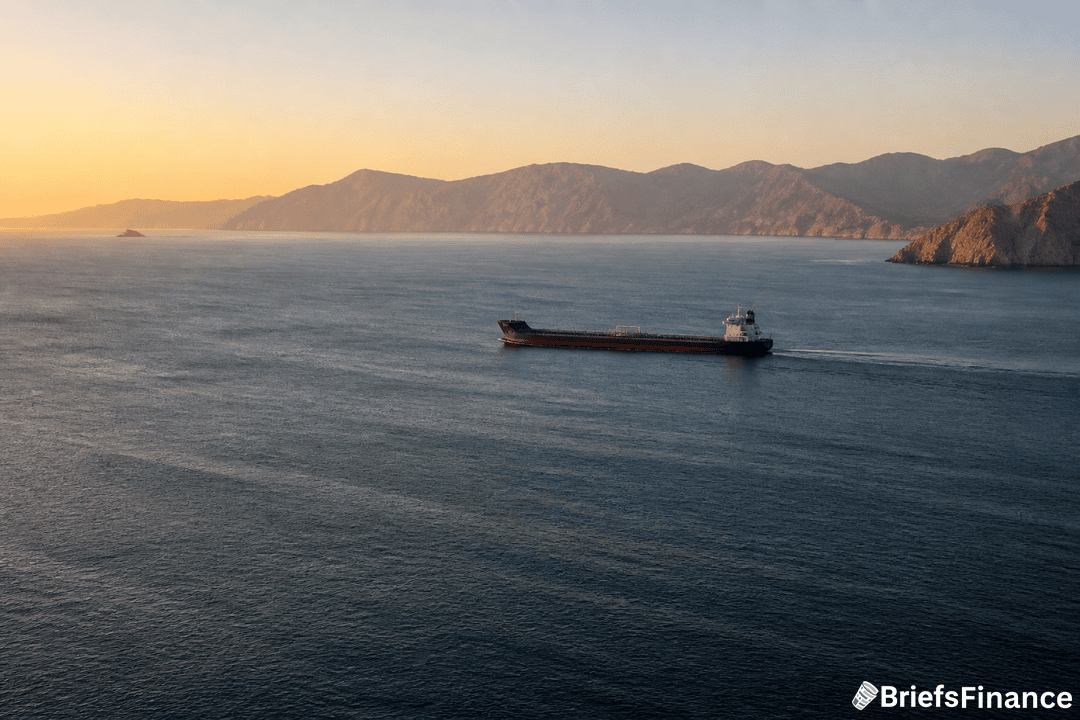
Tensions are showing up on the water. Preliminary ship-tracking cited by Reuters showed just nine vessels moving through the Strait of Hormuz on Friday, well below normal peacetime traffic for a waterway that typically carries roughly one-fifth of the world's oil supply.

What this means for your money

That stalemate is visible in thinner Hormuz traffic and in twitchy crude prices. If indirect talks, Xi's visit and pressure on Tehran change the calculus, oil flows could reset fast, with knock-ons for energy stocks, fuel costs and commodity funds. Keep an eye on Brent near $105.56 and WTI around $92.94, and whether vessel counts climb from nine transits.

In unsettled moments, a steady plan helps your money work toward lasting goals. Our CEO Jaspreet Singh is hosting a FREE live investor workshop, How to Profit From A Dollar That's Losing its Value, on September 29th. Sign up free to join him live.

Disclosure

Recent News

1 2 3 … 85

Get Market Briefs delivered to your inbox every morning for free!

No fluff. No noise. No politics. Just finance news you can read in 5 minutes.

Blogs

September 24, 2026
The 2026 Economic Reset Is Starting: Are We in a Recession, or Is the Pain Still Ahead?
  • The Federal Reserve has flipped from stimulating the economy to fighting inflation with higher interest rates, while the White House still wants growth at almost any cost.
  • The national debt tops $40 trillion, has outgrown the entire U.S. economy, and its interest payments are now the government's fastest-growing expense.
  • Higher rates bring pain for private equity, private credit, and speculative assets, but they open opportunities for investors holding cash, treasuries, and value assets.
Read More
September 23, 2026
Are We in a Recession? Without AI, America Might Already Be in One - and Washington Knows It
  • The White House attributes about three quarters of U.S. economic growth to AI, and many believe the economy would already be in a recession without it.
  • Washington has three reasons it cannot let the AI boom slow down: staying the world's superpower, outgrowing $40 trillion in national debt, and protecting a government stock portfolio worth billions.
  • Every market goes through booms and busts, and investors who understand the cycle get to buy the downturn instead of panic-selling with the crowd.
Read More
September 22, 2026
Will Interest Rates Go Down in 2026? Where the Money Moves Either Way
  • The Fed is leaning toward higher rates to fight 4% inflation, while the White House and a cracking job market push the other way.
  • If rates rise, money has tended to move toward short-term Treasuries, floating-rate loans, energy, banks and dividend payers.
  • If rates fall, it has tended to move toward gold, silver and Bitcoin, real estate, small caps, the S&P 500 and speculative bets.
Read More
September 21, 2026
How the Federal Reserve Makes Money - and Why It Just Posted Its Biggest Loss Ever
  • For 109 years the Federal Reserve created money, lent it to the U.S. government and handed the interest it collected back to Washington - almost $1 trillion in the decade starting in 2011.
  • Pandemic-era lending locked the Fed into earning about 2% on trillions of dollars while it now pays banks around 4%, producing a record loss of hundreds of billions in 2026.
  • The Fed covers its losses by creating money and the government covers its lost revenue by borrowing, and both feed the inflation that eats at the dollars in your account.
Read More
September 18, 2026
Kevin Warsh Just Defied Trump: What the Fed Rate Hike Means for Your Money
  • The Fed raised rates for the first time since 2023 in a unanimous vote led by Kevin Warsh, the chairman President Trump appointed to cut them.
  • Higher rates make the $40 trillion national debt, business loan resets and mortgages more expensive, but they strengthen the dollar and pay investors holding cash.
  • The war with Iran is pushing up oil, grocery and chip prices, another hike is likely in 2026, and recession talk is about to get louder.
Read More
September 17, 2026
Why America Bailed Out the Yen: The Japan Carry Trade, the Dollar and Your Mortgage Rate
  • In July 2026 the US sent money to steady the yen because Japan is the largest foreign owner of US debt, and Washington needs Japan to keep lending.
  • For decades the Japan carry trade let Wall Street borrow yen at essentially 0% and pour it into US stocks, real estate and Treasuries, and rising Japanese rates are shutting that off.
  • A weaker yen means fewer buyers for the dollar and for US debt, which pushes Treasury rates up and drags mortgage, car loan and credit card rates up with them.
Read More
September 16, 2026
Treasury Yields Are Spiking Because Lenders Are Backing Away From U.S. Debt
  • The U.S. is paying its highest 30-year borrowing rate in about two decades because its biggest lenders, the Fed, foreign governments, and banks, are all pulling back from Treasuries.
  • Every mortgage, car loan, credit card, and business loan is priced off the 10-year Treasury yield, so when Washington pays more to borrow, so do you.
  • With about $40 trillion of debt against a $32 trillion economy, the country either outgrows its debt or slides into a doom loop, and investors need a plan for both.
Read More
September 15, 2026
Fiat Currency Runs on Trust, and the World Just Stopped Trusting the Dollar
  • Gold has overtaken US treasuries as the world's top reserve asset, and central banks are now buying less US debt and more gold.
  • The US dollar is a fiat currency, meaning it's backed by a promise rather than gold, so it loses value when fewer countries want to hold it.
  • Whether the US economy or its national debt grows faster from here decides which assets stand to benefit next.
Read More
September 14, 2026
Why RAM Prices Are Soaring - and Where the Money Is Moving
  • Memory chips - the RAM inside phones, laptops, fridges, and trucks - are in a shortage Tim Cook called a 100-year flood, and some memory prices have climbed about 90% in a single quarter.
  • Four forces hit at once: AI demand, a production shutdown in 2023, build times that push any fix to 2028 at the earliest, and a bombed helium plant in Qatar.
  • The last two supply shocks ended in aggressive Fed rate hikes and market drops of around 45% and 20%, and this time Washington is spending heavily to bring memory production home.
Read More
September 11, 2026
How Is the Economy Doing? Washington Says It's Fixed, but the Numbers Don't Agree
  • Treasury Secretary Scott Bessent says the economy is fixed because lower earners' incomes are now rising faster than top earners'.
  • The Atlanta Fed and Bank of America show different numbers, and Hilton, Marriott, and McDonald's can't agree on what they're seeing either.
  • Whichever side is right, the economy is built to make investors rich, and inflation is how it does it.
Read More
1 2 3 … 27
Share via
Copy link











