Free NewsletterPro Login

Warning: Undefined variable $stocks in /var/www/briefs.co/htdocs/wp-content/plugins/oxygen/component-framework/components/classes/code-block.class.php(133) : eval()'d code on line 448

Warning: foreach() argument must be of type array|object, null given in /var/www/briefs.co/htdocs/wp-content/plugins/oxygen/component-framework/components/classes/code-block.class.php(133) : eval()'d code on line 448

Warning: Undefined variable $funds in /var/www/briefs.co/htdocs/wp-content/plugins/oxygen/component-framework/components/classes/code-block.class.php(133) : eval()'d code on line 472

Warning: foreach() argument must be of type array|object, null given in /var/www/briefs.co/htdocs/wp-content/plugins/oxygen/component-framework/components/classes/code-block.class.php(133) : eval()'d code on line 472
/* the link was here */

U.S. AI Data Centers Lean on Chinese Power Gear as Washington Tightens the Screws

Published Sep 3, 2026
[tts_player]
Share:
Summary:
  • The AI boom runs on hardware like transformers, switchgear, batteries, and optics, and a lot of that still comes from China.
  • President Donald Trump declared a national emergency over foreign-made bulk-power equipment, giving the Energy Department latitude to block or restrict certain deals.
  • Analysts say China has meaningful share in transformers, switchgear, batteries, and optical components, while U.S. capacity for data centers is forecast to more than double by 2030.

Where the exposure is

America's AI push needs a massive power backbone, and much of the gear feeding that backbone is tied to Chinese suppliers. Analysts told CNBC that transformers, switchgear, batteries, and optical technology are all areas where Chinese firms supply big portions of what goes into AI-ready data centers. That is why U.S. reliance on China for the power stack has become a strategic worry, even as American companies lead on the most advanced AI chips and systems. As Laveena Iyer at The Economist Group put it, scrutiny of China's role in the U.S. data center power stack has climbed over the last eight months, shifting attention beyond just the compute side.

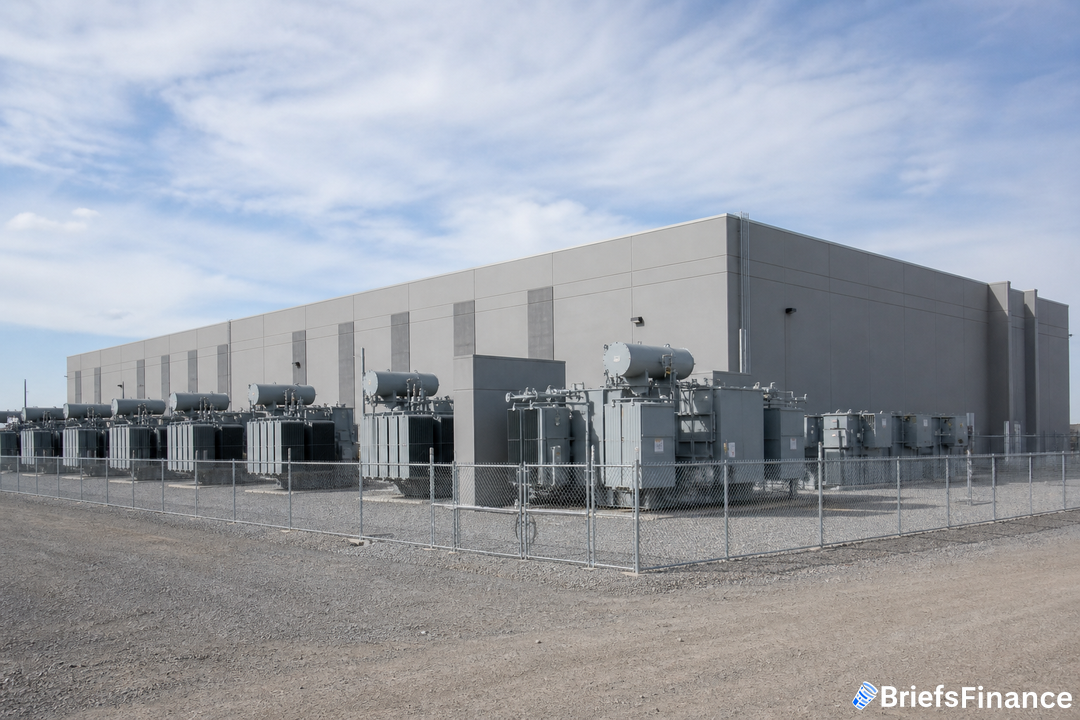
Here is the short version of the power stack: transformers step high-voltage electricity down so servers and cooling can use it, switchgear houses the switches, fuses, and breakers that control and protect circuits, and batteries cover backup power. Ben Boucher of Wood Mackenzie said AI infrastructure is increasingly reliant on Chinese imports in several key areas, especially substation transformers that hyperscalers install on site to bring transmission voltages down. Yury Dvorkin of Johns Hopkins University said the mid-term risk is concentrated in the gear that ties data centers to the grid, namely transformers, switchgear, and batteries. He added that China's share in certain transformer and switchgear categories is close to 30% and that the country supplies more than 40% of U.S. battery imports, and that vulnerabilities extend further up the chain to inputs such as copper, electrical steel and materials used for battery cathodes.

Optics are another choke point. Counterpoint Research says Chinese firms collectively produce about two thirds of global data center optical transceiver units, with Zhongji Innolight and Eoptolink among the top vendors by revenue. Neil Shah of Counterpoint warned in August that Western rivals have the designs but not yet the cleanrooms, automated packaging, or yields to take on that volume within 12 to 24 months. His words: "Western competitors like Coherent and Lumentum possess advanced photonic designs, but currently lack the cleanroom capacity, automated packaging infrastructure, and yield scale required to absorb Innolight and Eoptolink's volume within a 12-to-24-month horizon."

Policy moves and industry responses

Last week, President Donald Trump issued an executive order that declared a national emergency over the "extraordinary foreign threat" posed by bulk‑power system equipment manufactured overseas. The order lets the Energy Department block or attach conditions to certain transactions involving components used across the grid and in data centers. In remarks accompanying the order, he argued the foreign‑sourcing risk has worsened since his first term, pointing to the rapid expansion of defense production plus AI, data centers, and advanced manufacturing as factors that heighten the country's dependence on reliable electricity and the costs of disruptions.

Regulators have stepped in elsewhere too. In July, the Federal Communications Commission added power inverters made in foreign countries to its Covered List of equipment and services deemed an unacceptable national security risk. Reports also indicate the administration is preparing to prohibit new Chinese optical transceivers from entering the U.S. via imports, the devices that move high‑speed data between data centers. CNBC said it reached out to the U.K. embassy of the People's Republic of China for comment on the executive order and on China's role in providing components for the AI data center build‑out.

The administration's message is that reshoring is the plan. "Reshoring manufacturing that's critical to our national and economic security has been a top priority for President Trump, and the Administration continues to deliver with a robust and nimble agenda of tax cuts, tariffs, and deregulation," a White House spokesperson told CNBC. "Trillions in investments across key sectors - from steel to semiconductors to autos - prove that the Administration's strategy is paying off."

When long term goals matter, focus on steady contributions and download the free Always Be Buying E-Book today

Market gaps, investment, and timing

Tight supply is already biting. Wood Mackenzie estimates that in 2026 the market will be short by about 15% on power transformers and 8% on substations. The crunch is most severe for 100 MVA and above, the segment where data centers have leaned on Chinese manufacturers to manage delays.

The demand picture is not easing. That kind of scaling lifts everything tied to the power stack and the optical links between facilities.

Money is moving to expand supply. In February, Siemens Energy also announced a $1 billion U.S. investment for grid and gas turbine equipment tied to AI infrastructure and data center growth.

On the optics front, any curbs on Chinese vendors could steer orders toward U.S. names such as Lumentum and Coherent; both received $2 billion apiece from Nvidia in March. Analysts caution that ramping domestic capacity will be a challenge in the near term, echoing Shah's point about facilities, packaging, and yields.

What this means for your money

Expect pressure on timelines and prices as Washington tries to reduce China exposure while AI data center demand keeps climbing. Iyer said a ban on Chinese optical transceivers would push U.S. hyperscalers to source locally, likely raising costs. She also noted that the political will to de-risk the power stack is growing and that the goal is to act before Chinese tech is embedded, pointing to the 5G experience where ripping out equipment later slowed builds and raised costs.

If you follow companies that make transformers, switchgear, batteries, or optical components, keep an eye on two levers beyond AI hype cycles: policy and production. Restrictions and incentives can redirect orders, while new factories and cleanrooms take time to stand up. The gap between demand and domestic supply is where margins, delays, and stock stories will be decided.

Disclosure

Recent News

1 2 3 66

Get Market Briefs delivered to your inbox every morning for free!

No fluff. No noise. No politics. Just finance news you can read in 5 minutes.

Blogs

September 2, 2026
The Best Way to Invest 10k: Three Options To Transform 10K into 10 Million
  • Passive investing in stocks or real estate targets around 10% a year, and time in the market matters more than the price you get in at.
  • Active investing means putting your time in alongside your money, which raises the target to roughly 20% a year and raises the risk of losing it all.
  • Investing in yourself has no ceiling, because a new skill can create a new income that no market return can match.
Read More
September 1, 2026
The Tax Write Offs the Rich Are Using in 2026 While the IRS Shrinks
  • The 2026 tax brackets landed lower than they were headed, and the standard deduction jumped from a planned $8,350 to $16,100 for single filers.
  • New write offs for overtime, tips, seniors and car loan interest are live now, and most of them are written to expire in 2028.
  • About a third of IRS auditors have been fired, and four assets do most of the work for people who want income without a matching tax bill.
Read More
August 31, 2026
America Is Running Out of Debt Buyers. Treasury Bills Are the Government's Fix
  • The government took in about $5 trillion in taxes in 2025 and spent about $7 trillion, and the national debt is now over $40 trillion.
  • Investors, banks, and foreign countries are all lending less to the U.S., so starting September 9 the government plans to sell more short-term treasury bills and use that cash to buy back its long-term debt.
  • Government interest rates set the floor for your mortgage, your car loan, and your credit card, and short-term Treasury ETFs like SGOV are one way investors are playing it.
Read More
August 23, 2026
How to Get the Most From Your Guideline 401k
  • Guideline is a company that provides low-cost 401k plans, popular with small businesses and their employees.
  • A "Guideline 401k" follows the same core rules as any 401k: tax-advantaged growth, contribution limits, and often an employer match.
  • The biggest results come from capturing the full match, choosing low-cost funds, and picking Roth or traditional to fit your situation.
Read More
August 23, 2026
Principal 401k: What to Know About Your Plan
  • Principal is one of many companies that manage workplace 401k plans, so a "Principal 401k" is simply a 401k where Principal is the provider.
  • The rules of a 401k are the same no matter who runs it: pre-tax or Roth contributions, tax-advantaged growth, and often an employer match.
  • The biggest wins come from grabbing the full match, picking low-cost funds, and knowing whether Roth or traditional fits you.
Read More
August 23, 2026
What a Tariff Dividend Means for Your Money
  • A "tariff dividend" is the idea of taking money the government collects from tariffs and paying some of it back to citizens.
  • To judge the idea, you first need to know what a tariff is: a tax on imported goods, usually paid by the companies bringing them in.
  • Tariffs ripple through prices, businesses, and your investments, so the smart move is understanding those ripples, not just the headline.
Read More
August 23, 2026
No Tax on Overtime: How Overtime Pay Is Taxed
  • "No tax on overtime" refers to a tax break that lets certain workers deduct some overtime pay, lowering the income they get taxed on.
  • A deduction does not mean overtime is truly tax-free. It means part of that pay is subtracted before your tax is figured.
  • The bigger money lesson: how you earn money changes how it is taxed, and investors often get the friendliest treatment of all.
Read More
August 23, 2026
Reading the Silver Price Forecast for 2026
  • Nobody can honestly promise a specific silver price for 2026. Any exact number is a guess, so treat forecasts as opinions, not facts.
  • Silver is unusual because it is both a precious metal and an industrial metal, so its price answers to two very different forces.
  • Instead of chasing a forecast, learn the drivers - inflation, interest rates, recession fear, and industrial demand - so you can judge any prediction yourself.
Read More
August 23, 2026
What to Do When Reddit Stocks Go Viral
  • "Reddit stocks" usually means stocks getting hyped in online communities, where crowds can send a price soaring or crashing fast.
  • These tips can be entertaining and sometimes useful, but they are opinions, not research, and often come loaded with hype.
  • The safe move is to treat every online tip as a starting point, then do your own homework before risking a dollar.
Read More
August 23, 2026
Why Is Bitcoin Dropping Right Now?
  • Bitcoin drops for a mix of reasons: interest rates, big-picture money policy, regulation news, and simple shifts in how much risk investors want to take.
  • Bitcoin has a fixed supply and no earnings, so its price runs almost entirely on supply, demand, and sentiment.
  • Sharp drops are normal for bitcoin. Understanding the drivers matters more than reacting to any single day.
Read More
1 2 3 25
Share via
Copy link










