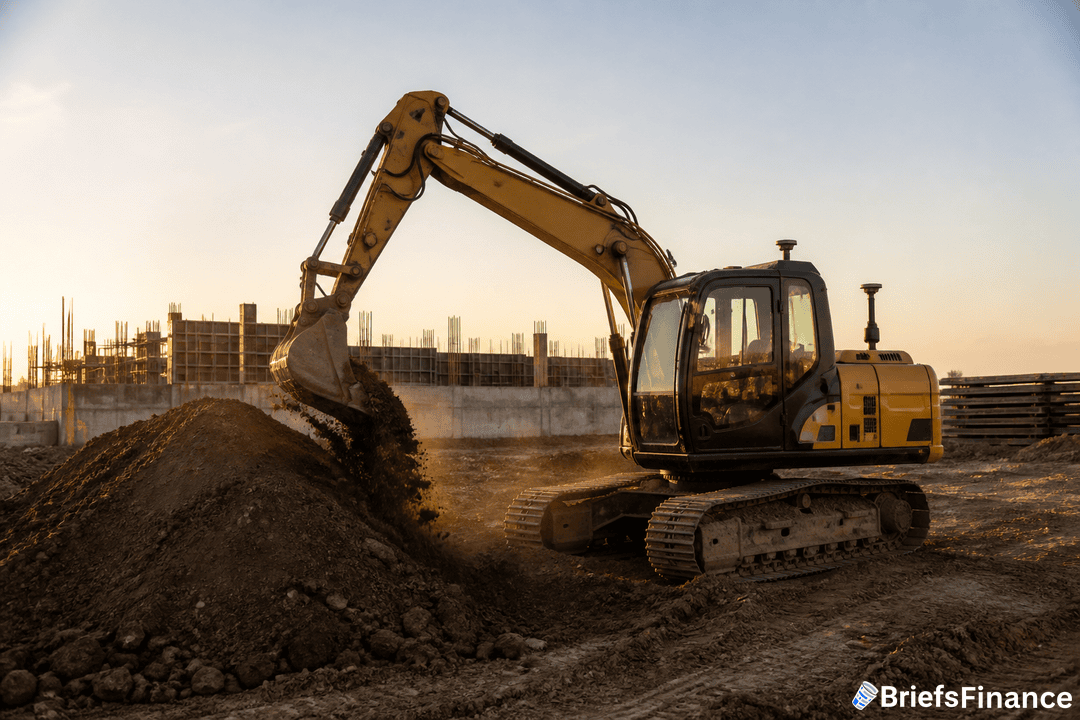
A Safer Way to Run Construction Sites
SoftBank is putting $200 million into Gravis Robotics, a Swiss startup that develops software and hardware for autonomous earthmoving equipment. The Zurich-based company, which spun out of ETH Zurich in 2022, builds systems that let heavy machinery operate without a human in the cab.
The startup says its technology allows machine operators to move to safe, social spaces while keeping an eye on multiple robotic machines from a distance. In full self-driving mode, the system gives operators remote oversight of entire fleets.
The Japanese conglomerate's investment came as part of a Series A round that Gravis announced Monday, though it did not reveal a valuation. Gravis previously raised $11 million in a round led by IQ Capital and Zacua Ventures.
SoftBank's interest in Gravis is part of a broader push into robotics and AI. SoftBank has previously invested in numerous robotics companies, and it acquired ABB's industrial robotics division last year. SoftBank has also set up a new holding company called Roze, which plans to list in the US.
A few minutes a day is enough to stay genuinely informed about your money. Join Market Briefs free and start tomorrow.
Gravis was founded in 2022 as a spinout of ETH Zurich. It develops software and hardware that let construction machines operate autonomously. In the company's statement Monday, it said the system allows operators to supervise entire robotic fleets from safe and social environments.
The company also said Monday that its technology had been chosen for a UK government infrastructure project valued at $8 million. As part of that work, Gravis will outfit existing heavy equipment with its self-driving systems.
What It Means for Investors
The investment signals SoftBank's willingness to back early-stage companies in the construction robotics space. Gravis's approach differs from companies that build autonomous machines from scratch; instead, it retrofits conventional construction equipment, potentially allowing fleets to become automated without replacing expensive machinery.
The UK contract marks an early public-sector deployment for Gravis's technology. The project is valued at $8 million, and the work will involve outfitting existing heavy equipment rather than deploying brand-new autonomous machines.
Gravis's previous $11 million round gives it some early traction, and the new $200 million injection from SoftBank is a significant validation. The startup's ability to supervise multiple machines from a distance could address safety concerns on construction sites, where accidents involving heavy equipment remain a major risk. By moving operators out of cabs and into remote oversight roles, the technology aims to reduce the danger of human-machine collisions.
SoftBank's broader robotics strategy, including the ABB acquisition and the planned Roze listing, suggests that the Japanese investor sees long-term value in automation beyond the factory floor. Construction sites are less controlled than factory floors, and Gravis's software is designed for those conditions. The new funding gives the company resources to expand its engineering team and deploy its systems more widely.
The company remains privately held, and its valuation was not disclosed. Still, the size of the Series A round is notable for a startup that only spun out of ETH Zurich in 2022. With SoftBank's backing, Gravis is positioned to become a major player in the market for autonomous construction equipment.
Rates, prices and policy all end up in your budget eventually. Get the free Market Briefs daily newsletter and see it coming.