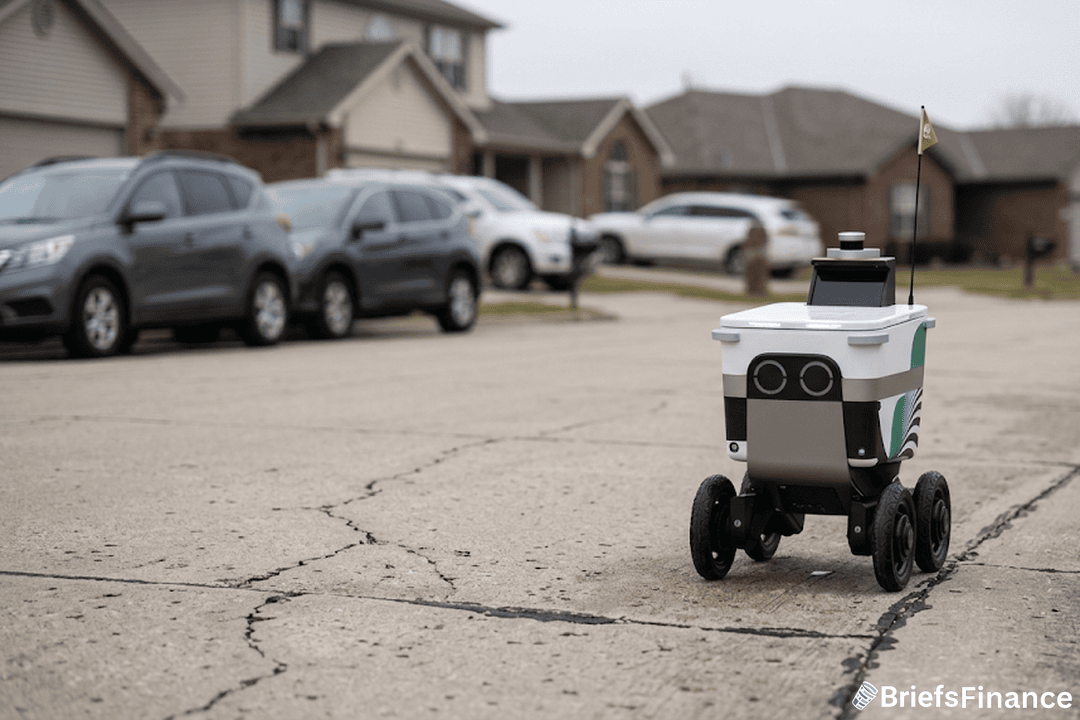
Uber's Exit Caught Serve Off Guard
Uber has completely sold off its holdings in Serve Robotics, the firm that operates those sidewalk delivery robots carrying food orders. Serve found out about the sale the same way everyone else did - when the regulatory filing went public.
Bloomberg was first to report the sale.
A person familiar with the situation said Serve was caught off guard. Uber had been trimming its Serve stake during 2025, according to earlier regulatory filings, but the full sale still came as a surprise.
Uber did not respond to requests for comment. The sale marks a clean break from a company that started inside Uber's own walls over five years ago.
A Robot Company Born From a Delivery App
Serve's roots go back to Postmates, the delivery app Uber bought in 2020 for $2.65 billion.
Inside Postmates was a robotics arm called Postmates X, and that team built a sidewalk delivery bot that became Serve Robotics when the division spun out a year after the acquisition.
So Uber was more than an early investor. It was the parent.
The two companies kept working together after the spinoff, forming a partnership in 2022 and expanding it in May 2023 to put as many as 2,000 of Serve's bots on Uber's app across different US markets.
For Serve, the deal was a chance to reach Uber's customers without building its own delivery network.
Get the free Always Be Buying eBook and learn the simple system for building wealth on any income
For a while, the arrangement looked like a win-win. Uber got to offer robot delivery without owning the robots, and Serve got a steady stream of orders from one of the biggest delivery apps in the country.
The Partnership Started Cracking
The departure follows a business split between the two companies. The cracks showed up in the numbers well before the sale.
Serve's CEO, Ali Kashani, said on the company's second-quarter earnings call on August 6 that deliveries through Uber had grown for 17 straight quarters, from Q1 2022 through Q1 of this year.
"From the first quarter of 2022 through the first quarter of this year, delivery volume through Uber grew for 17 consecutive quarters," Kashani said. "In Q2, that trend reversed for the first time."
Kashani blamed the reversal on lower-than-expected robot utilization.
He also said Uber and Serve hold "differing views" on how to scale their shared autonomous fleet, covering things like how to coordinate the robots and how to bring restaurants into the system.
That is a polite way of saying the two companies no longer see the road ahead the same way. The reversal was the first sign that the Uber pipeline was losing steam.
The split was not just about Uber, and Serve was already finding growth elsewhere.
Serve's deliveries with another food delivery partner jumped nearly 50% in one quarter during that same stretch, even as its Uber deliveries were sliding.
Serve had already started to diversify through that other delivery partner, but the Uber agreement had powered years of growth before the recent decline. The company's earlier expansion was built largely on the Uber relationship, making the end of that agreement a major turning point.
What It Means for Your Portfolio
Serve is only one of the many self-driving firms that Uber has invested in or worked alongside, a group that numbers over 30.
Uber is spreading its bets across the self-driving world, from robotaxis to delivery bots, and Serve was just one piece of that bigger picture.
For investors, the interesting part is how quickly a partnership can cool. The Uber relationship was the engine behind 17 straight quarters of delivery growth for Serve, and now that engine is gone.
That kind of dependence is a risk in any growth story. The next few quarters will show whether Serve can replace that demand on its own.
If it can, the Uber exit becomes a footnote, and if it cannot, the company's growth story changes completely.
Download the free Always Be Buying eBook and start putting your money to work today