Free NewsletterPro Login
S&P 500 6,287 +0.42%
DOW 44,521 -0.18%
NASDAQ 21,103 +0.71%

Warning: Undefined variable $funds in /var/www/briefs.co/htdocs/wp-content/plugins/oxygen/component-framework/components/classes/code-block.class.php(133) : eval()'d code on line 491

Warning: foreach() argument must be of type array|object, null given in /var/www/briefs.co/htdocs/wp-content/plugins/oxygen/component-framework/components/classes/code-block.class.php(133) : eval()'d code on line 491
/* the link was here */

Europe's Latest Heat Wave Shrinks the Rhine and Sends Power Prices Soaring

Published Aug 10, 2026
[tts_player]
Share:
Europe's Latest Heat Wave Shrinks the Rhine and Sends Power Prices Soaring
Summary:
  • Temperatures in northern France are forecast to approach 40°C (104°F) on Tuesday as a heat dome settles over the region, while Frankfurt could hit 38°C by Friday.
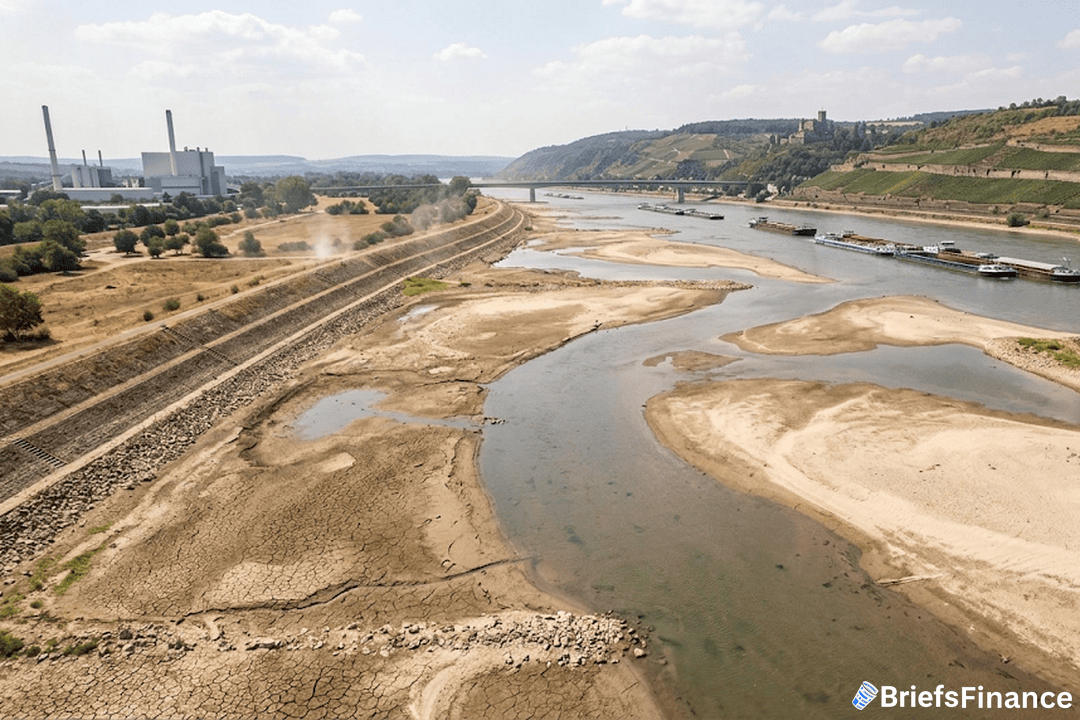
  • A week ago, the Rhine at Kaub dropped to 24 centimeters (9.5 inches), its lowest since 1880; by Monday it was 16 centimeters, and the forecast for Friday is just 4.
  • In France and Germany, evening electricity trades above €170 per megawatt-hour from 8pm to 10pm, versus under €20 around 1pm.

A Heat Dome Pushes Temperatures Toward 40°C

Europe is now enduring its fifth big heat wave of the year, and this one is parked over the rivers, power grids, and farms that investors watch most.

Météo-France expects a high-pressure dome to drive temperatures in northern France to almost 40°C (104°F) on Tuesday.

Southern England could see mid-30s this week.

Frankfurt is forecast to reach 38°C on Friday, based on data from the European Centre for Medium-Range Weather Forecasts.

Red heat warnings are in effect for Italy and Croatia, while amber alerts stretch across southeastern France, Switzerland's north, Poland's west, and large parts of southeastern Europe.

Most of England is under an amber heat health alert.

The European Commission's Joint Research Centre sees a high risk of fire across the UK, Spain, France, Germany, and Italy this week.

Roughly 200 Greek firefighters are battling a wildfire near Agios Stylianos in Attica, where evacuations have been ordered.

A Key Shipping Chokepoint Is Running Out of Water

The heat dome is doing more than pushing up thermometers. It is also blocking the moisture-carrying clouds that usually refill Europe's big rivers, and the Rhine, Po, and Danube are at record-low water levels.

Get the free Always Be Buying eBook and learn the simple system for building wealth on any income

That has already disrupted shipping and power generation, and the Rhine shows the problem most clearly.

The Rhine is one of Europe's busiest freight routes, and power stations along its banks use its water for cooling. When the river drops, both of those things suffer at once.

When the river is that shallow, barges either travel lighter or do not sail at all.

Loaded barges sit lower in the water, so a few centimeters can be the difference between a profitable run and a canceled one.

Fuel, grain, and other goods move along these rivers. Every canceled trip adds cost somewhere down the line.

The forecast does not offer much relief.

Some thunderstorms are possible this week, mainly in the Alps and areas south of them, but MetDesk's Daniel Gardner-Declaudure says the rain is "unlikely to make a large difference on downstream flows."

Power Prices Jump When Solar Fades

The price of electricity bought and sold during the day itself (known as intraday power) shows the strain in France and Germany.

Many plants rely on river water for cooling, so shallow rivers can force them to dial back output right when demand is highest.

Europe is the world's fastest-warming continent, and climate change is loading extra heat onto it.

Each stretch like this stresses power grids, water supplies, and farms, which is how a weather story becomes a portfolio story.

Farming is feeling the same pressure, and that is the kind of strain that eventually shows up in food prices.

What It Means for Investors

So what does that mean for your money?

A swing that wide does not stay inside the power market. It shows up in what manufacturers pay, what grocers charge, and what it costs to keep homes cool.

From there, those costs reach the companies in your portfolio.

Download the free Always Be Buying eBook and start putting your money to work today
Disclosure

Recent News

1 2 3 52

Get Market Briefs delivered to your inbox every morning for free!

No fluff. No noise. No politics. Just finance news you can read in 5 minutes.

Blogs

June 29, 2026
Portfolio Diversification: Why Putting All Your Eggs in One Basket Destroys Wealth
  • Real diversification means spreading investments across all 11 economic sectors plus bonds, alternatives, and cash so no single bet can sink the portfolio.
  • Different sectors perform at different times, so a diversified portfolio captures upswings while smoothing the brutal drawdowns that wipe out concentrated bets.
  • Total market index funds offer the simplest path to diversification, and annual rebalancing is what keeps the structure working over time.
Read More
June 29, 2026
Non Taxable Income: What It Is and Why It Matters
  • Non taxable income is money you receive that you don't owe income tax on.
  • The tax code treats workers, investors, and business owners very differently, and investors often come out ahead.
  • Learning how income is taxed is a quiet superpower for keeping more of what you earn.
Read More
June 29, 2026
Semiconductor Stocks: A Simple Guide for Investors
  • Semiconductor stocks are companies that design and make computer chips, the brains inside nearly every modern device.
  • The AI boom has turned chips into one of the market's most important and most watched groups.
  • They offer big growth potential, but come with high valuations and a notoriously cyclical history.
Read More
June 25, 2026
How Stocks Work: A Simple Guide for Beginners
  • A stock is a slice of ownership in a company - buy one, and you own a piece of the business.
  • You make money two ways: the share price rising over time, and dividends paid to shareholders.
  • The simplest path for most beginners is buying into the whole market through a low-cost index fund.
Read More
June 25, 2026
Stop Loss vs Stop Limit: What's the Difference?
  • A stop loss order sells your stock once it hits a trigger price, prioritizing getting you out.
  • A stop limit order only sells within a price range you set, prioritizing price over a guaranteed exit.
  • The trade-off: a stop loss almost always executes; a stop limit might not if the price moves too fast.
Read More
June 25, 2026
Energy Stocks: A Simple Guide for Investors
  • Energy stocks are companies that produce and supply the power the world runs on, from oil and gas to newer sources.
  • They make up one of the 11 sectors of the market and tend to move with energy prices and big-picture shifts.
  • Like any sector, the key is diversification and understanding the forces driving demand.
Read More
June 18, 2026
What Is a Stop Loss Order? A Simple Guide
  • A stop loss order automatically sells a stock once it falls to a price you set.
  • It's a tool to cap losses or lock in gains without watching the market all day.
  • It works best for active strategies, and can backfire if used carelessly on long-term holdings.
Read More
June 18, 2026
Best S&P 500 Index Fund: How to Choose One
  • The best S&P 500 index fund for most investors is simply the cheapest, most established one that tracks the index well.
  • Funds like VOO, IVV, and SPY all hold the same 500 companies, so the biggest difference is the fee.
  • Pick one, automate your buys, and let time do the heavy lifting.
Read More
June 17, 2026
What Are Penny Stocks? Risks and Rewards Explained
  • Penny stocks are very low-priced shares of very small companies, often trading for just a few dollars or less.
  • They promise huge gains but carry huge risks: low liquidity, high failure rates, and wild price swings.
  • Most investors are better served by quality companies and funds than by chasing cheap shares.
Read More
June 17, 2026
Best Stocks for Beginners With Little Money
  • The best stocks for beginners with little money usually aren't individual stocks at all - they're low-cost index funds.
  • You can start with $100 or less and use small, regular investments to build wealth over time.
  • Focus on diversification and consistency, not on picking the next big winner.
Read More
1 2 3 24
Share via
Copy link













