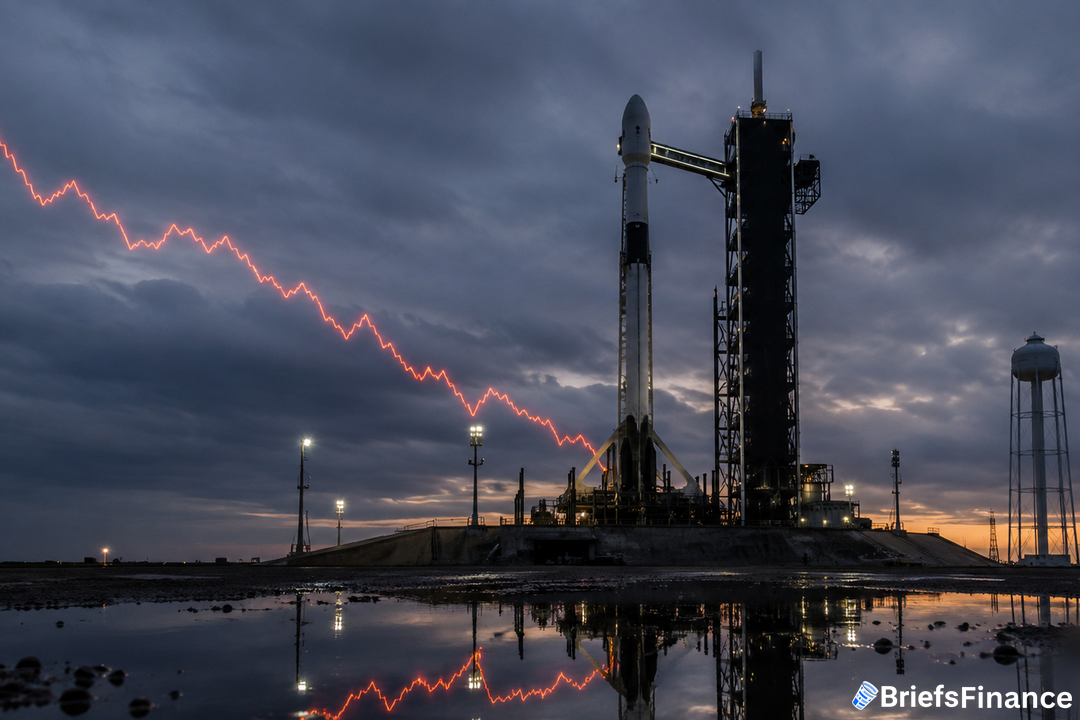
A Space Venture Loses Momentum
This June saw SpaceX launch one of the largest initial public offerings ever. The company raised a record $86 billion, and founder Elon Musk was cemented as the first trillionaire. The stock's first trade price was $150, and it surged roughly 20% during its initial trading session. Within the first month, the stock's price had climbed past the $225 mark. A company spokesperson said, "We remain focused on our long-term mission and are not concerned with short-term price movements."
The Rule Change That Shook Things Up
A recent rule change shortened the eligibility period for newly public companies to join the Nasdaq-100 to 15 trading days. Because of this, SpaceX was inducted into the concentrated Nasdaq-100 last week, about a week before its stock fell below the IPO price. That inclusion pulled in passive investors via index-tracking funds. The stock dropped below its initial trade price of $150 just one day after being added to the index.
Get the market news that matters in a five-minute read with Market Briefs, our free daily newsletter
SpaceX entered the public markets at the beginning of what could be a record-setting period for IPOs. Anthropic and OpenAI have each submitted confidential IPO filings to the SEC, though they have yet to announce specific timelines.
A Historic IPO's Volatile Aftermath
High-growth tech debuts often experience wild swings, and SpaceX's decline fits that pattern. Meanwhile, the upcoming potential IPOs from Anthropic and OpenAI indicate that the market for space and AI companies remains active, though SpaceX's performance may temper expectations.
The broader market backdrop also plays a role. Rising interest rates and cautious investor sentiment have weighed on speculative growth stocks in recent weeks. Even established tech giants have seen volatility.
For SpaceX, the drop below its IPO price marks a psychological threshold that could either attract bargain hunters or signal more downside if fundamentals shift. Analysts are watching closely for any updates on the company's Starship program and Starlink revenue, both key drivers of long-term valuation. The stock's next support level is around $120, with resistance near $150. The company's long-term prospects still hinge on the successful deployment of its Starship rocket and the continued growth of its Starlink satellite internet service, both of which are central to Musk's vision of interplanetary travel and global connectivity.
The psychological weight of falling below the IPO price adds another layer of uncertainty. For early investors who bought at $135, unrealized losses are now a reality, while index funds that acquired shares near the top may face continued pressure from rebalancing flows. Combined with the broader market's rotation away from high-growth names, the near-term path for SpaceX stock remains clouded until clearer catalysts emerge.
Join Market Briefs, our free daily newsletter, for a quick daily rundown of the markets