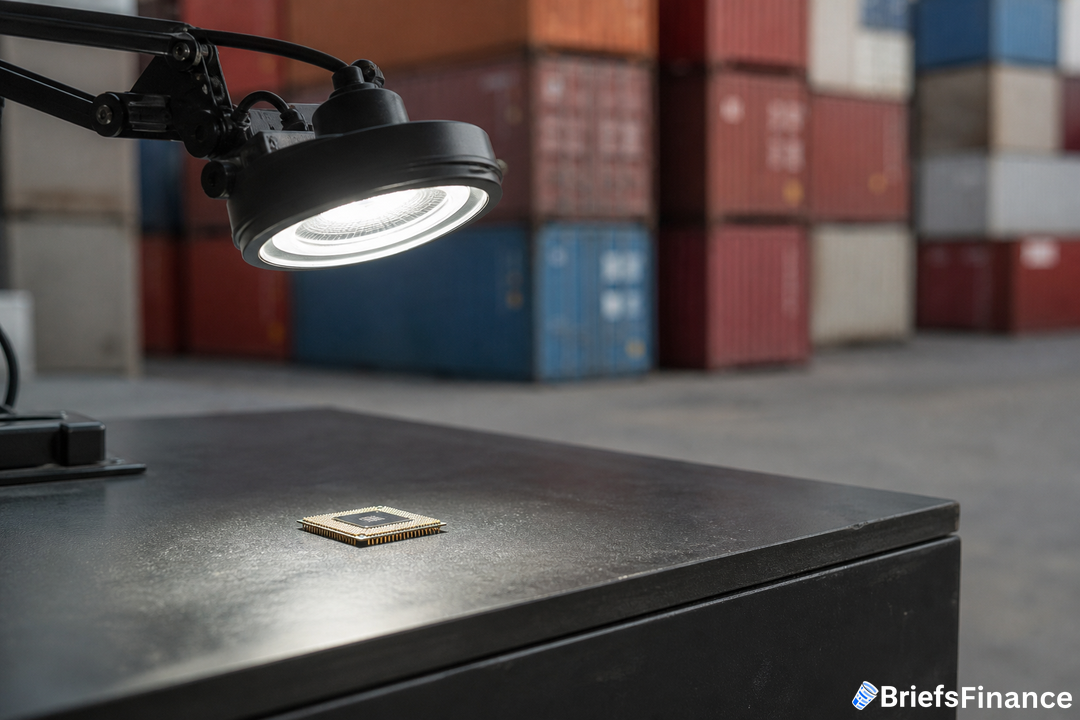
Kevin Hassett said the U.S. would tighten export limits on top-tier chips if it verifies advanced semiconductors reached China, and that screening for next-gen sales will be tougher.
According to Bloomberg, two Chinese companies placed Nvidia Blackwell chips at a Shanghai data center tied to Alice Huang; Jensen Huang - restored to the helm of Nvidia - was previously in a relationship with her.
Jensen Huang faces multiple congressional panels this week, as Republicans including Senator Pete Ricketts and Representative Michael McCaul escalate national security criticism.
What the White House Is Signaling
Kevin Hassett, who directs President Donald Trump's National Economic Council, said on CNN's State of the Union that Washington will clamp down further on exports if it confirms that top-end U.S. chips landed in Chinese hands, and that approvals for the next wave of advanced chips will face stricter reviews.
He also argued any breach would be short lived. "To the extent that the greatest chips, the latest chips, did a few of them get over into bad hands - or through data centers, that they indirectly got them into bad hands - is something that, absolutely, that has to be tightened up if that's true," Hassett said. He added that "Those chips are actually soon going to be outdated and reproduced with better chips that are going to have even closer scrutiny," and that if older models slipped through, it would be a brief narrowing of a U.S. lead. He stopped short of confirming that the most advanced current chips actually reached China.
The Nvidia Twist and Trump's Response
Bloomberg previously reported that two Chinese firms put Nvidia's Blackwell semiconductors into a Shanghai data center associated with Alice Huang, and Jensen Huang - who had been brought back to lead Nvidia - was in a relationship with her. That revelation landed amid a larger drama in which Trump personally pushed to restore Jensen Huang atop Nvidia, putting his leadership of the company ahead of questions about his relationships and whether he knowingly or unknowingly enabled China to get advanced chips.
Speaking on Thanksgiving, Trump said of Huang, "Based on information and belief, I think he's absolutely fine." On Saturday, he said the Securities and Exchange Commission intends to press companies to adopt the label "super intelligence" instead of "artificial intelligence." Administration officials have downplayed the broader controversy, framing Nvidia's strength as a strategic aim. As Hassett put it, "I think that in the end the fact that Nvidia's going to continue to make great chips and produce them almost completely for US intelligence firms is a big, big competitive advantage and security advantage for the US."
Capitol Hill Turns Up the Heat
Jensen Huang is scheduled to face inquiries from multiple House and Senate panels this week. On Fox News Sunday, Senator Pete Ricketts said Huang "has no credibility" after reports he allegedly misled Nvidia's board. Ricketts, a member of the Senate Banking Committee slated to take testimony from Huang on Thursday, said there are "a lot of questions that have to be answered," including "what types of information have passed on to the Chinese."
Representative Michael McCaul, a Texas Republican and self-described "China hawk," said Sunday that Trump's push to reinstate Huang created a "national security risk." He asked whether the FBI is pursuing the chip diversion issue forcefully enough and argued Huang has "done enough damage to our national security selling tens of billions of dollars of advanced AI chips to a fake company controlled" by Alice Huang, whom he called an alleged Chinese spy. McCaul predicted that when the Democratic-controlled Congress chosen in the recent election is seated in January, it will move to tighten export restrictions on China, and he added that China hawks in both chambers will work in tandem. McCaul previously chaired the Foreign Affairs Committee and will retire after this term.
When policy and technology intersect, staying informed matters, so sign up for the free Market Briefs and get concise context
Democrats want answers too. Jim Himes, the top Democrat on the House Intelligence Committee, said on CNN he is "a lot less interested in Jensen Huang than I am in Alice Huang," arguing she could have been the bridge for information "from which information flowed from Jensen Huang."
Inside the Administration's Process and the Investor Angle
Hassett said the Commerce Department sent the matter to the Justice Department about a year and a half ago and credited Secretary Howard Lutnick, while downplaying friction with Treasury Secretary Scott Bessent, who has criticized Commerce for moving too slowly. "It absolutely hasn't been slow-walked, it was referred directly to the Justice Department the minute that it came up," Hassett said.
Ricketts said he wants to understand Commerce's thinking after several other cabinet departments recommended adding Megaspeed International, a firm linked to Alice Huang, to the U.S. entity list that subjects companies to export restrictions. He called for a clear timeline to assess how Commerce handled the case.
Why this matters for your portfolio: policy risk is now central to AI hardware. Watch for any confirmation on where advanced chips ended up, Huang's Senate Banking appearance on Thursday, and whether Congress rallies around tougher controls. Each step can shift the regulatory overhang on Nvidia and peers, which can move valuations tied to data center and AI buildouts.
When global developments feel complex, a quick daily summary helps, so subscribe to the free Market Briefs newsletter for clarity
Anthropic has gone public at a valuation of about $1.5 trillion, while Amazon went public in 1997 at around $440 million. Anthropic has about $33 billion in revenue this year and no profit, and investors are paying more than 40 times its sales, against about 3 times for Amazon. Briefs Finance CEO Jaspreet Singh says nobody knows what comes next, and that long-term investors use downturns to buy instead of panic selling.
Tech stocks are selling off because investors don't know who will lead Nvidia, the company that has been funding the AI industry and selling it chips.
Inflation has the Federal Reserve planning to raise interest rates, with a hike expected in December, and that puts pressure on homebuyers, private equity and the $40 trillion national debt.
Briefs Finance CEO Jaspreet Singh says nobody has a crystal ball, so his rules are to buy when markets are low, hold long term and invest only what you're willing to lose.
The national debt is above $40 trillion, and the Federal Reserve has gone from sending Washington its profits to losing money.
President Trump's four-part plan leans on shorter-term debt, stablecoin companies buying Treasuries, a bigger balance sheet and government stakes in private companies.
The goal is to outgrow the debt, not pay it off, so Jaspreet Singh points investors to the seven industries where Washington wants growth.
The Fed makes its next rate decision on December 9 and is now talking about jumbo interest rate hikes of 0.5%, though one in December looks unlikely.
Washington will pay a record $1.05 trillion in interest this year on $40 trillion of debt, and that debt resets at higher rates as the Fed hikes.
Jaspreet Singh's five moves are to pay down variable-rate debt, earn interest on your savings, know which stocks feel the pressure, look at value and hedge.
Margin debt, the money investors borrow to buy stocks, is at a record of around 4.6% of GDP, up from 3.9% in 2021.
ETF money has more than tripled in five years to 7% of GDP, while corporate buybacks and 401(k) money sit below their earlier peaks.
Margin calls and panic selling can make the next downturn deeper, so Jaspreet Singh keeps buying broad market funds and says most investors should skip margin debt.
Jensen Huang is out at Nvidia over affairs with multiple people, and the company he founded has been the bank of American AI, with about $30 billion into OpenAI and $10 billion into Anthropic.
A hotter-than-expected inflation report has Fed officials talking about a possible 0.5% hike in December, and gold, silver, and bitcoin fell on the news.
President Trump said the US may not need a deal with Iran, keeping oil prices and inflation risk high. Jaspreet Singh breaks down what it all means for AI stocks and your portfolio.
Stocks are booming at the fastest pace in years, jobless claims just hit a 57-year low, and most investors still feel like nobody is hiring.
The Fed is protecting the dollar over the economy, oil swings on every Iran headline, and a few AI companies are carrying an S&P 500 where four of five stocks sit in a correction.
Jaspreet Singh explains why circular financing between Nvidia, OpenAI, Anthropic, and SpaceX rhymes with 2008's house of cards, and how his three investing pillars handle a stock market bubble.
The Fed has raised rates, cut them, then raised them again only twice in the last 60 years, and both times the economy fell into a recession and stocks crashed.
The same stop-and-go cycle is playing out now, with one big difference: US debt is 125% of GDP today versus about 30% in 1980.
In the 1970s gold rose roughly 24x, real estate 157%, stocks lagged, and cash lost half its value. Jaspreet Singh lays out five assets to consider before the next flip.
The IRS 2027 tax plan keeps the same seven rates but widens every bracket and lifts the married-filing-jointly standard deduction to $33,200.
The 0% long-term capital gains bracket rises to $102,100, so a household living on $135,300 of investment income could owe $0 in federal income tax.
C corporations still pay 21%, small businesses keep the 20% QBI deduction, and the 401(k) limit climbs to $25,500 with an $8,500 catch-up for investors over 50.
Make sure to check your inbox for the first email.
Before you go
We’re hosting our first ever livestream on how investors can use ChatGPT & Claude to invest like a pro. It’s on 11/17 and is hosted by our CEO Jaspreet Singh.