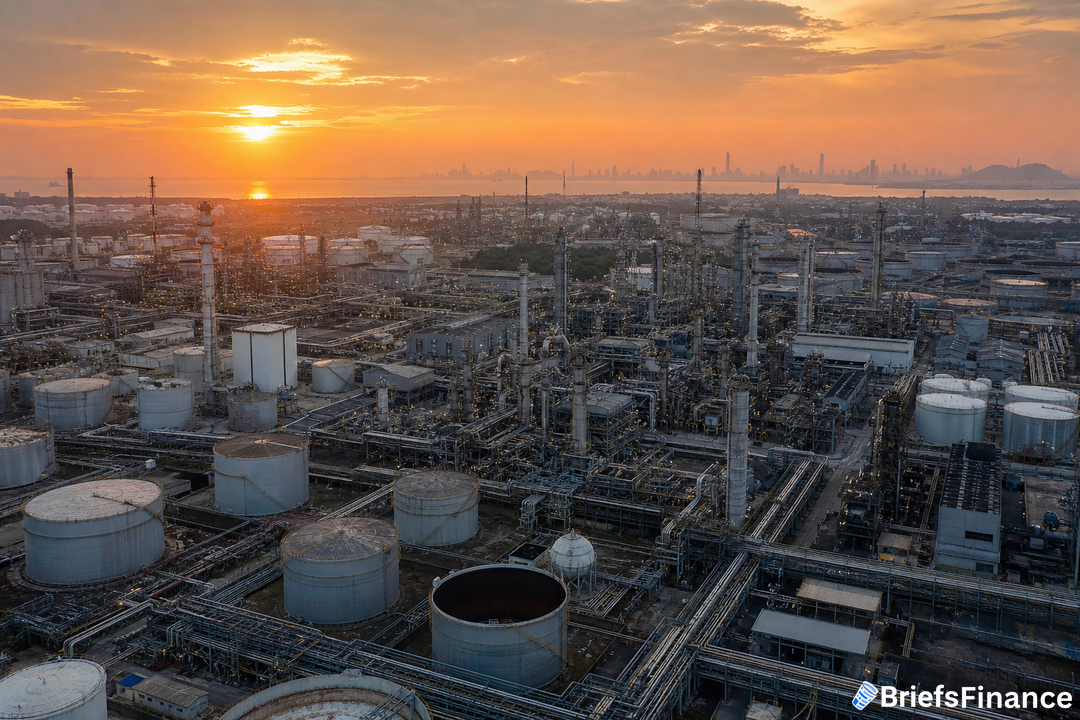
Dangote Petroleum Refinery and Petrochemicals FZE, founded by Aliko Dangote, is slated to start trading in Lagos on Dec. 1 after regulatory clearance, per multiple media reports.
The minority-stake sale priced at 525 naira ($0.39) and, according to the company, drew applications from investors in 120 countries and every African nation.
Using that price and the firm's registered share count, Reuters estimated an IPO value near $47 billion; the complex cost about $20 billion to build and began operating in 2024.
What happened
One of the world's largest refining complexes, built for roughly $20 billion by Nigerian billionaire Aliko Dangote, is headed to the public market. Multiple outlets report trading in Lagos is expected to kick off Dec. 1 following regulatory approval. The offer covered a minority slice of the company and, by the firm's account, demand far exceeded the shares available.
Aliko Dangote pitched it as an "IPO for the people," saying at the early September launch, "With a minimum subscription of just 10 shares, the offer is designed to give ordinary Nigerians and Africans an opportunity to own a stake in the refinery." He added, "The IPO is positioned not simply as a capital-raising exercise, but as an opportunity for workers, entrepreneurs and everyday Nigerians to participate in the refinery's future growth." A company representative did not reply to CNBC's request for comment.
The numbers to know
Shares were offered at 525 naira, or $0.39. Based on that price and the refinery's official share tally, Reuters pegged the IPO-implied value at about $47 billion, which would make it Africa's largest market debut to date.
The operation, based in Lagos, began running in 2024 and is widely considered a flagship of Nigeria's energy sector given how it has reshaped the country's fuel market. A photo dated Oct. 12, 2026, identified infrastructure at the plant in Ibeju Lekki, Lagos.
How the refinery is performing today
The refinery ranks among the biggest globally, with crude distillation capacity between 650,000 and 700,000 barrels a day. It has also become a notable supplier of jet fuel in recent months as buyers turned to West Africa amid Middle Eastern disruptions tied to the Iran war.
From January through October, Vortexa data showed seaborne refined-product loadings averaging around 400,000 barrels a day, roughly 50 percent more than the same stretch a year earlier. During the first 21 days of November, loadings set a record at 575,000 barrels a day, beating the October peak of 550,000. "It's been able to ramp up quite spectacularly and provide a lot of these products to the market in an extremely high price environment," said Vortexa analyst Mick Strautmann, who added, "So, it's been one of the few places that's adding a lot of fuel supply to the Atlantic Basin, and at the same time, you know, to make West Africa less reliant on imports from other regions, particularly Europe for its gasoline supply."
When major financial events occur, stay calmly informed with our free Market Briefs newsletter that explains it simply
Market reaction and views from analysts
According to the company, purchasers spanning 120 countries, including each of the 54 African nations, submitted applications for shares. "In theory, it's a win-win situation," said Cyril Widdershoven of Blue Water Strategy, who also pointed to risks around high build costs, commissioning delays, and the chance that new capacity comes online into softer refining margins. "Right now it's like Anthropic or Nvidia, you are now buying the hype," he said.
Capital Economics' David Omojomolo said the upcoming listing has drawn attention because the refinery is seen as a rare industrial policy bright spot on the continent. "It's been a good news story, and it's been an optimistic one as well," he said. "I don't want to be a hostage to fortune and say this time is different … but it does feel like a buzz and it's a question as to does it force other, say, billionaire industrialists to put their money where their mouth is in terms of helping the region's industrialisation prospects."
What this means for your portfolio
If trading begins Dec. 1 as reported, investors are looking at a potential $47 billion newcomer built for scale, already ramping shipments, and aiming even higher - Widdershoven said the company intends to push capacity to 1.4 million barrels a day by 2029. The bottom line: a widely held offer at a defined price, strong early operating stats, and big growth plans could reshape energy exposure on the Nigerian market, though the flagged cost, timing, and margin risks are part of the package.
When company events are in focus, get quick daily context from Market Briefs for free in five minutes
Anthropic has gone public at a valuation of about $1.5 trillion, while Amazon went public in 1997 at around $440 million. Anthropic has about $33 billion in revenue this year and no profit, and investors are paying more than 40 times its sales, against about 3 times for Amazon. Briefs Finance CEO Jaspreet Singh says nobody knows what comes next, and that long-term investors use downturns to buy instead of panic selling.
Tech stocks are selling off because investors don't know who will lead Nvidia, the company that has been funding the AI industry and selling it chips.
Inflation has the Federal Reserve planning to raise interest rates, with a hike expected in December, and that puts pressure on homebuyers, private equity and the $40 trillion national debt.
Briefs Finance CEO Jaspreet Singh says nobody has a crystal ball, so his rules are to buy when markets are low, hold long term and invest only what you're willing to lose.
The national debt is above $40 trillion, and the Federal Reserve has gone from sending Washington its profits to losing money.
President Trump's four-part plan leans on shorter-term debt, stablecoin companies buying Treasuries, a bigger balance sheet and government stakes in private companies.
The goal is to outgrow the debt, not pay it off, so Jaspreet Singh points investors to the seven industries where Washington wants growth.
The Fed makes its next rate decision on December 9 and is now talking about jumbo interest rate hikes of 0.5%, though one in December looks unlikely.
Washington will pay a record $1.05 trillion in interest this year on $40 trillion of debt, and that debt resets at higher rates as the Fed hikes.
Jaspreet Singh's five moves are to pay down variable-rate debt, earn interest on your savings, know which stocks feel the pressure, look at value and hedge.
Margin debt, the money investors borrow to buy stocks, is at a record of around 4.6% of GDP, up from 3.9% in 2021.
ETF money has more than tripled in five years to 7% of GDP, while corporate buybacks and 401(k) money sit below their earlier peaks.
Margin calls and panic selling can make the next downturn deeper, so Jaspreet Singh keeps buying broad market funds and says most investors should skip margin debt.
Jensen Huang is out at Nvidia over affairs with multiple people, and the company he founded has been the bank of American AI, with about $30 billion into OpenAI and $10 billion into Anthropic.
A hotter-than-expected inflation report has Fed officials talking about a possible 0.5% hike in December, and gold, silver, and bitcoin fell on the news.
President Trump said the US may not need a deal with Iran, keeping oil prices and inflation risk high. Jaspreet Singh breaks down what it all means for AI stocks and your portfolio.
Stocks are booming at the fastest pace in years, jobless claims just hit a 57-year low, and most investors still feel like nobody is hiring.
The Fed is protecting the dollar over the economy, oil swings on every Iran headline, and a few AI companies are carrying an S&P 500 where four of five stocks sit in a correction.
Jaspreet Singh explains why circular financing between Nvidia, OpenAI, Anthropic, and SpaceX rhymes with 2008's house of cards, and how his three investing pillars handle a stock market bubble.
The Fed has raised rates, cut them, then raised them again only twice in the last 60 years, and both times the economy fell into a recession and stocks crashed.
The same stop-and-go cycle is playing out now, with one big difference: US debt is 125% of GDP today versus about 30% in 1980.
In the 1970s gold rose roughly 24x, real estate 157%, stocks lagged, and cash lost half its value. Jaspreet Singh lays out five assets to consider before the next flip.
The IRS 2027 tax plan keeps the same seven rates but widens every bracket and lifts the married-filing-jointly standard deduction to $33,200.
The 0% long-term capital gains bracket rises to $102,100, so a household living on $135,300 of investment income could owe $0 in federal income tax.
C corporations still pay 21%, small businesses keep the 20% QBI deduction, and the 401(k) limit climbs to $25,500 with an $8,500 catch-up for investors over 50.
Make sure to check your inbox for the first email.
Before you go
We’re hosting our first ever livestream on how investors can use ChatGPT & Claude to invest like a pro. It’s on 11/17 and is hosted by our CEO Jaspreet Singh.