Free NewsletterPro Login

Ukraine's AI Drones Now Hit Russian Targets 93 Miles Past The Front Line

Published Jun 13, 2026
Share:
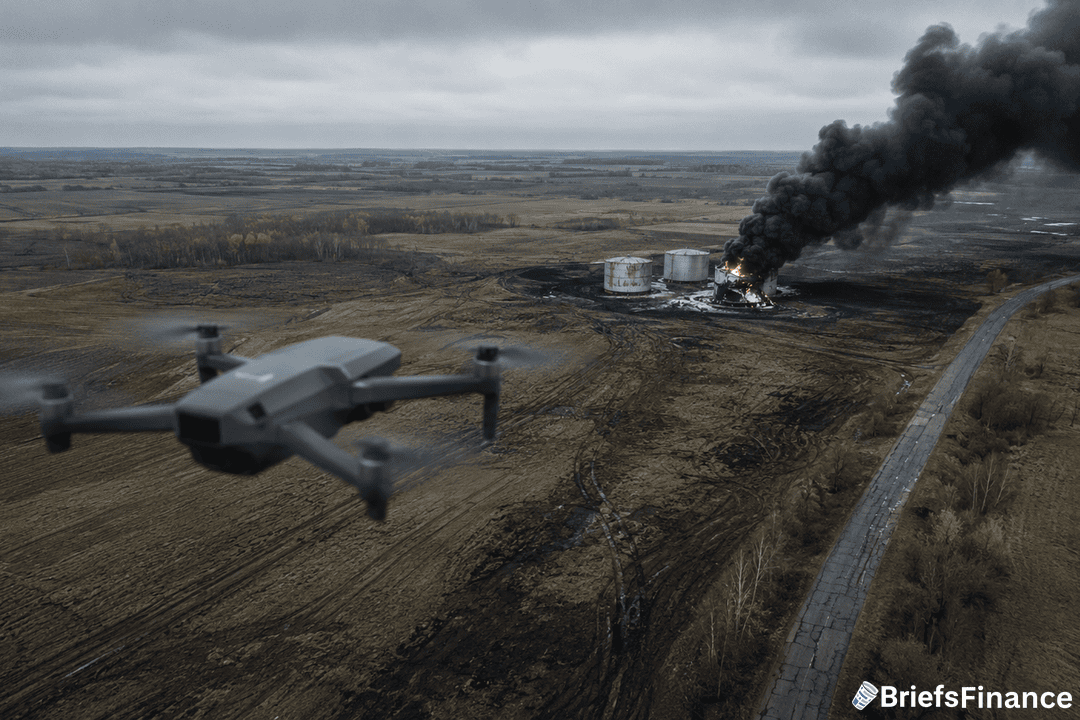
A drone flies over a rural area with a large fire and black smoke rising from burning fuel tanks near an empty road, under a cloudy sky. The image is credited to BriefsFinance.
Summary:
  • Ukraine's strikes on Russian fuel trucks ran 40% higher in May than in April.
  • The newest AI drones can hit targets up to 150 km, about 93 miles, past the front line.
  • One Ukrainian system now does about 95% of the work to shoot down incoming Russian drones.

Ukraine has fewer troops than Russia. It has fewer big guns, too.

What it has more of is software. And over the past month, that gap has started to show. AI-guided drones are letting Kyiv hit targets it could not reach before.

What The Drones Can Do Now

Russia's main defense is jamming. It scrambles the radio link to the pilot. That used to send a drone off course.

The new Ukrainian drones get around it. They lock onto a target on their own, even when the signal is cut.

That also buys range. The newest drones reach about 93 miles past the front line. Fuel depots, ammo stores, and command posts used to sit safely in the rear. Now they are fair game.

Why does that matter so much? Hit a fuel depot, and tanks stall miles away. Supply lines are the soft spot, and Ukraine is hitting them hard.

The results show up fast. Strikes on Russian fuel trucks rose 40% in May, well ahead of April. The number of Russian air defenses knocked out more than doubled.

We turn stories like this into what they mean for your portfolio every morning in Market Briefs, five minutes a day, with a free investing masterclass when you join.

Machines Are Doing More Of The Aiming

The big shift is who pulls the trigger.

One Ukrainian firm is called MaXon Systems. It built a system to shoot down Shahed drones. Those are cheap, Iranian-style attack drones. The system does about 95% of the work on its own. A person just keeps watch. Think cruise control, but for air defense.

AI is creeping into the rest of the war. Danylo Tsvok runs Ukraine's defense AI center. He says it now helps plan attacks and fly drones. It also helps read intelligence. The goal is one linked system that spots a threat and suggests a move on the spot.

A Whole Industry Is Forming

This is not one lab. More than 200 firms now build AI-powered drones for Ukraine. Dozens are already in use at the front.

More than 300 AI projects sit on the country's main defense platform. Over 70 are already in the field. Ukraine trains its software on real combat data, then shares some of it with allies.

The push reaches well past Ukraine. It is teaming up with partners like Norway to build drones together. Foreign firms also test their own gear at the front. For them, it is a rare live trial.

"We must be faster than the enemy at every stage," said defense minister Mykhailo Fedorov.

The plan is bold. Ukraine wants every front-line drone to "see" on its own. That means machine vision, software that lets a drone spot and name a target.

What To Watch

Wars push tech forward fast. This one is doing it with smart weapons. Allies are taking notes, and Germany just signed a deal to share defense data with Kyiv.

For investors, that hints at where defense money may flow next. Cheaper, smarter drones are starting to rival big, costly weapons.

The front line has quietly become the world's biggest test lab for AI in war.

If you want this kind of read before the day starts, join 350,000+ investors reading Market Briefs, and you'll get a 45-minute investing course thrown in.

Disclosure

Get Market Briefs delivered to your inbox every morning for free!

No fluff. No noise. No politics. Just finance news you can read in 5 minutes.

Blogs

May 30, 2026
Financial Literacy Books That Actually Build Wealth
  • The best financial literacy books don't just teach budgeting, they shift how you think about money.
  • Two classics stand out: The Intelligent Investor for valuing investments, and Rich Dad Poor Dad for the owner's mindset.
  • Reading is only step one. The real wealth comes from acting on what you learn.
Read More
May 30, 2026
What Is a Roth Conversion? A Simple Guide
  • A Roth conversion moves money from a traditional retirement account into a Roth account.
  • You pay taxes on the money now, in exchange for tax-free growth and withdrawals later.
  • It can pay off if you expect higher taxes or more income in the future, but the timing and tax hit matter a lot.
Read More
May 30, 2026
Trailing Stop Loss: How to Protect Your Gains
  • A trailing stop loss is an order that automatically sells a stock if it falls a set percentage from its recent high.
  • As the stock rises, the sell point rises with it, locking in gains while capping losses.
  • It's most useful for active strategies like momentum investing, not for long-term buy-and-hold.
Read More
May 30, 2026
5 Types of Wealth: Why Money Is Only One of Them
  • Real wealth is more than a bank balance. It spans your finances, health, mind, purpose, and freedom.
  • Money is powerful, but it amplifies the life you already have rather than fixing a broken one.
  • True financial wealth means your cash flow covers your expenses, so your money works while you live.
Read More
May 30, 2026
How to Invest in Private Equity: A Beginner's Guide
  • Private equity means investing in companies that aren't listed on the stock market.
  • Traditional private equity is built for experienced, high-net-worth investors with large amounts to invest.
  • New rules have opened more accessible paths, like startup crowdfunding and real estate deals, often starting around $100.
Read More
May 30, 2026
What Is a Call Option? A Simple Guide With Examples
  • A call option gives you the right to buy a stock at a set price by a set date.
  • Investors buy calls when they expect a stock to rise, using less money than buying the shares outright.
  • The most you can lose buying a call is the premium, but time works against you, so it's an advanced tool.
Read More
May 30, 2026
EBITDA Formula: How to Calculate It Step by Step
  • EBITDA stands for Earnings Before Interest, Taxes, Depreciation, and Amortization, a measure of a company's core profit.
  • The formula adds those four items back to net income to show what the underlying business earns.
  • Investors use EBITDA to compare companies and to judge how many times earnings a stock is selling for.
Read More
May 30, 2026
What Is a Stock Option? A Plain-English Guide
  • A stock option is a contract giving you the right, but not the obligation, to buy or sell a stock at a set price by a set date.
  • There are two types: calls (the right to buy) and puts (the right to sell).
  • Options are powerful but risky, so they suit investors who already have the basics down.
Read More
May 30, 2026
Put Option: What It Is and How It Works
  • A put option gives you the right to sell a stock at a set price by a set date.
  • Investors use puts to bet a stock will fall, or as insurance to protect shares they own.
  • The most you can lose buying a put is the premium you paid, which makes it a defined-risk tool.
Read More
May 30, 2026
Operating Margin: What It Is and How to Calculate It
  • Operating margin shows how much profit a company keeps from its core business after paying its running costs.
  • The formula is operating income divided by revenue, shown as a percent.
  • A strong, steady operating margin signals a well-run business that controls its costs.
Read More
1 2 3 22
Share via
Copy link










