Free NewsletterPro Login

The World's Hottest Stock Market Just Had Its Worst Day in History

A stylized illustration of a cylindrical cup with blue arrows and lines indicating a swirling or rotational motion inside the cup.
Published Mar 4, 2026
Share:
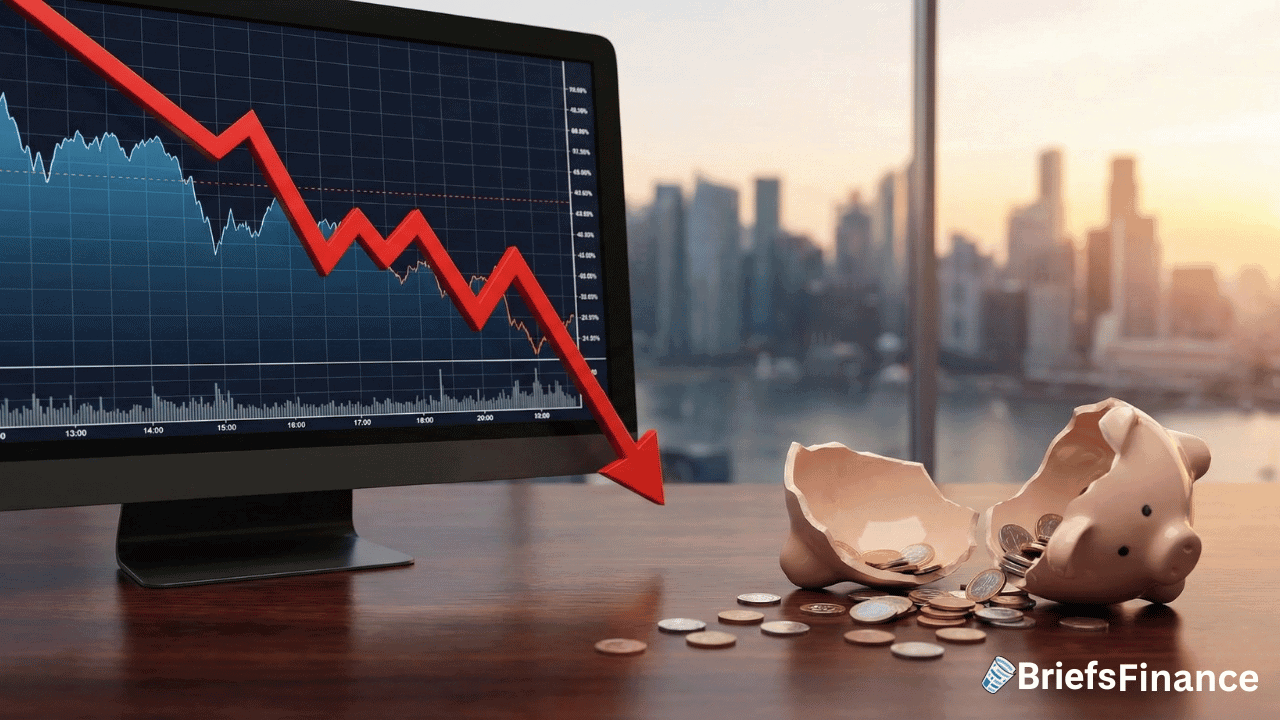
A computer screen shows a stock market graph with a sharp decline, capturing one of the worst days in stock market history; a broken piggy bank and scattered coins lie on the desk, with a city skyline in the background.
Summary:

  • South Korea's KOSPI dropped 12.1% on Wednesday — its single worst day ever, worse than 9/11.
  • The index had more than doubled in the past 12 months before the Iran war triggered the selloff.
  • Samsung, SK Hynix, and Hyundai Motor all fell 10% or more; a circuit breaker halted trading.

Six weeks ago, South Korea's president was calling it a "Korea premium." Wednesday, it became something else entirely.

What Happened

South Korea's benchmark KOSPI index fell 12.1% on Wednesday, closing at 5,093 — its worst single-day drop ever, surpassing even the 12.02% plunge recorded after the September 11 attacks. The selloff came on the heels of a 7.2% drop on Tuesday, making it the steepest two-day crash in decades. Trading was halted for 20 minutes early in the session after losses crossed the 8% threshold that triggers South Korea's circuit breaker. Of the more than 800 stocks on the index, only 10 finished in the green.

Samsung Electronics fell nearly 10%. SK Hynix, the memory chipmaker, dropped more than 11%. Hyundai Motor lost nearly 12%. The Korean won weakened alongside stocks, compounding losses for foreign investors.

Why South Korea Got Hit So Hard

The Iran war rattled markets globally, but South Korea felt it more than most. Korea imports nearly all of its fossil fuels, with about 70% of its oil and up to 30% of its liquefied natural gas coming from the Middle East — all of it transported by tanker through the same waters now under threat.

There's also a valuation problem. The KOSPI had surged more than 100% over the past 12 months, driven almost entirely by Samsung and SK Hynix on the back of the AI chip boom. Those two stocks alone make up more than a third of the entire index. When they fall, everything falls. Jay Woods of Freedom Capital Markets called it a "capitulation" after a monster run, not a structural collapse.

What Comes Next

Despite this week's carnage, the KOSPI is still up more than 20% in 2026 and roughly 100% over the past year. That context matters. Euronews reported that oil's "war premium" is likely to persist even with Trump's pledge to escort tankers through the Strait of Hormuz — higher insurance costs alone could add $5 to $15 per barrel.

The question now is whether this is a violent correction in a still-healthy bull market, or the start of something worse. For an economy that imports almost all its energy and built its recent rally on two chip stocks, the answer depends almost entirely on how long the Middle East stays hot.

Disclosure

Get Market Briefs delivered to your inbox every morning for free!

No fluff. No noise. No politics. Just finance news you can read in 5 minutes.

Blogs

May 30, 2026
Financial Literacy Books That Actually Build Wealth
  • The best financial literacy books don't just teach budgeting, they shift how you think about money.
  • Two classics stand out: The Intelligent Investor for valuing investments, and Rich Dad Poor Dad for the owner's mindset.
  • Reading is only step one. The real wealth comes from acting on what you learn.
Read More
May 30, 2026
What Is a Roth Conversion? A Simple Guide
  • A Roth conversion moves money from a traditional retirement account into a Roth account.
  • You pay taxes on the money now, in exchange for tax-free growth and withdrawals later.
  • It can pay off if you expect higher taxes or more income in the future, but the timing and tax hit matter a lot.
Read More
May 30, 2026
Trailing Stop Loss: How to Protect Your Gains
  • A trailing stop loss is an order that automatically sells a stock if it falls a set percentage from its recent high.
  • As the stock rises, the sell point rises with it, locking in gains while capping losses.
  • It's most useful for active strategies like momentum investing, not for long-term buy-and-hold.
Read More
May 30, 2026
5 Types of Wealth: Why Money Is Only One of Them
  • Real wealth is more than a bank balance. It spans your finances, health, mind, purpose, and freedom.
  • Money is powerful, but it amplifies the life you already have rather than fixing a broken one.
  • True financial wealth means your cash flow covers your expenses, so your money works while you live.
Read More
May 30, 2026
How to Invest in Private Equity: A Beginner's Guide
  • Private equity means investing in companies that aren't listed on the stock market.
  • Traditional private equity is built for experienced, high-net-worth investors with large amounts to invest.
  • New rules have opened more accessible paths, like startup crowdfunding and real estate deals, often starting around $100.
Read More
May 30, 2026
What Is a Call Option? A Simple Guide With Examples
  • A call option gives you the right to buy a stock at a set price by a set date.
  • Investors buy calls when they expect a stock to rise, using less money than buying the shares outright.
  • The most you can lose buying a call is the premium, but time works against you, so it's an advanced tool.
Read More
May 30, 2026
EBITDA Formula: How to Calculate It Step by Step
  • EBITDA stands for Earnings Before Interest, Taxes, Depreciation, and Amortization, a measure of a company's core profit.
  • The formula adds those four items back to net income to show what the underlying business earns.
  • Investors use EBITDA to compare companies and to judge how many times earnings a stock is selling for.
Read More
May 30, 2026
What Is a Stock Option? A Plain-English Guide
  • A stock option is a contract giving you the right, but not the obligation, to buy or sell a stock at a set price by a set date.
  • There are two types: calls (the right to buy) and puts (the right to sell).
  • Options are powerful but risky, so they suit investors who already have the basics down.
Read More
May 30, 2026
Put Option: What It Is and How It Works
  • A put option gives you the right to sell a stock at a set price by a set date.
  • Investors use puts to bet a stock will fall, or as insurance to protect shares they own.
  • The most you can lose buying a put is the premium you paid, which makes it a defined-risk tool.
Read More
May 30, 2026
Operating Margin: What It Is and How to Calculate It
  • Operating margin shows how much profit a company keeps from its core business after paying its running costs.
  • The formula is operating income divided by revenue, shown as a percent.
  • A strong, steady operating margin signals a well-run business that controls its costs.
Read More
1 2 3 22
Share via
Copy link









