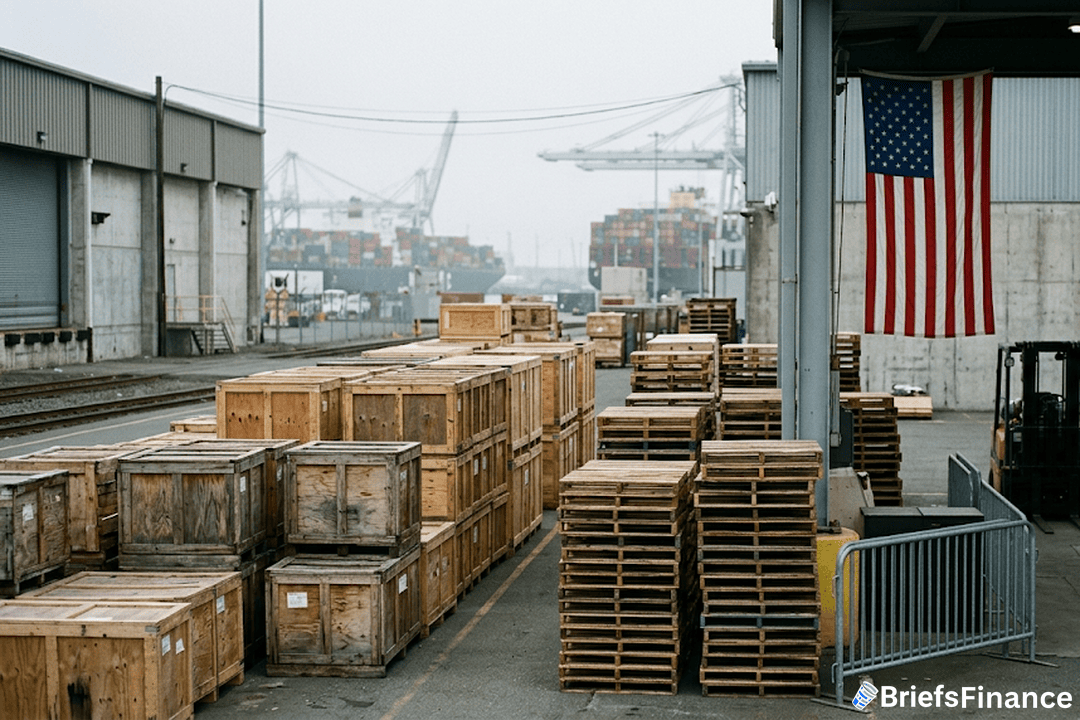
New Section 301 duties took effect July 24, 2026, adding 10% or 12.5% to most goods from 60 trading partners.
The tariffs cover approximately 99.4% of U.S. imports, with exemptions for steel, autos, and USMCA-qualifying goods from Canada and Mexico.
Two lawsuits at the Court of International Trade are challenging the duties and the forced-labor rationale.
A Temporary Tariff Just Became a Sweeping One
The US just traded a short-term tariff for a much bigger, longer-lasting one.
The new Section 301 duties took effect July 24, 2026, replacing the temporary 10% Section 122 tariff. That tariff took effect February 24, 2026, and generally could only last 150 days.
Rates vary by trading partner: the border levy generally comes to 10% or 12.5% of the value of goods, subject to caps and exemptions.
They apply to 60 trading partners that together supply approximately 99.4% of everything the United States imports.
The move marks a major expansion of Section 301. Earlier US trade penalties often targeted specific practices in specific countries, while this action reaches nearly all imports and stacks on top of existing anti-dumping and countervailing duties. The previous Section 122 tariff was always meant to be temporary, but the new Section 301 duties are built for the long haul.
The Forced-Labor Rationale
The official reason is forced labor. The US Trade Representative's office, known as USTR, says these countries did not impose or enforce bans on imports made with forced labor.
No one has to prove a specific product is tainted - a country's overall record is enough. The timeline moved fast.
USTR launched its Section 301 investigation on March 12, 2026, after President Trump directed it. The agency held public hearings in April and consulted more than 45 affected governments.
It concluded on June 2 that the practices were open to trade penalties.
Then came more than 1,600 written comments and testimony from over 100 witnesses at a July hearing.
Rates, Caps, and Exemptions
The 10% rate generally applies to a long list of countries, including Canada, Mexico, India, Bangladesh, and the United Kingdom.
Most goods from other investigated economies face the 12.5% rate.
Some partners get a cap. For the European Union and Taiwan, the combined normal duty plus Section 301 charge generally cannot go above 10%.
For Japan, Korea, and Switzerland, the ceiling is 12.5%. If the normal duty already hits that ceiling, no extra charge applies.
Exemptions are broad. Steel, aluminum, automobiles, auto parts, copper, and other products covered by Section 232 national security rules are out.
So are USMCA-qualifying goods from Canada and Mexico (USMCA is the North American trade deal). Raw materials, energy products, and agricultural goods are out too.
There is a short grace period for goods already at sea. Shipments on a vessel before 12:01 am ET on July 24 skip the new duties if they clear customs by 12:01 am ET on July 28.
Textiles get their own track. USTR has orders to create tariff-rate quotas for Bangladesh, Cambodia, Indonesia, and Malaysia - limits that let a set amount of fabric in at lower rates - to encourage US cotton purchases.
Those quotas may be ready by September 1, 2026. Until then, those imports stay under the 10% tariff.
The Legal Fight and Your Portfolio
Two lawsuits are already at the Court of International Trade. In a proposed class action, Collective Horology LLC and Burlap and Barrel Inc., which had previously contested the earlier Section 122 tariffs, argue that USTR did not adequately explain "near-uniform duties across 60 economies with materially different enforcement records and trade profiles."
A second case, from seven businesses including Learning Resources Inc. and hand2mind Inc., calls the forced-labor rationale a pretext for "essentially the same set of sweeping global tariffs" the Supreme Court previously rejected when it invalidated the administration's IEEPA tariffs.
For your money, the key question is who pays. Importers hand over the duty, and that cost tends to travel - into higher prices, thinner profit margins, or both.
Companies that rely heavily on imports from the 60 listed countries could feel more pressure than rivals buying closer to home. USTR is telling importers to verify product rates and exemptions, update customs systems, and review contracts.
The tariffs are in place, so the size of the hit depends on what a company imports and where it buys from.
Either way, the border tax is now part of the math for nearly all imports, and that math could shift as the lawsuits move forward.
Anthropic has gone public at a valuation of about $1.5 trillion, while Amazon went public in 1997 at around $440 million. Anthropic has about $33 billion in revenue this year and no profit, and investors are paying more than 40 times its sales, against about 3 times for Amazon. Briefs Finance CEO Jaspreet Singh says nobody knows what comes next, and that long-term investors use downturns to buy instead of panic selling.
Tech stocks are selling off because investors don't know who will lead Nvidia, the company that has been funding the AI industry and selling it chips.
Inflation has the Federal Reserve planning to raise interest rates, with a hike expected in December, and that puts pressure on homebuyers, private equity and the $40 trillion national debt.
Briefs Finance CEO Jaspreet Singh says nobody has a crystal ball, so his rules are to buy when markets are low, hold long term and invest only what you're willing to lose.
The national debt is above $40 trillion, and the Federal Reserve has gone from sending Washington its profits to losing money.
President Trump's four-part plan leans on shorter-term debt, stablecoin companies buying Treasuries, a bigger balance sheet and government stakes in private companies.
The goal is to outgrow the debt, not pay it off, so Jaspreet Singh points investors to the seven industries where Washington wants growth.
The Fed makes its next rate decision on December 9 and is now talking about jumbo interest rate hikes of 0.5%, though one in December looks unlikely.
Washington will pay a record $1.05 trillion in interest this year on $40 trillion of debt, and that debt resets at higher rates as the Fed hikes.
Jaspreet Singh's five moves are to pay down variable-rate debt, earn interest on your savings, know which stocks feel the pressure, look at value and hedge.
Margin debt, the money investors borrow to buy stocks, is at a record of around 4.6% of GDP, up from 3.9% in 2021.
ETF money has more than tripled in five years to 7% of GDP, while corporate buybacks and 401(k) money sit below their earlier peaks.
Margin calls and panic selling can make the next downturn deeper, so Jaspreet Singh keeps buying broad market funds and says most investors should skip margin debt.
Jensen Huang is out at Nvidia over affairs with multiple people, and the company he founded has been the bank of American AI, with about $30 billion into OpenAI and $10 billion into Anthropic.
A hotter-than-expected inflation report has Fed officials talking about a possible 0.5% hike in December, and gold, silver, and bitcoin fell on the news.
President Trump said the US may not need a deal with Iran, keeping oil prices and inflation risk high. Jaspreet Singh breaks down what it all means for AI stocks and your portfolio.
Stocks are booming at the fastest pace in years, jobless claims just hit a 57-year low, and most investors still feel like nobody is hiring.
The Fed is protecting the dollar over the economy, oil swings on every Iran headline, and a few AI companies are carrying an S&P 500 where four of five stocks sit in a correction.
Jaspreet Singh explains why circular financing between Nvidia, OpenAI, Anthropic, and SpaceX rhymes with 2008's house of cards, and how his three investing pillars handle a stock market bubble.
The Fed has raised rates, cut them, then raised them again only twice in the last 60 years, and both times the economy fell into a recession and stocks crashed.
The same stop-and-go cycle is playing out now, with one big difference: US debt is 125% of GDP today versus about 30% in 1980.
In the 1970s gold rose roughly 24x, real estate 157%, stocks lagged, and cash lost half its value. Jaspreet Singh lays out five assets to consider before the next flip.
The IRS 2027 tax plan keeps the same seven rates but widens every bracket and lifts the married-filing-jointly standard deduction to $33,200.
The 0% long-term capital gains bracket rises to $102,100, so a household living on $135,300 of investment income could owe $0 in federal income tax.
C corporations still pay 21%, small businesses keep the 20% QBI deduction, and the 401(k) limit climbs to $25,500 with an $8,500 catch-up for investors over 50.
Make sure to check your inbox for the first email.
Before you go
We’re hosting our first ever livestream on how investors can use ChatGPT & Claude to invest like a pro. It’s on 11/17 and is hosted by our CEO Jaspreet Singh.