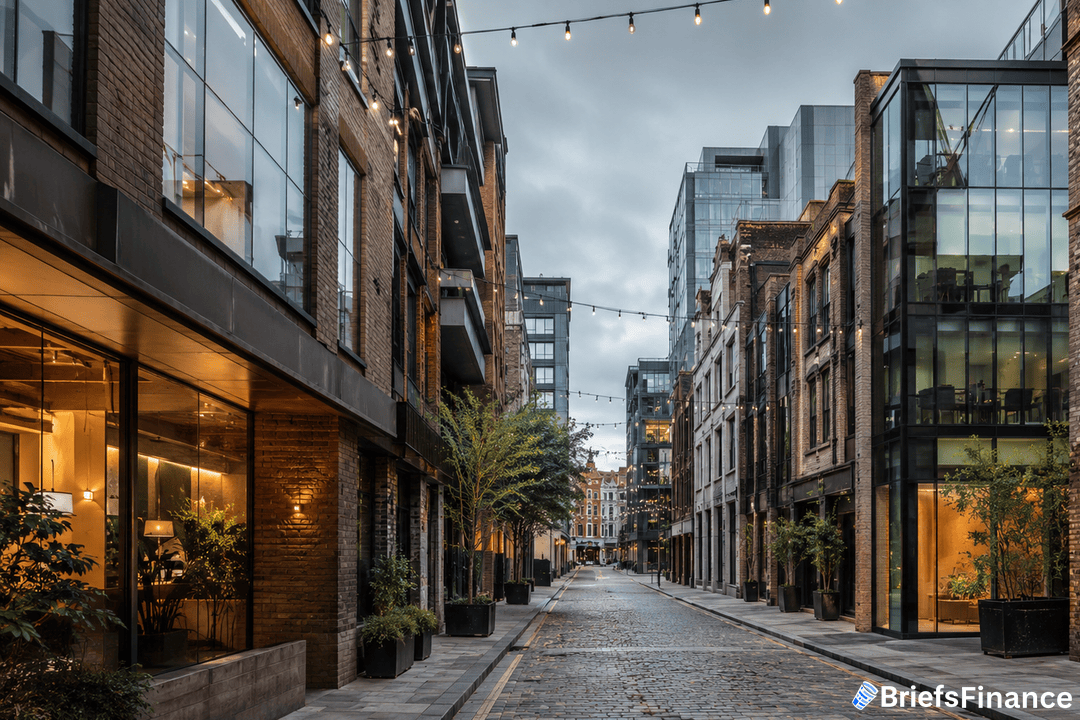
King's Cross has become Britain's leading AI district, with founders competing hard for scarce office space.
Google's 2016 move of DeepMind to the area triggered a wave of arrivals including OpenAI, Meta, Anthropic and Isomorphic Labs.
The neighborhood was a notorious drug and prostitution market in the 1980s before an early-2000s redevelopment reshaped it.
These days, almost every British AI founder wants the answer to one question: How do I find office space in King's Cross? Demand is so intense that, according to rumor, one venture firm closed a deal by providing a founder with office space in the neighborhood. Asked about the rumor, the firm declined to confirm or deny it, telling me, "We stop at nothing to win deals [for] and to support" founders, "including helping them source office space when needed."
A Magnet for AI Talent
King's Cross became a magnet in 2016, when Google moved its newly acquired DeepMind unit there. A wave of AI companies followed, drawn by the DeepMind effect and hoping to tap the concentrated AI talent. Today the district ranks among the world's leading AI hubs, alongside San Francisco and Beijing.
Locals call it the Knowledge Quarter because it hosts OpenAI, Meta, Isomorphic Labs, Cusp AI, Wayne, Recursive and, further along, Synthesia and Anthropic. The European Technology Network (ETN) recently opened a new office nearby, and University College London is around the corner.
New restaurants have also appeared among the office blocks, including Hoppers and BAO. By rail, founders can reach Cambridge in 45 minutes to recruit, or reach Paris in two hours to close a deal. It is hard to believe that just over two decades ago this was one of London's roughest neighborhoods.
A Neighborhood Transformed
"In the '80s, crack and heroin made the area a major narcotics market," said Hussein Kanji, an investor at Hoxton Ventures, who recalled needles left near trees and groups moving through the streets. "In 1982, the local church was occupied by the English Collective of Prostitutes for 12 straight days." He added, "Then, in the early 2000s, a real estate developer had a dream and, well, now it is the AI hotbed of the United Kingdom. What a change."
The transformation is visible in the mix around King's Cross station: new office blocks and university buildings now occupy streets that were once notorious for prostitution and drugs.
The area's revival did not happen overnight. A developer's vision in the early 2000s set the regeneration in motion, creating the modern office spaces and rail connections that later made the neighborhood an obvious home for DeepMind and the startups that followed. By the time the AI wave arrived, King's Cross was already one of London's best-connected districts, with Cambridge and Paris within easy reach.
What It Means for Investors
About 18 months ago, Kanji's portfolio company BioCorteX relocated from nearby Holborn to the Jellicoe building in King's Cross, seeking proximity to the action. "Lots going on in London right now," "Nik Sharma, co-founder of BioCorteX, told me". "Lots of hyperscalers moving in." That reportedly includes Jeff Bezos' AI company Prometheus, which may also be negotiating space in the Jellicoe.
The 18% rise in prime King's Cross rents applies only to the biggest leases, those for 10,000 square feet or more, such as the deals OpenAI and Prometheus are signing, according to Chris Dunn, an associate in commercial insight at Knight Frank. For smaller or shorter-term deals, rents go even higher, he added.
Anthropic has gone public at a valuation of about $1.5 trillion, while Amazon went public in 1997 at around $440 million. Anthropic has about $33 billion in revenue this year and no profit, and investors are paying more than 40 times its sales, against about 3 times for Amazon. Briefs Finance CEO Jaspreet Singh says nobody knows what comes next, and that long-term investors use downturns to buy instead of panic selling.
Tech stocks are selling off because investors don't know who will lead Nvidia, the company that has been funding the AI industry and selling it chips.
Inflation has the Federal Reserve planning to raise interest rates, with a hike expected in December, and that puts pressure on homebuyers, private equity and the $40 trillion national debt.
Briefs Finance CEO Jaspreet Singh says nobody has a crystal ball, so his rules are to buy when markets are low, hold long term and invest only what you're willing to lose.
The national debt is above $40 trillion, and the Federal Reserve has gone from sending Washington its profits to losing money.
President Trump's four-part plan leans on shorter-term debt, stablecoin companies buying Treasuries, a bigger balance sheet and government stakes in private companies.
The goal is to outgrow the debt, not pay it off, so Jaspreet Singh points investors to the seven industries where Washington wants growth.
The Fed makes its next rate decision on December 9 and is now talking about jumbo interest rate hikes of 0.5%, though one in December looks unlikely.
Washington will pay a record $1.05 trillion in interest this year on $40 trillion of debt, and that debt resets at higher rates as the Fed hikes.
Jaspreet Singh's five moves are to pay down variable-rate debt, earn interest on your savings, know which stocks feel the pressure, look at value and hedge.
Margin debt, the money investors borrow to buy stocks, is at a record of around 4.6% of GDP, up from 3.9% in 2021.
ETF money has more than tripled in five years to 7% of GDP, while corporate buybacks and 401(k) money sit below their earlier peaks.
Margin calls and panic selling can make the next downturn deeper, so Jaspreet Singh keeps buying broad market funds and says most investors should skip margin debt.
Jensen Huang is out at Nvidia over affairs with multiple people, and the company he founded has been the bank of American AI, with about $30 billion into OpenAI and $10 billion into Anthropic.
A hotter-than-expected inflation report has Fed officials talking about a possible 0.5% hike in December, and gold, silver, and bitcoin fell on the news.
President Trump said the US may not need a deal with Iran, keeping oil prices and inflation risk high. Jaspreet Singh breaks down what it all means for AI stocks and your portfolio.
Stocks are booming at the fastest pace in years, jobless claims just hit a 57-year low, and most investors still feel like nobody is hiring.
The Fed is protecting the dollar over the economy, oil swings on every Iran headline, and a few AI companies are carrying an S&P 500 where four of five stocks sit in a correction.
Jaspreet Singh explains why circular financing between Nvidia, OpenAI, Anthropic, and SpaceX rhymes with 2008's house of cards, and how his three investing pillars handle a stock market bubble.
The Fed has raised rates, cut them, then raised them again only twice in the last 60 years, and both times the economy fell into a recession and stocks crashed.
The same stop-and-go cycle is playing out now, with one big difference: US debt is 125% of GDP today versus about 30% in 1980.
In the 1970s gold rose roughly 24x, real estate 157%, stocks lagged, and cash lost half its value. Jaspreet Singh lays out five assets to consider before the next flip.
The IRS 2027 tax plan keeps the same seven rates but widens every bracket and lifts the married-filing-jointly standard deduction to $33,200.
The 0% long-term capital gains bracket rises to $102,100, so a household living on $135,300 of investment income could owe $0 in federal income tax.
C corporations still pay 21%, small businesses keep the 20% QBI deduction, and the 401(k) limit climbs to $25,500 with an $8,500 catch-up for investors over 50.
Make sure to check your inbox for the first email.
Before you go
We’re hosting our first ever livestream on how investors can use ChatGPT & Claude to invest like a pro. It’s on 11/17 and is hosted by our CEO Jaspreet Singh.