Free NewsletterPro Login

D-Matrix Starts Shipping An AI Chip That Skips The Memory Shortage

Published Jun 9, 2026
Share:
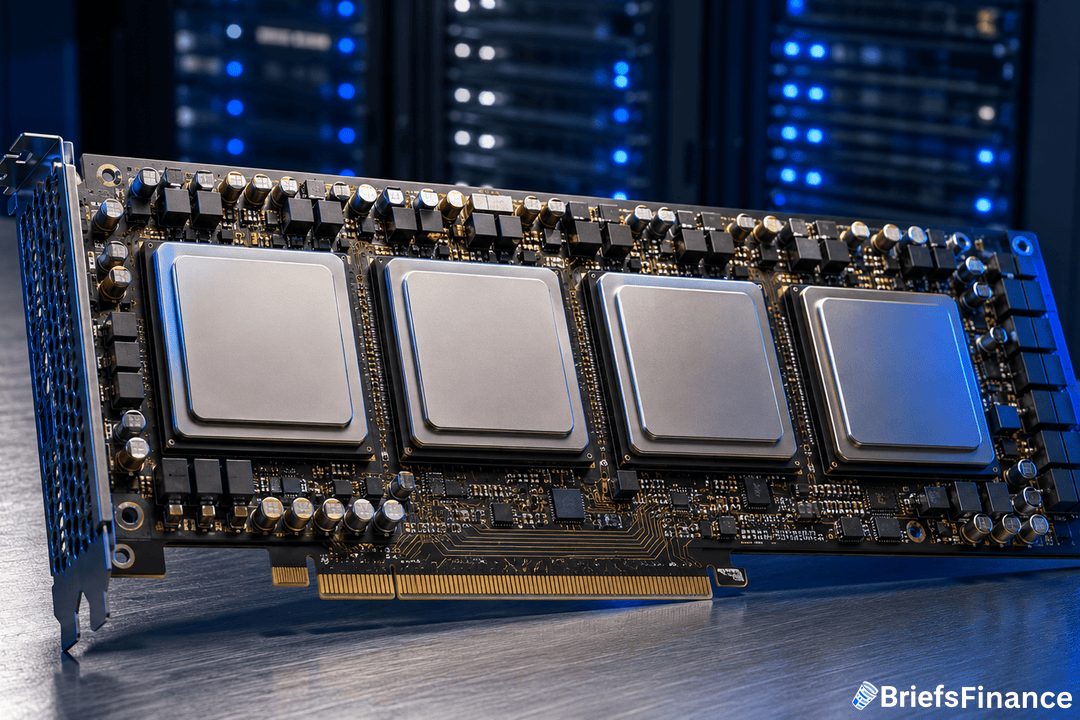
A close-up of a large computer processor card with four visible chips, positioned on a metallic surface. Blurred server racks with blue lights appear in the background. The image is branded with the BriefsFinance logo.
Summary:
  • D-Matrix began shipping its Corsair AI chip this month, with Microsoft as one of its backers.
  • The chip builds memory onto the chip itself, dodging the scarce DRAM that other AI gear needs.
  • D-Matrix has raised around $500 million and is worth about $2 billion.

Everyone in AI is fighting over the same scarce memory chips. D-Matrix built one that barely needs them.

The startup sits three miles from Nvidia. It began shipping its Corsair chip this month.

Why The Memory Trick Matters

Most AI chips lean on a memory type called DRAM. It is in short supply right now.

Only three firms make it: Micron, Samsung and SK Hynix. Demand runs far ahead of what they ship.

DRAM feeds data to a chip. Right now it is the traffic jam slowing the whole field.

D-Matrix took a different road. It builds its memory, called SRAM, right onto the chip.

We explain what shifts like this mean for chip stocks in Market Briefs - it takes five minutes a day, and a free investing masterclass comes with it.

The Payoff And The Catch

"We're not running into a chokepoint around DRAM with our product," CEO Sid Sheth told CNBC.

He says Corsair is now in full production. The payoff is faster answers using less power, at least on smaller jobs.

There is a limit, though. SRAM can't hold the giant models built by firms like OpenAI and Anthropic.

"That number of parameters just simply can't be put onto an SRAM-based design," said Rick Bahr, a Stanford professor.

How It Is Built

So Corsair is aimed at small, fast tasks. Think chatbots and voice helpers, not the heaviest work.

Each card packs four Corsair chips. It slides into a server rack and costs tens of thousands of dollars.

Sheth calls it the densest memory chip on the market. A single server can hold up to 128 gigabytes of it.

The chip is made in Taiwan on TSMC's 6-nanometer line. Its next chip, Raptor, moves to a newer 4-nanometer one.

D-Matrix also teamed with Arista, Broadcom and Super Micro. Together they built a full rack system called SquadRack.

A Crowded Field

D-Matrix is not the only small player here. Cerebras went public last month and is now worth over $50 billion.

Nvidia bought a rival, Groq, for $20 billion in December. The field is filling up fast.

Microsoft backed D-Matrix through its venture arm, even while building its own AI chips. That kind of bet brings both trust and deep pockets.

Many buyers will run Corsair next to Nvidia chips, not instead of them.

One chip analyst said buyers often pair the two. Each chip is simply better at different kinds of work.

What To Watch

About 90% of D-Matrix's early buyers are in the U.S. Its next chip is due next year.

Nvidia is not standing still, either. Huang says his new Vera Rubin system still leads on low-cost AI work.

Sheth calls AI inference "a $1 trillion market in the making." He has no plans to sell the firm.

The race is no longer just about the fastest chip. It is about who builds one without waiting in the memory line.

If you want plain-English takes on the AI trade every morning, start reading Market Briefs here - you also get a 45-minute investing course thrown in.

Disclosure

Get Market Briefs delivered to your inbox every morning for free!

No fluff. No noise. No politics. Just finance news you can read in 5 minutes.

Blogs

May 30, 2026
Financial Literacy Books That Actually Build Wealth
  • The best financial literacy books don't just teach budgeting, they shift how you think about money.
  • Two classics stand out: The Intelligent Investor for valuing investments, and Rich Dad Poor Dad for the owner's mindset.
  • Reading is only step one. The real wealth comes from acting on what you learn.
Read More
May 30, 2026
What Is a Roth Conversion? A Simple Guide
  • A Roth conversion moves money from a traditional retirement account into a Roth account.
  • You pay taxes on the money now, in exchange for tax-free growth and withdrawals later.
  • It can pay off if you expect higher taxes or more income in the future, but the timing and tax hit matter a lot.
Read More
May 30, 2026
Trailing Stop Loss: How to Protect Your Gains
  • A trailing stop loss is an order that automatically sells a stock if it falls a set percentage from its recent high.
  • As the stock rises, the sell point rises with it, locking in gains while capping losses.
  • It's most useful for active strategies like momentum investing, not for long-term buy-and-hold.
Read More
May 30, 2026
5 Types of Wealth: Why Money Is Only One of Them
  • Real wealth is more than a bank balance. It spans your finances, health, mind, purpose, and freedom.
  • Money is powerful, but it amplifies the life you already have rather than fixing a broken one.
  • True financial wealth means your cash flow covers your expenses, so your money works while you live.
Read More
May 30, 2026
How to Invest in Private Equity: A Beginner's Guide
  • Private equity means investing in companies that aren't listed on the stock market.
  • Traditional private equity is built for experienced, high-net-worth investors with large amounts to invest.
  • New rules have opened more accessible paths, like startup crowdfunding and real estate deals, often starting around $100.
Read More
May 30, 2026
What Is a Call Option? A Simple Guide With Examples
  • A call option gives you the right to buy a stock at a set price by a set date.
  • Investors buy calls when they expect a stock to rise, using less money than buying the shares outright.
  • The most you can lose buying a call is the premium, but time works against you, so it's an advanced tool.
Read More
May 30, 2026
EBITDA Formula: How to Calculate It Step by Step
  • EBITDA stands for Earnings Before Interest, Taxes, Depreciation, and Amortization, a measure of a company's core profit.
  • The formula adds those four items back to net income to show what the underlying business earns.
  • Investors use EBITDA to compare companies and to judge how many times earnings a stock is selling for.
Read More
May 30, 2026
What Is a Stock Option? A Plain-English Guide
  • A stock option is a contract giving you the right, but not the obligation, to buy or sell a stock at a set price by a set date.
  • There are two types: calls (the right to buy) and puts (the right to sell).
  • Options are powerful but risky, so they suit investors who already have the basics down.
Read More
May 30, 2026
Put Option: What It Is and How It Works
  • A put option gives you the right to sell a stock at a set price by a set date.
  • Investors use puts to bet a stock will fall, or as insurance to protect shares they own.
  • The most you can lose buying a put is the premium you paid, which makes it a defined-risk tool.
Read More
May 30, 2026
Operating Margin: What It Is and How to Calculate It
  • Operating margin shows how much profit a company keeps from its core business after paying its running costs.
  • The formula is operating income divided by revenue, shown as a percent.
  • A strong, steady operating margin signals a well-run business that controls its costs.
Read More
1 2 3 22
Share via
Copy link










