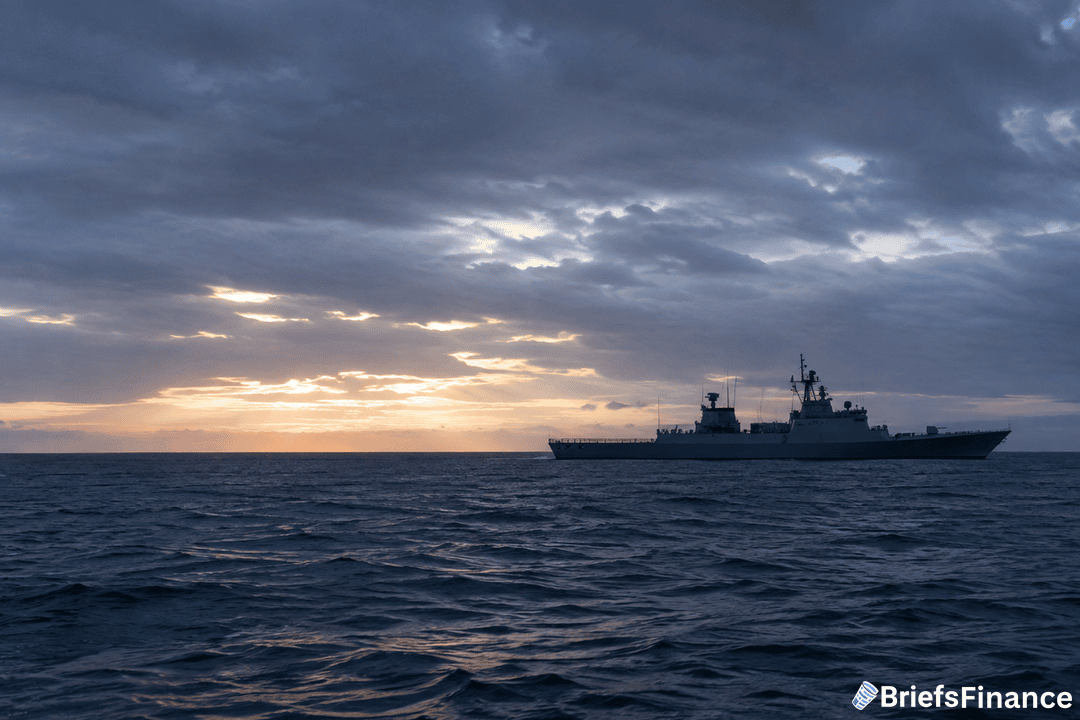
China says its guided-missile frigate Honghe will train with an Indonesian vessel east of Taiwan in mid-August.
Beijing withheld dates, coordinates, and the operational route for the exercise.
It is the first time China has disclosed a joint naval drill with another country in that zone.
Joint Exercise Announced
Beijing has announced that its naval forces and Indonesia's military will train together in an area east of Taiwan. The Chinese guided-missile frigate Honghe, belonging to the Type 054A class, is scheduled to rendezvous with an Indonesian naval vessel for maneuvers during the middle of August.
The official statement from Beijing omitted specific dates, coordinates, and the operational route for the exercise. As of August 11, 2026, Indonesian defense officials had yet to issue a public response to inquiries about the planned operation, leaving the full scope of the activity unconfirmed.
What the Drill Involves
According to the Chinese announcement, the exercise will center on maritime communication procedures and replenishment-at-sea operations. While these activities appear standard, Beijing emphasized that the broader objective involves enhancing joint operational effectiveness between the two navies and contributing to regional stability.
China and Indonesia have engaged in military cooperation previously, making this joint activity itself unsurprising. The unusual element is the setting, because Beijing has never before disclosed a combined exercise with another nation's navy in this zone. It is also the first occasion on which China has cooperated militarily with another state in that area.
Strategic Significance of the Location
The choice of location carries considerable weight given recent regional dynamics. China has increased its military activity around these waters after Japan and the Philippines said they planned to discuss the territorial disagreements affecting the zone. Those discussions pertain to waters that Beijing considers part of its claimed territory. The same zone sits close to the Philippines and the southern Japanese islands, giving the planned drill a geographic reach that extends beyond Taiwan itself.
The timing also connects to broader patterns. Since former U.S. House Speaker Nancy Pelosi's visit to Taiwan in 2022, China's military operations near the island have become a recurring feature of regional tensions. The area east of Taiwan has been a focus of that buildup, and the new drill with Indonesia adds an international element to Beijing's posture.
Regional Context
Indonesia's participation is notable because Jakarta has generally sought to balance its ties with China and its relationships with other regional powers. The two countries have held naval exchanges and port visits in the past, but this announced exercise is different in that it is happening in a zone where China's maritime claims overlap with the concerns of Japan and the Philippines. For Beijing, staging a cooperative naval activity with a Southeast Asian partner in the same waters may be a way to show that normal military diplomacy can continue even while tensions rise elsewhere. For observers, the key question will be whether the promised drill actually takes place and whether Indonesia clarifies its view of the operation.
Anthropic has gone public at a valuation of about $1.5 trillion, while Amazon went public in 1997 at around $440 million. Anthropic has about $33 billion in revenue this year and no profit, and investors are paying more than 40 times its sales, against about 3 times for Amazon. Briefs Finance CEO Jaspreet Singh says nobody knows what comes next, and that long-term investors use downturns to buy instead of panic selling.
Tech stocks are selling off because investors don't know who will lead Nvidia, the company that has been funding the AI industry and selling it chips.
Inflation has the Federal Reserve planning to raise interest rates, with a hike expected in December, and that puts pressure on homebuyers, private equity and the $40 trillion national debt.
Briefs Finance CEO Jaspreet Singh says nobody has a crystal ball, so his rules are to buy when markets are low, hold long term and invest only what you're willing to lose.
The national debt is above $40 trillion, and the Federal Reserve has gone from sending Washington its profits to losing money.
President Trump's four-part plan leans on shorter-term debt, stablecoin companies buying Treasuries, a bigger balance sheet and government stakes in private companies.
The goal is to outgrow the debt, not pay it off, so Jaspreet Singh points investors to the seven industries where Washington wants growth.
The Fed makes its next rate decision on December 9 and is now talking about jumbo interest rate hikes of 0.5%, though one in December looks unlikely.
Washington will pay a record $1.05 trillion in interest this year on $40 trillion of debt, and that debt resets at higher rates as the Fed hikes.
Jaspreet Singh's five moves are to pay down variable-rate debt, earn interest on your savings, know which stocks feel the pressure, look at value and hedge.
Margin debt, the money investors borrow to buy stocks, is at a record of around 4.6% of GDP, up from 3.9% in 2021.
ETF money has more than tripled in five years to 7% of GDP, while corporate buybacks and 401(k) money sit below their earlier peaks.
Margin calls and panic selling can make the next downturn deeper, so Jaspreet Singh keeps buying broad market funds and says most investors should skip margin debt.
Jensen Huang is out at Nvidia over affairs with multiple people, and the company he founded has been the bank of American AI, with about $30 billion into OpenAI and $10 billion into Anthropic.
A hotter-than-expected inflation report has Fed officials talking about a possible 0.5% hike in December, and gold, silver, and bitcoin fell on the news.
President Trump said the US may not need a deal with Iran, keeping oil prices and inflation risk high. Jaspreet Singh breaks down what it all means for AI stocks and your portfolio.
Stocks are booming at the fastest pace in years, jobless claims just hit a 57-year low, and most investors still feel like nobody is hiring.
The Fed is protecting the dollar over the economy, oil swings on every Iran headline, and a few AI companies are carrying an S&P 500 where four of five stocks sit in a correction.
Jaspreet Singh explains why circular financing between Nvidia, OpenAI, Anthropic, and SpaceX rhymes with 2008's house of cards, and how his three investing pillars handle a stock market bubble.
The Fed has raised rates, cut them, then raised them again only twice in the last 60 years, and both times the economy fell into a recession and stocks crashed.
The same stop-and-go cycle is playing out now, with one big difference: US debt is 125% of GDP today versus about 30% in 1980.
In the 1970s gold rose roughly 24x, real estate 157%, stocks lagged, and cash lost half its value. Jaspreet Singh lays out five assets to consider before the next flip.
The IRS 2027 tax plan keeps the same seven rates but widens every bracket and lifts the married-filing-jointly standard deduction to $33,200.
The 0% long-term capital gains bracket rises to $102,100, so a household living on $135,300 of investment income could owe $0 in federal income tax.
C corporations still pay 21%, small businesses keep the 20% QBI deduction, and the 401(k) limit climbs to $25,500 with an $8,500 catch-up for investors over 50.
Make sure to check your inbox for the first email.
Before you go
We’re hosting our first ever livestream on how investors can use ChatGPT & Claude to invest like a pro. It’s on 11/17 and is hosted by our CEO Jaspreet Singh.