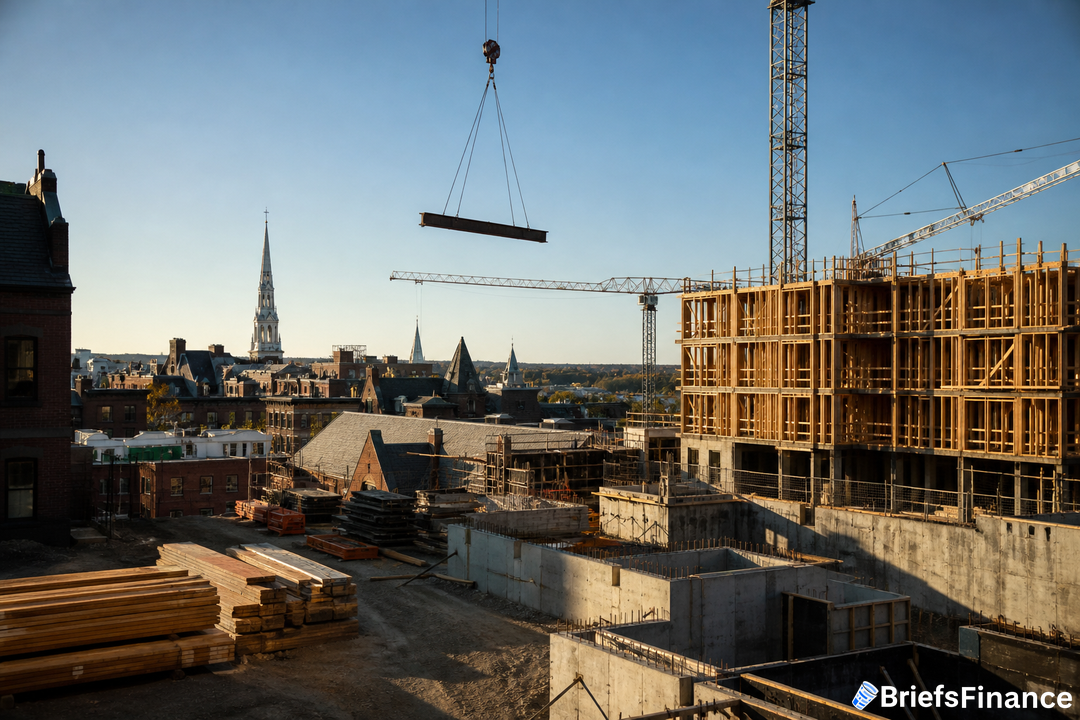
WorkNomads plans a 200‑unit work‑and‑live building inside +Colonia in Colonia, Uruguay, a short ferry ride from Buenos Aires.
The Sofia‑based firm expects to break ground next year and open in 2029; its move follows Praxis, which with Silicon Valley backing committed $1 billion for a separate complex.
Five buildings totaling nearly 500 units are now under construction; about 400 units are slated for completion before the end of next year, with the remainder due in 2028.
A ferry ride away and suddenly relevant
Across the river from Buenos Aires, a planned city in Uruguay is finally moving forward as international buyers wager that young professionals will live and work an hour by ferry from Argentina's capital. +Colonia sits by the Colonia ferry terminal, and that quick hop is central to the pitch.
Argentine developer Eduardo Bastitta began shaping the project four years ago and presented it publicly in October 2022. "The international context is favorable to foster a new wave of immigration," he said, arguing Uruguay's appeal rises as conflicts elsewhere persist in a country with more cattle than residents.
Who is investing and what they are building
Based in Sofia, Bulgaria, WorkNomads specializes in placing remote talent and intends to develop a 200-unit co-living and co-working project within the larger +Colonia plan. Founder Katrien Meire said, "We are on the doorstep of Buenos Aires and still part of a country with political and economic stability," adding, "We are actually looking for underdog destinations." She declined to disclose how much the firm will invest.
Meire said the mix of Uruguay's predictability and a quick trip to Buenos Aires tipped the decision to build in the small coastal town, choosing low-profile Colonia over Punta del Este for the company's second facility. WorkNomads aims to break ground next year and have the property operational in 2029.
The WorkNomads deal arrived shortly after Praxis, an online community with support from Silicon Valley backers, committed $1 billion to a separate resort and residence project inside +Colonia.
When major projects reshape local markets, staying informed matters, so sign up for the free Market Briefs for concise daily updates
Building, incentives, and the commute question
As master developer, +Colonia is putting in essential infrastructure and selling plots to real estate groups that will construct and market the apartments. Unlike the gated enclaves around Buenos Aires, Bastitta picked an open-city approach where anyone can move about freely.
After permitting delays, builders including Argentine names Argencons and Criba Real Estate now have five buildings underway with nearly 500 units. About 400 should be delivered by late next year, with the balance scheduled for 2028, Bastitta said. He argues +Colonia can stand up to Buenos Aires suburbs like Nordelta and Pilar, even if daily cross-river commuting is not yet common from Uruguay. "We have beaches, we have tax benefits, we have mortgages," he said.
Colonia is also drawing broader commercial real estate bets. A free trade zone in Colonia that was inaugurated last week offers tax breaks for companies, bolstering the case for professionals in tech and other services such as law and finance.
Why the backdrop matters for demand
When Bastitta introduced +Colonia in October 2022, Argentina's left-wing administration was expanding the money supply, pushing inflation toward 100% and into recession, while Uruguay attracted wealthy nonresidents by offering substantial tax breaks. Four years on, President Javier Milei removed currency controls for citizens, liberalized the economy, and pushed inflation lower. That progress, though still fragile, raises a live question: does a refuge across the river still resonate with the young professionals +Colonia first targeted?
+Colonia's supporters think so. Juan Manuel Fernandez, who works on new business at InfoCasas, a real estate firm, said the project fits a wider shift of people and companies relocating from central Buenos Aires to new urban areas near the capital. "It's conceived as a way for companies to decentralize" away from downtown, he said. "Today the center of Buenos Aires is very congested."
The bottom line for your portfolio
Money is flowing toward a once sleepy ferry stop that could evolve into a business address. Watch three milestones: developers delivering about 400 units by late next year, the remaining units coming in 2028, and WorkNomads targeting a 2029 opening for its building. If remote-work nodes keep gaining traction, +Colonia's open-city model and new tax-advantaged zone could turn Colonia into a cross-border hub worth tracking.
Across borders and time zones, the simplest briefings cut through complexity, so subscribe to our free Market Briefs newsletter today
Anthropic has gone public at a valuation of about $1.5 trillion, while Amazon went public in 1997 at around $440 million. Anthropic has about $33 billion in revenue this year and no profit, and investors are paying more than 40 times its sales, against about 3 times for Amazon. Briefs Finance CEO Jaspreet Singh says nobody knows what comes next, and that long-term investors use downturns to buy instead of panic selling.
Tech stocks are selling off because investors don't know who will lead Nvidia, the company that has been funding the AI industry and selling it chips.
Inflation has the Federal Reserve planning to raise interest rates, with a hike expected in December, and that puts pressure on homebuyers, private equity and the $40 trillion national debt.
Briefs Finance CEO Jaspreet Singh says nobody has a crystal ball, so his rules are to buy when markets are low, hold long term and invest only what you're willing to lose.
The national debt is above $40 trillion, and the Federal Reserve has gone from sending Washington its profits to losing money.
President Trump's four-part plan leans on shorter-term debt, stablecoin companies buying Treasuries, a bigger balance sheet and government stakes in private companies.
The goal is to outgrow the debt, not pay it off, so Jaspreet Singh points investors to the seven industries where Washington wants growth.
The Fed makes its next rate decision on December 9 and is now talking about jumbo interest rate hikes of 0.5%, though one in December looks unlikely.
Washington will pay a record $1.05 trillion in interest this year on $40 trillion of debt, and that debt resets at higher rates as the Fed hikes.
Jaspreet Singh's five moves are to pay down variable-rate debt, earn interest on your savings, know which stocks feel the pressure, look at value and hedge.
Margin debt, the money investors borrow to buy stocks, is at a record of around 4.6% of GDP, up from 3.9% in 2021.
ETF money has more than tripled in five years to 7% of GDP, while corporate buybacks and 401(k) money sit below their earlier peaks.
Margin calls and panic selling can make the next downturn deeper, so Jaspreet Singh keeps buying broad market funds and says most investors should skip margin debt.
Jensen Huang is out at Nvidia over affairs with multiple people, and the company he founded has been the bank of American AI, with about $30 billion into OpenAI and $10 billion into Anthropic.
A hotter-than-expected inflation report has Fed officials talking about a possible 0.5% hike in December, and gold, silver, and bitcoin fell on the news.
President Trump said the US may not need a deal with Iran, keeping oil prices and inflation risk high. Jaspreet Singh breaks down what it all means for AI stocks and your portfolio.
Stocks are booming at the fastest pace in years, jobless claims just hit a 57-year low, and most investors still feel like nobody is hiring.
The Fed is protecting the dollar over the economy, oil swings on every Iran headline, and a few AI companies are carrying an S&P 500 where four of five stocks sit in a correction.
Jaspreet Singh explains why circular financing between Nvidia, OpenAI, Anthropic, and SpaceX rhymes with 2008's house of cards, and how his three investing pillars handle a stock market bubble.
The Fed has raised rates, cut them, then raised them again only twice in the last 60 years, and both times the economy fell into a recession and stocks crashed.
The same stop-and-go cycle is playing out now, with one big difference: US debt is 125% of GDP today versus about 30% in 1980.
In the 1970s gold rose roughly 24x, real estate 157%, stocks lagged, and cash lost half its value. Jaspreet Singh lays out five assets to consider before the next flip.
The IRS 2027 tax plan keeps the same seven rates but widens every bracket and lifts the married-filing-jointly standard deduction to $33,200.
The 0% long-term capital gains bracket rises to $102,100, so a household living on $135,300 of investment income could owe $0 in federal income tax.
C corporations still pay 21%, small businesses keep the 20% QBI deduction, and the 401(k) limit climbs to $25,500 with an $8,500 catch-up for investors over 50.
Make sure to check your inbox for the first email.
Before you go
We’re hosting our first ever livestream on how investors can use ChatGPT & Claude to invest like a pro. It’s on 11/17 and is hosted by our CEO Jaspreet Singh.