Warning: Undefined variable $stocks in /var/www/briefs.co/htdocs/wp-content/plugins/oxygen/component-framework/components/classes/code-block.class.php(133) : eval()'d code on line 448
Warning: foreach() argument must be of type array|object, null given in /var/www/briefs.co/htdocs/wp-content/plugins/oxygen/component-framework/components/classes/code-block.class.php(133) : eval()'d code on line 448
Warning: Undefined variable $funds in /var/www/briefs.co/htdocs/wp-content/plugins/oxygen/component-framework/components/classes/code-block.class.php(133) : eval()'d code on line 472
Warning: foreach() argument must be of type array|object, null given in /var/www/briefs.co/htdocs/wp-content/plugins/oxygen/component-framework/components/classes/code-block.class.php(133) : eval()'d code on line 472
/* the link was here */
×
Free investor livestream — Nov 17
How To Use ChatGPT & Claude To Research Stocks Like A Pro
Moscow protested Estonia's plan to shut road crossings with Russia on Dec. 1, saying Tallinn's steps are "on the verge of unleashing open war with Russia."
Russia cited a claimed naval blockade, alleged use of Estonian airspace by Ukrainian drones, and a grain-transit ban that took effect in early October.
Estonia rejected the allegations, denying it lets any country conduct military operations from its territory and pointing to Russian actions that threaten European security.
What Moscow is protesting
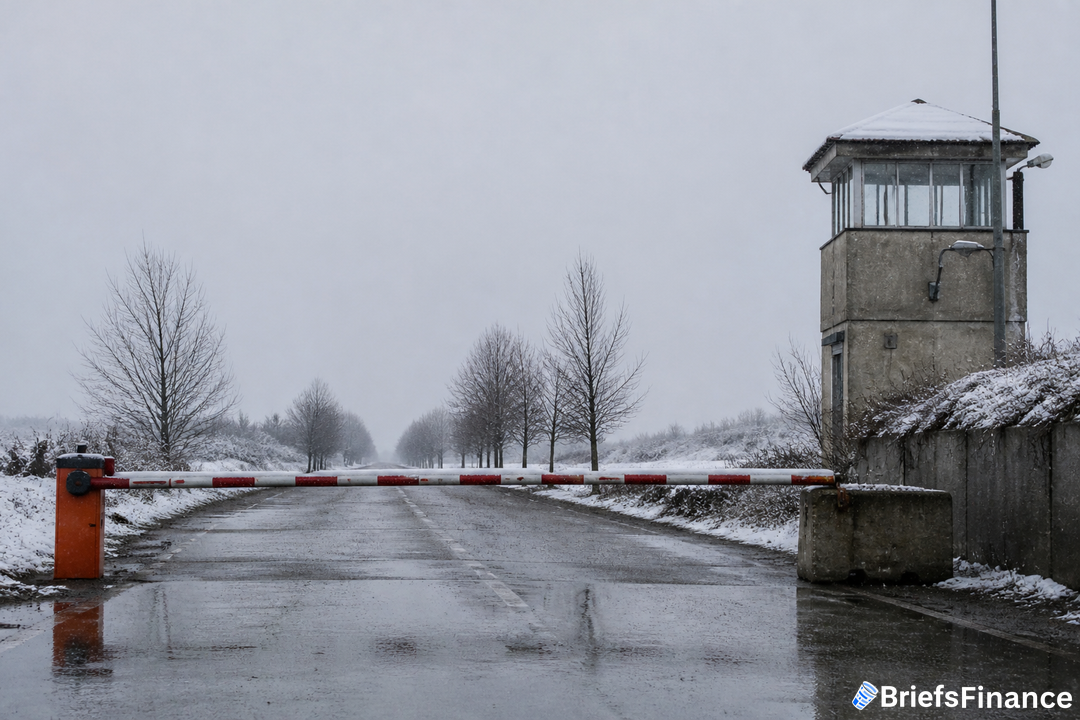
Russia's Foreign Ministry blasted Estonia for what it called hostile behavior after Tallinn announced plans to shut road border checkpoints with Russia from Dec. 1. On Monday, the ministry announced it filed an official complaint with Estonia's chargé d'affaires, Marek Uhtegi, over the move.
In its statement, Moscow accused the EU member of imposing a naval blockade and told the Estonian diplomat that "such provocative and extremely dangerous actions are on the verge of unleashing open war with Russia." The ministry labeled measures taken by Estonian lawmakers "Russophobic," alleged Estonia has "tacitly" allowed Ukrainian drones to traverse its airspace, and objected to a measure by Tallinn halting the passage of Russian and Belarusian grain via Estonia that took effect at the beginning of October.
In a pool photograph distributed by Russian state agency Sputnik, President Vladimir Putin is seen chairing a Security Council meeting in Moscow on Nov. 6, 2026.
How Tallinn answered back
Estonia, which shares a 294 kilometer (183 mile) border with Russia, swiftly denied ever permitting its territory to be used for another country's military operations. It argued the Kremlin appears to be diverting attention from its own efforts that undermine European security.
Foreign Minister Margus Tsahkna said Monday: "Russian missiles have reached Polish territory, Danish security services have identified an assassination plot in Denmark orchestrated by Russian intelligence services, merchant vessels in the Black Sea are under constant threat from Russian attacks, and in Estonia, an arson attack targeting a defence industry company, planned on the orders of Russian military intelligence, was foiled." He added, "All this is happening while Russia continues its war of aggression against Ukraine."
When geopolitics affect trade and borders, stay informed with our free Market Briefs newsletter in five minutes or less each day
Earlier this month, Tallinn announced the closure of road checkpoints on the Russian frontier starting Dec. 1, blaming Moscow for an attempted "sabotage" of a defense-sector firm - an accusation the Kremlin denies. Estonia says the closures are meant to limit hostile activity and reduce the risk of sanctions circumvention.
The wider backdrop
The dispute lands as tensions rise along NATO's eastern flank and as Ukraine increases strikes on high-value Russian targets. In recent operations, the bridge to Crimea was damaged, a Russian freighter in the Baltic Sea was hit, and one of Russia's newest warships was destroyed while it was in a Libyan port.
On Saturday, after a suspected Ukrainian strike on a Russian military-linked freighter in the Gulf of Finland, Finnish Prime Minister Petteri Orpo cautioned that the war is "spilling over" into nearby waters. Finland, among NATO's most recent entrants, has likewise closed its land crossings with Russia.
Mario Bikarski, who serves as Verisk Maplecroft's senior analyst for Europe and Central Asia, said Ukraine's latest hits against some of Russia's most heavily defended targets show Kyiv can hurt Moscow even without large U.S. military support. He expects Ukraine to keep looking for ways to damage Russia's economy and wider regional interests, adding that a near term peace deal appears unlikely, although "the latest surge in diplomatic activity and mounting losses for both sides signals an appetite from all sides to reach an agreement."
What this means for your portfolio
Policy shifts and trade frictions are stacking up: road crossings set to close on Dec. 1, grain transit blocked since early October, and Finland tightening its frontier. Add shipping risks in the Black Sea and the Baltic Sea, and logistics and sanctions exposure get harder to model. The bottom line: watch companies tied to Baltic and Nordic transport lanes, defense supply chains, and grain flows, where small rule changes at these borders can quickly sway costs, delivery times, and pricing power.
Keeping a clear view of global risks matters, so sign up for the free Market Briefs newsletter for concise daily context
Anthropic has gone public at a valuation of about $1.5 trillion, while Amazon went public in 1997 at around $440 million. Anthropic has about $33 billion in revenue this year and no profit, and investors are paying more than 40 times its sales, against about 3 times for Amazon. Briefs Finance CEO Jaspreet Singh says nobody knows what comes next, and that long-term investors use downturns to buy instead of panic selling.
Tech stocks are selling off because investors don't know who will lead Nvidia, the company that has been funding the AI industry and selling it chips.
Inflation has the Federal Reserve planning to raise interest rates, with a hike expected in December, and that puts pressure on homebuyers, private equity and the $40 trillion national debt.
Briefs Finance CEO Jaspreet Singh says nobody has a crystal ball, so his rules are to buy when markets are low, hold long term and invest only what you're willing to lose.
The national debt is above $40 trillion, and the Federal Reserve has gone from sending Washington its profits to losing money.
President Trump's four-part plan leans on shorter-term debt, stablecoin companies buying Treasuries, a bigger balance sheet and government stakes in private companies.
The goal is to outgrow the debt, not pay it off, so Jaspreet Singh points investors to the seven industries where Washington wants growth.
The Fed makes its next rate decision on December 9 and is now talking about jumbo interest rate hikes of 0.5%, though one in December looks unlikely.
Washington will pay a record $1.05 trillion in interest this year on $40 trillion of debt, and that debt resets at higher rates as the Fed hikes.
Jaspreet Singh's five moves are to pay down variable-rate debt, earn interest on your savings, know which stocks feel the pressure, look at value and hedge.
Margin debt, the money investors borrow to buy stocks, is at a record of around 4.6% of GDP, up from 3.9% in 2021.
ETF money has more than tripled in five years to 7% of GDP, while corporate buybacks and 401(k) money sit below their earlier peaks.
Margin calls and panic selling can make the next downturn deeper, so Jaspreet Singh keeps buying broad market funds and says most investors should skip margin debt.
Jensen Huang is out at Nvidia over affairs with multiple people, and the company he founded has been the bank of American AI, with about $30 billion into OpenAI and $10 billion into Anthropic.
A hotter-than-expected inflation report has Fed officials talking about a possible 0.5% hike in December, and gold, silver, and bitcoin fell on the news.
President Trump said the US may not need a deal with Iran, keeping oil prices and inflation risk high. Jaspreet Singh breaks down what it all means for AI stocks and your portfolio.
Stocks are booming at the fastest pace in years, jobless claims just hit a 57-year low, and most investors still feel like nobody is hiring.
The Fed is protecting the dollar over the economy, oil swings on every Iran headline, and a few AI companies are carrying an S&P 500 where four of five stocks sit in a correction.
Jaspreet Singh explains why circular financing between Nvidia, OpenAI, Anthropic, and SpaceX rhymes with 2008's house of cards, and how his three investing pillars handle a stock market bubble.
The Fed has raised rates, cut them, then raised them again only twice in the last 60 years, and both times the economy fell into a recession and stocks crashed.
The same stop-and-go cycle is playing out now, with one big difference: US debt is 125% of GDP today versus about 30% in 1980.
In the 1970s gold rose roughly 24x, real estate 157%, stocks lagged, and cash lost half its value. Jaspreet Singh lays out five assets to consider before the next flip.
The IRS 2027 tax plan keeps the same seven rates but widens every bracket and lifts the married-filing-jointly standard deduction to $33,200.
The 0% long-term capital gains bracket rises to $102,100, so a household living on $135,300 of investment income could owe $0 in federal income tax.
C corporations still pay 21%, small businesses keep the 20% QBI deduction, and the 401(k) limit climbs to $25,500 with an $8,500 catch-up for investors over 50.
Make sure to check your inbox for the first email.
Before you go
We’re hosting our first ever livestream on how investors can use ChatGPT & Claude to invest like a pro. It’s on 11/17 and is hosted by our CEO Jaspreet Singh.