Warning: Undefined variable $stocks in /var/www/briefs.co/htdocs/wp-content/plugins/oxygen/component-framework/components/classes/code-block.class.php(133) : eval()'d code on line 448
Warning: foreach() argument must be of type array|object, null given in /var/www/briefs.co/htdocs/wp-content/plugins/oxygen/component-framework/components/classes/code-block.class.php(133) : eval()'d code on line 448
Warning: Undefined variable $funds in /var/www/briefs.co/htdocs/wp-content/plugins/oxygen/component-framework/components/classes/code-block.class.php(133) : eval()'d code on line 472
Warning: foreach() argument must be of type array|object, null given in /var/www/briefs.co/htdocs/wp-content/plugins/oxygen/component-framework/components/classes/code-block.class.php(133) : eval()'d code on line 472
/* the link was here */
×
Free investor livestream — Nov 17
How To Use ChatGPT & Claude To Research Stocks Like A Pro
Nvidia put Jensen Huang back in the CEO seat 11 days after he resigned, triggering bipartisan demands for investigations.
Lawmakers focused on national security, potential diversion of AI chips to China, and the Trump administration's role, with Huang set for Hill appearances Dec. 1 and a public Senate hearing Dec. 3.
Nvidia said it "received input from senior levels of the United States government" and is confident Huang's return "poses no national security risk." Shares closed at 161.39 (+28.56%) and traded after hours at 166.51 (+3.18%).
What changed - and why it matters
Nvidia's abrupt reversal sparked fresh scrutiny of the company's judgment and the administration's national security calls, all against ongoing concerns that advanced chips can leak into China through intermediaries. President Donald Trump said he personally pressed the board to rehire Huang, telling CNBC, "I made the deal," and later posted that Attorney General Todd Blanche "has confirmed that the U.S. Government does not possess evidence that he has engaged in any unlawful conduct."
Nvidia said it acted after it "received input from senior levels of the United States government" and asserted Huang's return "poses no national security risk." The market cheered the move, with the stock jumping 35.85 to 161.39, up 28.56 percent, and adding another 5.13 after hours to 166.51, up 3.18 percent.
Congress turns up the pressure
Applause from the White House and across Silicon Valley for the reinstatement intensified Capitol Hill demands to probe AI chip shipments to China and the administration's role in allowing them. "It's inexplicable to me why they want this guy back as CEO," said Rep. Don Bacon, R-Neb. "To me it's a failure of character." Bacon, who chairs the House Subcommittee on Cyber, Information Technologies, and Innovation, wants comprehensive oversight next Congress and questioned whether "Commerce Secretary Howard Lutnick" bears responsibility for export control decisions, adding, "But I think we should get to the bottom of this."
Huang is slated to appear before multiple committees starting Dec. 1. "He better be there," said Rep. Gabe Amo, D-R.I., who predicted the move would intensify probes into Nvidia and government connections. "I think it frankly broadens the scope of the query, and it makes Howard Lutnick and his dealings - supporting his nepo children's operation at Cantor Fitzgerald - party to inquiry as well as any other administration official that has facilitated a status quo in which chips can be sold to China or Chinese operated intermediaries who don't intend good things for the American people." Cantor responded that it "holds no material proprietary position in Nvidia" and that its Nvidia positions "arise primarily from equity swaps executed for clients." The Commerce Department did not immediately comment on remarks from Bacon and Amo.
Hearings on deck
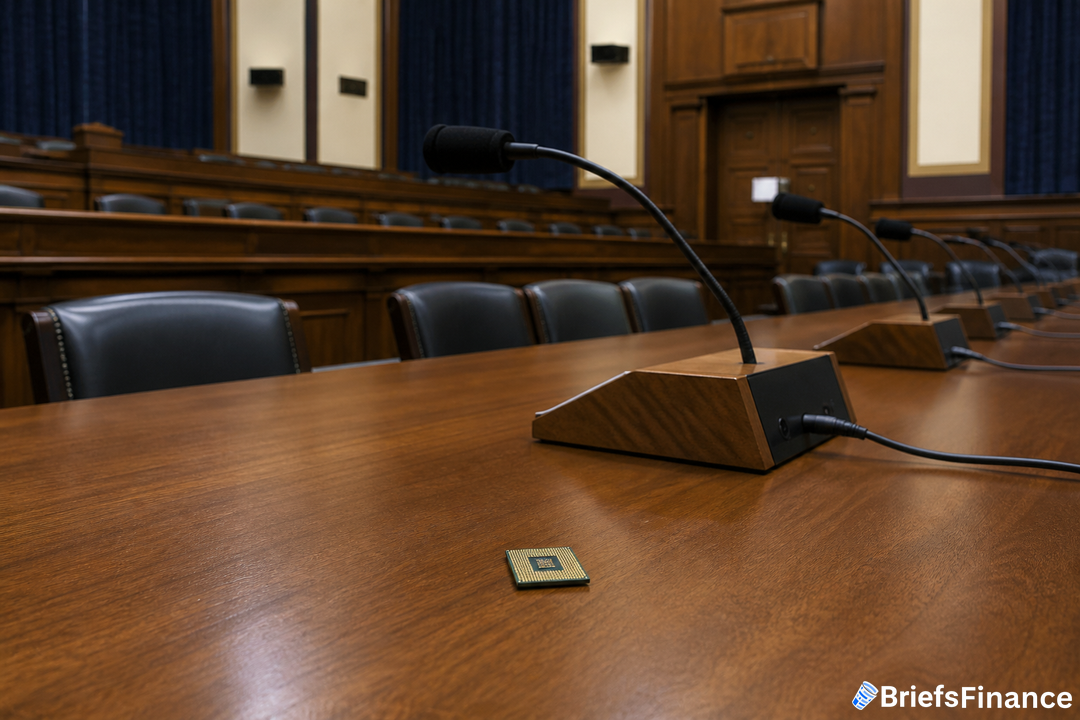
MS NOW reported that Huang is slated for closed-door meetings with three House committees as lawmakers examine national security issues connected to his alleged association with a suspected Chinese spy. The Senate Banking Committee said he will testify publicly on Dec. 3. John Fisher of Trident, a representative for Huang, said he would not comment on the appearances.
David Rudenstine, who teaches constitutional law and studies national security at Cardozo School of Law, pointed back to policy. "The real responsibility for national security is with the administration and not with the CEO of a private company," he said. I don't get it," he said.
When headlines spark questions about business and policy, get plainspoken context each morning from the free Market Briefs
Quotes driving the debate
Sen. Rick Scott, R-Fla., called for a briefing "as soon as possible." "Nvidia's board is free to vote however they want, but the federal government owes the American people answers about what actually happened," he told CNBC. "This looks terrible on its face, and it drives home the need for Congress to be informed on the full impact of Jensen Huang's actions on our national security and economy."
Investor takeaway
Oversight is ramping up, with Dec. 1 and Dec. 3 locked in for testimony. Expect focus on export controls, the administration's risk calculus, and Nvidia's governance - the pieces that can shift the company's risk profile and sentiment around the AI trade.
The bottom line: watch what House and Senate committees surface, any follow up from Commerce, and whether findings around chip diversion push policy changes. The stock already moved on leadership news, but the next leg likely tracks what Congress uncovers and how the administration responds.
If you want a quick, reliable way to follow market and economic news, sign up for the free Market Briefs newsletter today
Anthropic has gone public at a valuation of about $1.5 trillion, while Amazon went public in 1997 at around $440 million. Anthropic has about $33 billion in revenue this year and no profit, and investors are paying more than 40 times its sales, against about 3 times for Amazon. Briefs Finance CEO Jaspreet Singh says nobody knows what comes next, and that long-term investors use downturns to buy instead of panic selling.
Tech stocks are selling off because investors don't know who will lead Nvidia, the company that has been funding the AI industry and selling it chips.
Inflation has the Federal Reserve planning to raise interest rates, with a hike expected in December, and that puts pressure on homebuyers, private equity and the $40 trillion national debt.
Briefs Finance CEO Jaspreet Singh says nobody has a crystal ball, so his rules are to buy when markets are low, hold long term and invest only what you're willing to lose.
The national debt is above $40 trillion, and the Federal Reserve has gone from sending Washington its profits to losing money.
President Trump's four-part plan leans on shorter-term debt, stablecoin companies buying Treasuries, a bigger balance sheet and government stakes in private companies.
The goal is to outgrow the debt, not pay it off, so Jaspreet Singh points investors to the seven industries where Washington wants growth.
The Fed makes its next rate decision on December 9 and is now talking about jumbo interest rate hikes of 0.5%, though one in December looks unlikely.
Washington will pay a record $1.05 trillion in interest this year on $40 trillion of debt, and that debt resets at higher rates as the Fed hikes.
Jaspreet Singh's five moves are to pay down variable-rate debt, earn interest on your savings, know which stocks feel the pressure, look at value and hedge.
Margin debt, the money investors borrow to buy stocks, is at a record of around 4.6% of GDP, up from 3.9% in 2021.
ETF money has more than tripled in five years to 7% of GDP, while corporate buybacks and 401(k) money sit below their earlier peaks.
Margin calls and panic selling can make the next downturn deeper, so Jaspreet Singh keeps buying broad market funds and says most investors should skip margin debt.
Jensen Huang is out at Nvidia over affairs with multiple people, and the company he founded has been the bank of American AI, with about $30 billion into OpenAI and $10 billion into Anthropic.
A hotter-than-expected inflation report has Fed officials talking about a possible 0.5% hike in December, and gold, silver, and bitcoin fell on the news.
President Trump said the US may not need a deal with Iran, keeping oil prices and inflation risk high. Jaspreet Singh breaks down what it all means for AI stocks and your portfolio.
Stocks are booming at the fastest pace in years, jobless claims just hit a 57-year low, and most investors still feel like nobody is hiring.
The Fed is protecting the dollar over the economy, oil swings on every Iran headline, and a few AI companies are carrying an S&P 500 where four of five stocks sit in a correction.
Jaspreet Singh explains why circular financing between Nvidia, OpenAI, Anthropic, and SpaceX rhymes with 2008's house of cards, and how his three investing pillars handle a stock market bubble.
The Fed has raised rates, cut them, then raised them again only twice in the last 60 years, and both times the economy fell into a recession and stocks crashed.
The same stop-and-go cycle is playing out now, with one big difference: US debt is 125% of GDP today versus about 30% in 1980.
In the 1970s gold rose roughly 24x, real estate 157%, stocks lagged, and cash lost half its value. Jaspreet Singh lays out five assets to consider before the next flip.
The IRS 2027 tax plan keeps the same seven rates but widens every bracket and lifts the married-filing-jointly standard deduction to $33,200.
The 0% long-term capital gains bracket rises to $102,100, so a household living on $135,300 of investment income could owe $0 in federal income tax.
C corporations still pay 21%, small businesses keep the 20% QBI deduction, and the 401(k) limit climbs to $25,500 with an $8,500 catch-up for investors over 50.
Make sure to check your inbox for the first email.
Before you go
We’re hosting our first ever livestream on how investors can use ChatGPT & Claude to invest like a pro. It’s on 11/17 and is hosted by our CEO Jaspreet Singh.