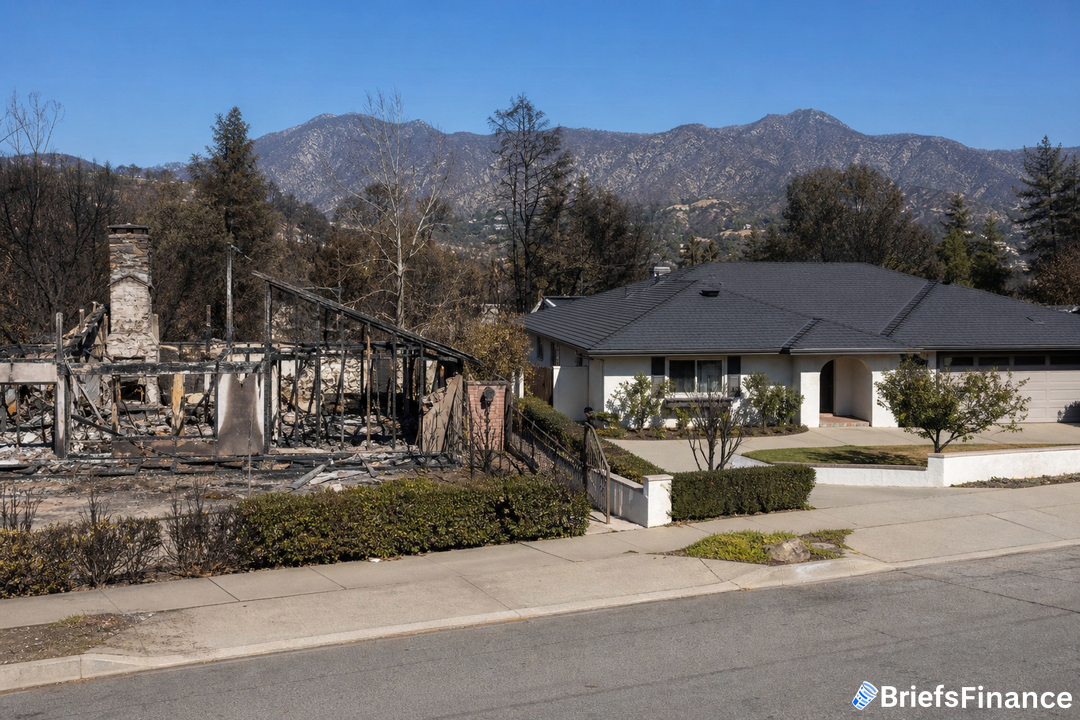
Hedge funds have stepped up purchases of subrogation claims arising from the 2025 Los Angeles fires, with deals executing as low as 3 cents on the dollar and topping out near 60 cents.
Insured losses tied to the Eaton and Palisades blazes are estimated at about $40 billion, and roughly 20 months later the question of who pays is still open.
A 2025 California law gave utilities first refusal on claim sales but did not ban hedge fund deals, and a legislative impasse has eased fears of tighter limits.
Where the action is now
After a push in Sacramento to curb these deals fizzled, hedge funds have been leaning back in. Cherokee Acquisition's Bradley Max, who last year talked about "a chill" in this niche, says the mood has flipped. "There's plenty of appetite for buyers and sellers," said Max, who brokers transactions between hedge funds and insurers offloading subrogation claims. "Insurance companies know that there is liquidity available and the market has become more mainstream," he added, while declining to name specific insurers or funds.
Pricing is all over the map. Cherokee says Eaton fire claims are changing hands around 55 to 60 cents on the dollar. Palisades fire claims, which carry heavier questions around establishing liability, are trading closer to 3 to 5 cents. Cherokee also recently acquired Palisades-related insurance claims for roughly $100 million at a price below 10 cents on the dollar, according to Max.
How subrogation deals work and why they move fast
Subrogation gives an insurer the right to pursue another party, like a utility suspected of sparking a blaze, to recover what it paid out. Rather than wait years for lawsuits to resolve, some insurers sell those rights to investors at a discount for immediate cash, while buyers bet ultimate recoveries will exceed their entry price. "Most hedge funds are looking for returns in the low-to-mid teens and are happy with that," Max said. The mechanics tend to be quick, too: "They are typically funded within just a couple of weeks."
It remains a discreet corner of alternative investing where terms rarely see daylight and buyers prefer not to be named, in part because the politics are thorny. The California Earthquake Authority, which administers the California Wildfire Fund, last year labeled these investments an "opportunistic" Wall Street play amid social and environmental upheaval. Governor Gavin Newsom sought to keep hedge funds and other alternative managers out of the mix.
California's 2025 statute obliges insurers to give utilities the initial option to buy before any sale to investors. It stopped short of prohibiting hedge fund purchases. Attorney Willis Hon of Nossaman LLP put it this way: "From a hedge fund manager's perspective, it would be reassuring that the concept of taking subrogation entirely off the table did not materialize." Max says the new rule has not shifted demand. "I'd be surprised if utilities or government entities had the means to acquire claims," he said. "I've not lost any transactions as a result of that."
Verisk calls the LA fires a "historical loss event" with a "multiyear development tail," and the liability picture is still being sorted out. Southern California Edison reported that, as of July, it was tracking roughly 2,000 lawsuits tied to the Eaton fire, encompassing about 32,000 individual plaintiffs, in addition to cases filed by public entities and by subrogation plaintiffs. A "bellwether" jury trial in the Eaton litigation is scheduled for January 2027.
California has become a focal point for trading these rights given the scale of wildfire losses and the state's "inverse condemnation" doctrine, which applies to investor-owned utilities and does not require plaintiffs to prove negligence. That has set up a steady push and pull: utilities seek to avoid passing costs to ratepayers, while insurers try to recoup policyholder losses and keep the option to sell subrogation claims. "It's an enormously complex process that keeps a lot of people employed," Hon said.
What it means for your money
This is a live, specialized market where hedge funds buy legal claims at steep discounts or midrange prices and wait for court outcomes. "But whether it goes to an insurer or an investor, it's the same amount of money." As Hon summed it up: "Billions of dollars are in play now."
Anthropic has gone public at a valuation of about $1.5 trillion, while Amazon went public in 1997 at around $440 million. Anthropic has about $33 billion in revenue this year and no profit, and investors are paying more than 40 times its sales, against about 3 times for Amazon. Briefs Finance CEO Jaspreet Singh says nobody knows what comes next, and that long-term investors use downturns to buy instead of panic selling.
Tech stocks are selling off because investors don't know who will lead Nvidia, the company that has been funding the AI industry and selling it chips.
Inflation has the Federal Reserve planning to raise interest rates, with a hike expected in December, and that puts pressure on homebuyers, private equity and the $40 trillion national debt.
Briefs Finance CEO Jaspreet Singh says nobody has a crystal ball, so his rules are to buy when markets are low, hold long term and invest only what you're willing to lose.
The national debt is above $40 trillion, and the Federal Reserve has gone from sending Washington its profits to losing money.
President Trump's four-part plan leans on shorter-term debt, stablecoin companies buying Treasuries, a bigger balance sheet and government stakes in private companies.
The goal is to outgrow the debt, not pay it off, so Jaspreet Singh points investors to the seven industries where Washington wants growth.
The Fed makes its next rate decision on December 9 and is now talking about jumbo interest rate hikes of 0.5%, though one in December looks unlikely.
Washington will pay a record $1.05 trillion in interest this year on $40 trillion of debt, and that debt resets at higher rates as the Fed hikes.
Jaspreet Singh's five moves are to pay down variable-rate debt, earn interest on your savings, know which stocks feel the pressure, look at value and hedge.
Margin debt, the money investors borrow to buy stocks, is at a record of around 4.6% of GDP, up from 3.9% in 2021.
ETF money has more than tripled in five years to 7% of GDP, while corporate buybacks and 401(k) money sit below their earlier peaks.
Margin calls and panic selling can make the next downturn deeper, so Jaspreet Singh keeps buying broad market funds and says most investors should skip margin debt.
Jensen Huang is out at Nvidia over affairs with multiple people, and the company he founded has been the bank of American AI, with about $30 billion into OpenAI and $10 billion into Anthropic.
A hotter-than-expected inflation report has Fed officials talking about a possible 0.5% hike in December, and gold, silver, and bitcoin fell on the news.
President Trump said the US may not need a deal with Iran, keeping oil prices and inflation risk high. Jaspreet Singh breaks down what it all means for AI stocks and your portfolio.
Stocks are booming at the fastest pace in years, jobless claims just hit a 57-year low, and most investors still feel like nobody is hiring.
The Fed is protecting the dollar over the economy, oil swings on every Iran headline, and a few AI companies are carrying an S&P 500 where four of five stocks sit in a correction.
Jaspreet Singh explains why circular financing between Nvidia, OpenAI, Anthropic, and SpaceX rhymes with 2008's house of cards, and how his three investing pillars handle a stock market bubble.
The Fed has raised rates, cut them, then raised them again only twice in the last 60 years, and both times the economy fell into a recession and stocks crashed.
The same stop-and-go cycle is playing out now, with one big difference: US debt is 125% of GDP today versus about 30% in 1980.
In the 1970s gold rose roughly 24x, real estate 157%, stocks lagged, and cash lost half its value. Jaspreet Singh lays out five assets to consider before the next flip.
The IRS 2027 tax plan keeps the same seven rates but widens every bracket and lifts the married-filing-jointly standard deduction to $33,200.
The 0% long-term capital gains bracket rises to $102,100, so a household living on $135,300 of investment income could owe $0 in federal income tax.
C corporations still pay 21%, small businesses keep the 20% QBI deduction, and the 401(k) limit climbs to $25,500 with an $8,500 catch-up for investors over 50.
Make sure to check your inbox for the first email.
Before you go
We’re hosting our first ever livestream on how investors can use ChatGPT & Claude to invest like a pro. It’s on 11/17 and is hosted by our CEO Jaspreet Singh.