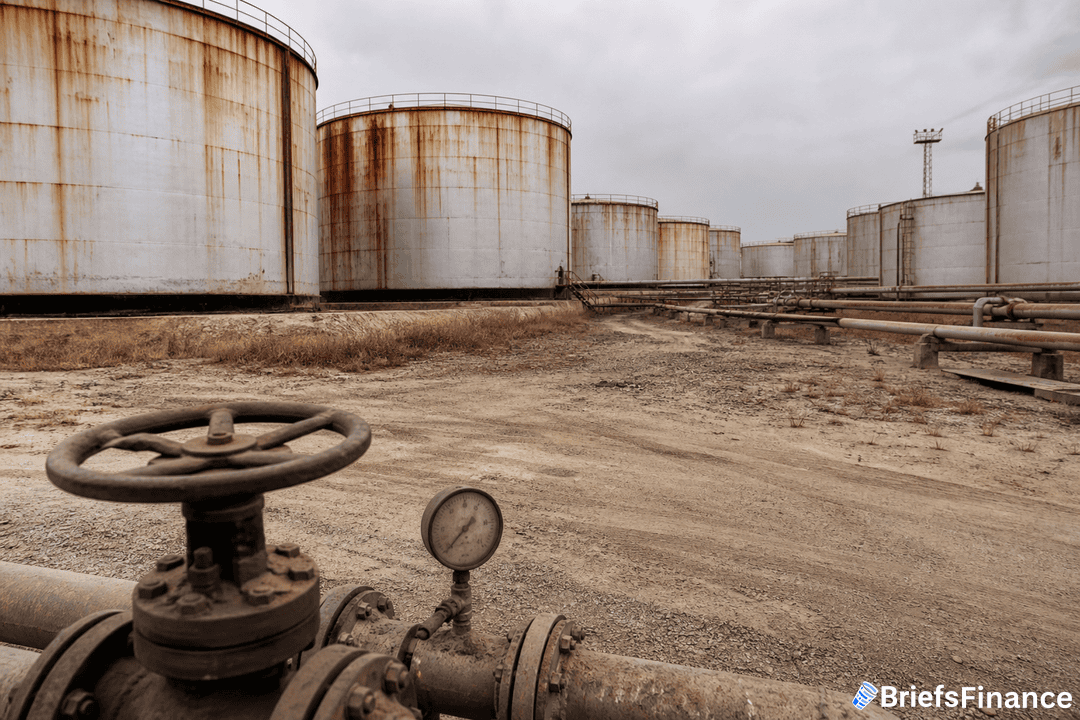
The Strategic Petroleum Reserve has dropped to roughly 250 million barrels, its lowest level in four decades.
Energy officials and outside experts disagree on the minimum safe operating level, with estimates ranging from 70 million to 300 million barrels.
Repeated drawdowns have raised concerns about the long-term structural integrity of the underground salt caverns that store the crude.
The nation's Strategic Petroleum Reserve has fallen to approximately 250 million barrels, its lowest point in 40 years, following a series of emergency sales and drawdowns. That decline has intensified scrutiny on the aging underground salt caverns in Louisiana and Texas that hold the crude, with questions mounting about how low the inventory can safely go before the storage system is compromised.
Energy Department officials say the reserve can continue operating at current levels, but they acknowledge there is a lower bound. According to department statements, the physical minimum required to keep brine pumps working and maintain cavern pressure is about 70 million barrels. Below that, the caverns could risk structural damage. However, officials stress that 70 million is not a practical target - it is an absolute floor, not a recommended operating level.
"The caverns are always full of either oil or water," said Energy Department spokesman Ben Dietz. "Changing the mix does not endanger their integrity." He added that the reserve is being managed responsibly as a national security asset, and that current inventories remain well above any danger point.
Yet not everyone agrees on where the safe threshold lies. Amos Hochstein, a senior energy adviser to President Biden, dismissed the 70 million figure as misleading. "Do not believe the people out of the government who say the SPR can go down to 70 million barrels," Hochstein told CNBC. "That's nonsense." He argued that the practical operational floor is much higher - closer to 250 million barrels - because below that level, the reserve would lose its ability to respond quickly to a major supply disruption.
Texas A&M petroleum engineering professor Siddharth Misra offered a middle view. He said the true minimum sits somewhere between 250 million and 300 million barrels, depending on how quickly the reserve might need to be drawn down in an emergency. "The physical minimum is 70 million, but operating at that level would be extremely risky," Misra explained. "You need a buffer to account for the rate of withdrawal, the condition of the caverns, and the time required to refill them." He noted that the caverns were originally designed for five full cycles of emptying and refilling, but after more than four decades of use, they have experienced significant wear.
A May report from the Government Accountability Office flagged those concerns. The report warned that repeated partial drawdowns can erode the salt walls, leaving irregular shapes that weaken the structural integrity of the caverns over time. While no immediate failure is expected, the GAO recommended that the Energy Department develop a long-term maintenance plan and consider whether the current drawdown strategy is sustainable.
The debate matters because the reserve remains a key tool for managing oil market shocks. Congress authorized several large sales in recent years, both to raise revenue and to counter price spikes following geopolitical events. Those sales have brought the inventory down from a peak of over 700 million barrels in 2010 to its current level. Refilling the reserve will take years and depends on oil prices staying low enough for the government to buy crude at a discount.
For now, officials say the reserve is safe and functional. But the gap between the physical minimum and the practical minimum - and the disagreement over where that line sits - underscores the delicate balance between using the reserve as a policy instrument and preserving it for genuine emergencies. As one analyst put it, the SPR is not just a storage facility; it is a strategic buffer. Pushing it too low could leave the nation vulnerable when it matters most.
The reserve was created in 1975 as a buffer against oil supply disruptions, and its design anticipated multiple full drawdowns and refills over several decades. But the recent pattern of repeated partial sales - often driven by budget needs rather than genuine emergencies - has accelerated the wear on the caverns. While the Department of Energy maintains that current operations remain safe, the combination of aging infrastructure, a shrinking inventory, and political pressure to use the reserve for non-emergency purposes has left the nation's energy safety net in a more fragile state than at any point since its early years.
Anthropic has gone public at a valuation of about $1.5 trillion, while Amazon went public in 1997 at around $440 million. Anthropic has about $33 billion in revenue this year and no profit, and investors are paying more than 40 times its sales, against about 3 times for Amazon. Briefs Finance CEO Jaspreet Singh says nobody knows what comes next, and that long-term investors use downturns to buy instead of panic selling.
Tech stocks are selling off because investors don't know who will lead Nvidia, the company that has been funding the AI industry and selling it chips.
Inflation has the Federal Reserve planning to raise interest rates, with a hike expected in December, and that puts pressure on homebuyers, private equity and the $40 trillion national debt.
Briefs Finance CEO Jaspreet Singh says nobody has a crystal ball, so his rules are to buy when markets are low, hold long term and invest only what you're willing to lose.
The national debt is above $40 trillion, and the Federal Reserve has gone from sending Washington its profits to losing money.
President Trump's four-part plan leans on shorter-term debt, stablecoin companies buying Treasuries, a bigger balance sheet and government stakes in private companies.
The goal is to outgrow the debt, not pay it off, so Jaspreet Singh points investors to the seven industries where Washington wants growth.
The Fed makes its next rate decision on December 9 and is now talking about jumbo interest rate hikes of 0.5%, though one in December looks unlikely.
Washington will pay a record $1.05 trillion in interest this year on $40 trillion of debt, and that debt resets at higher rates as the Fed hikes.
Jaspreet Singh's five moves are to pay down variable-rate debt, earn interest on your savings, know which stocks feel the pressure, look at value and hedge.
Margin debt, the money investors borrow to buy stocks, is at a record of around 4.6% of GDP, up from 3.9% in 2021.
ETF money has more than tripled in five years to 7% of GDP, while corporate buybacks and 401(k) money sit below their earlier peaks.
Margin calls and panic selling can make the next downturn deeper, so Jaspreet Singh keeps buying broad market funds and says most investors should skip margin debt.
Jensen Huang is out at Nvidia over affairs with multiple people, and the company he founded has been the bank of American AI, with about $30 billion into OpenAI and $10 billion into Anthropic.
A hotter-than-expected inflation report has Fed officials talking about a possible 0.5% hike in December, and gold, silver, and bitcoin fell on the news.
President Trump said the US may not need a deal with Iran, keeping oil prices and inflation risk high. Jaspreet Singh breaks down what it all means for AI stocks and your portfolio.
Stocks are booming at the fastest pace in years, jobless claims just hit a 57-year low, and most investors still feel like nobody is hiring.
The Fed is protecting the dollar over the economy, oil swings on every Iran headline, and a few AI companies are carrying an S&P 500 where four of five stocks sit in a correction.
Jaspreet Singh explains why circular financing between Nvidia, OpenAI, Anthropic, and SpaceX rhymes with 2008's house of cards, and how his three investing pillars handle a stock market bubble.
The Fed has raised rates, cut them, then raised them again only twice in the last 60 years, and both times the economy fell into a recession and stocks crashed.
The same stop-and-go cycle is playing out now, with one big difference: US debt is 125% of GDP today versus about 30% in 1980.
In the 1970s gold rose roughly 24x, real estate 157%, stocks lagged, and cash lost half its value. Jaspreet Singh lays out five assets to consider before the next flip.
The IRS 2027 tax plan keeps the same seven rates but widens every bracket and lifts the married-filing-jointly standard deduction to $33,200.
The 0% long-term capital gains bracket rises to $102,100, so a household living on $135,300 of investment income could owe $0 in federal income tax.
C corporations still pay 21%, small businesses keep the 20% QBI deduction, and the 401(k) limit climbs to $25,500 with an $8,500 catch-up for investors over 50.
Make sure to check your inbox for the first email.
Before you go
We’re hosting our first ever livestream on how investors can use ChatGPT & Claude to invest like a pro. It’s on 11/17 and is hosted by our CEO Jaspreet Singh.