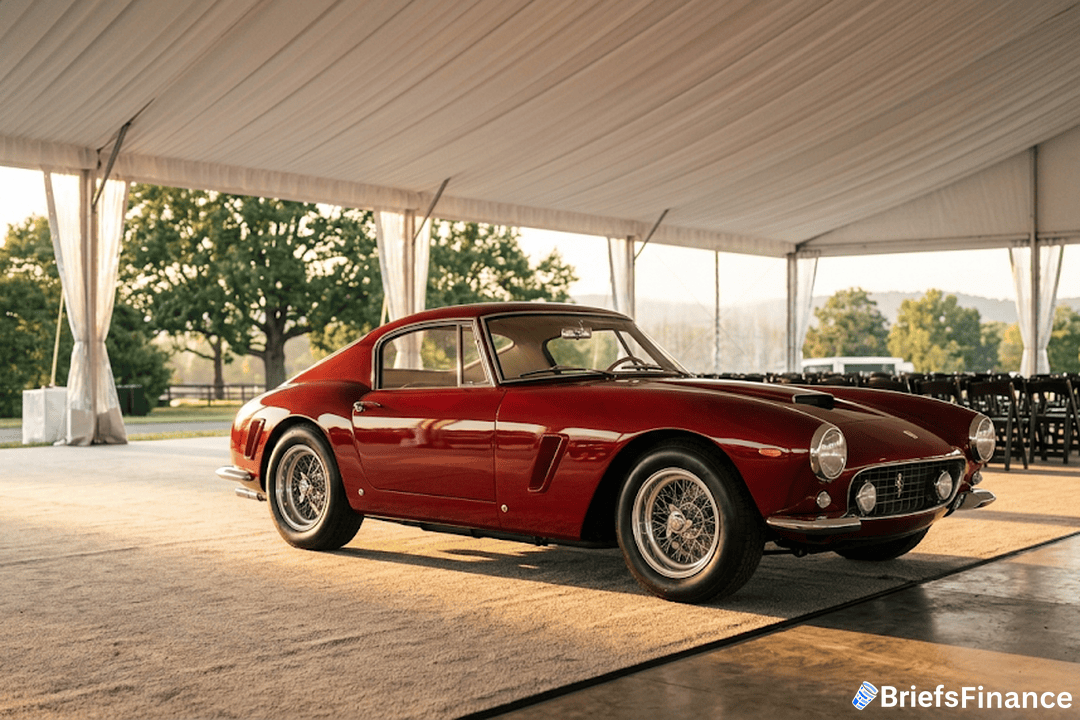
Hagerty projects Monterey Car Week auctions will bring in $470 million to $500 million, potentially topping the $471 million record set in 2022.
Millennial and Gen Z buyers are driving demand for 1990s and 2000s supercars instead of the 1950s and 1960s classics that once led sales.
Hagerty's Supercar Index rose 30% over the past year while its Blue Chip Index of traditional collectibles fell 2%.
The cars are shiny, the paddock is packed, and the money is flowing. Monterey Car Week kicks off Thursday, and the auction houses are expecting something they have never seen before: a half-billion-dollar week.
Hagerty, the company that tracks collector car values, projects the auctions taking place this week will bring in between $470 million and $500 million. That could exceed the previous yearly best of $471 million from 2022 and extend a recovery from the slow 2023 and 2024 seasons.
Younger Buyers Are Changing What Sells
Millennials and Gen Z have taken over as the dominant buying group, and they are chasing a very different kind of car than their parents did.
Instead of the 1950s and 1960s classics that used to dominate Monterey's top sellers, these buyers want the supercars they dreamed about growing up. We are talking Ferrari F40s, F50s and Enzos, Bugatti Veyrons, Ruf Yellowbirds, Koenigseggs and Paganis. Many of these cars have roughly doubled in price over the last two years.
The numbers tell the story. Hagerty's Blue Chip Index, which tracks traditional collector cars, fell 2% in the past 12 months. Its Supercar Index rose 30% in the same period. That is a massive gap, and it shows up in the auction results.
In March, a black 2003 Enzo brought $15.2 million at Broad Arrow's Amelia Island auction. A 2005 Porsche Carrera GT fetched $6.7 million, more than double its old auction record.
Hagerty CEO McKeel Hagerty summed up the mood simply: "All roads lead to Maranello." That is the home of Ferrari, and the data backs him up. Nine of the top 10 auction sales so far this year are Ferraris, and five of Monterey's top lots this week are also Ferraris.
The Modern Machines Are Crushing the Classics
The old guard is not going quietly, but it is going. Last year, a 1961 Ferrari 250 GT SWB California Spider Competizione was expected to be the top seller at Monterey with a $20 million estimate. It ended up selling for $25.3 million, which sounds great until you see what happened next.
The highest price at Monterey last year was $26 million for a brand-new 2025 Ferrari Daytona SP3. That car was expected to sell for about $3.5 million. It went for more than seven times its estimate, and it was not even a classic. It was a current model.
This year, RM Sotheby's expects the top lot to be a 1996 McLaren F1 GTR at about $35 million. A 2023 Ferrari Daytona SP3, estimated above $10 million, could crack the top 10. Gooding Christie's is offering a 1963 Ferrari 250 P with a $15 million estimate and a 1961 Ferrari 250 GT SWB Berlinetta Competizione with an $8 million estimate.
The catch: not everyone thinks these prices make sense. Simon Kidston, a classic car dealer and advisor, sees trouble brewing. "There is a huge amount of speculation in that part of the market," he said. "It's been very frothy and created some inexplicable price imbalances to anyone who has long-term experience in the market."
What This Means for Your Portfolio
If you own a modern supercar, you are probably feeling pretty good right now. If you are thinking about buying one, the math gets trickier.
Some industry veterans warn that modern supercar prices are unsustainable. They point to traditional metrics like proven race histories, scarcity, lasting value and worldwide appeal, and they argue today's hot cars do not measure up.
But there is another side. A black 1967 Ferrari 275 GTB/4 recently went to a 35-year-old tech founder who called it his dream car. Kidston told the story with a note of hope: "He said to me, 'This is my dream car.'"
"It's great to see new people coming into this market and loving these cars," Kidston added. "And some actually want to drive them."
Anthropic has gone public at a valuation of about $1.5 trillion, while Amazon went public in 1997 at around $440 million. Anthropic has about $33 billion in revenue this year and no profit, and investors are paying more than 40 times its sales, against about 3 times for Amazon. Briefs Finance CEO Jaspreet Singh says nobody knows what comes next, and that long-term investors use downturns to buy instead of panic selling.
Tech stocks are selling off because investors don't know who will lead Nvidia, the company that has been funding the AI industry and selling it chips.
Inflation has the Federal Reserve planning to raise interest rates, with a hike expected in December, and that puts pressure on homebuyers, private equity and the $40 trillion national debt.
Briefs Finance CEO Jaspreet Singh says nobody has a crystal ball, so his rules are to buy when markets are low, hold long term and invest only what you're willing to lose.
The national debt is above $40 trillion, and the Federal Reserve has gone from sending Washington its profits to losing money.
President Trump's four-part plan leans on shorter-term debt, stablecoin companies buying Treasuries, a bigger balance sheet and government stakes in private companies.
The goal is to outgrow the debt, not pay it off, so Jaspreet Singh points investors to the seven industries where Washington wants growth.
The Fed makes its next rate decision on December 9 and is now talking about jumbo interest rate hikes of 0.5%, though one in December looks unlikely.
Washington will pay a record $1.05 trillion in interest this year on $40 trillion of debt, and that debt resets at higher rates as the Fed hikes.
Jaspreet Singh's five moves are to pay down variable-rate debt, earn interest on your savings, know which stocks feel the pressure, look at value and hedge.
Margin debt, the money investors borrow to buy stocks, is at a record of around 4.6% of GDP, up from 3.9% in 2021.
ETF money has more than tripled in five years to 7% of GDP, while corporate buybacks and 401(k) money sit below their earlier peaks.
Margin calls and panic selling can make the next downturn deeper, so Jaspreet Singh keeps buying broad market funds and says most investors should skip margin debt.
Jensen Huang is out at Nvidia over affairs with multiple people, and the company he founded has been the bank of American AI, with about $30 billion into OpenAI and $10 billion into Anthropic.
A hotter-than-expected inflation report has Fed officials talking about a possible 0.5% hike in December, and gold, silver, and bitcoin fell on the news.
President Trump said the US may not need a deal with Iran, keeping oil prices and inflation risk high. Jaspreet Singh breaks down what it all means for AI stocks and your portfolio.
Stocks are booming at the fastest pace in years, jobless claims just hit a 57-year low, and most investors still feel like nobody is hiring.
The Fed is protecting the dollar over the economy, oil swings on every Iran headline, and a few AI companies are carrying an S&P 500 where four of five stocks sit in a correction.
Jaspreet Singh explains why circular financing between Nvidia, OpenAI, Anthropic, and SpaceX rhymes with 2008's house of cards, and how his three investing pillars handle a stock market bubble.
The Fed has raised rates, cut them, then raised them again only twice in the last 60 years, and both times the economy fell into a recession and stocks crashed.
The same stop-and-go cycle is playing out now, with one big difference: US debt is 125% of GDP today versus about 30% in 1980.
In the 1970s gold rose roughly 24x, real estate 157%, stocks lagged, and cash lost half its value. Jaspreet Singh lays out five assets to consider before the next flip.
The IRS 2027 tax plan keeps the same seven rates but widens every bracket and lifts the married-filing-jointly standard deduction to $33,200.
The 0% long-term capital gains bracket rises to $102,100, so a household living on $135,300 of investment income could owe $0 in federal income tax.
C corporations still pay 21%, small businesses keep the 20% QBI deduction, and the 401(k) limit climbs to $25,500 with an $8,500 catch-up for investors over 50.
Make sure to check your inbox for the first email.
Before you go
We’re hosting our first ever livestream on how investors can use ChatGPT & Claude to invest like a pro. It’s on 11/17 and is hosted by our CEO Jaspreet Singh.