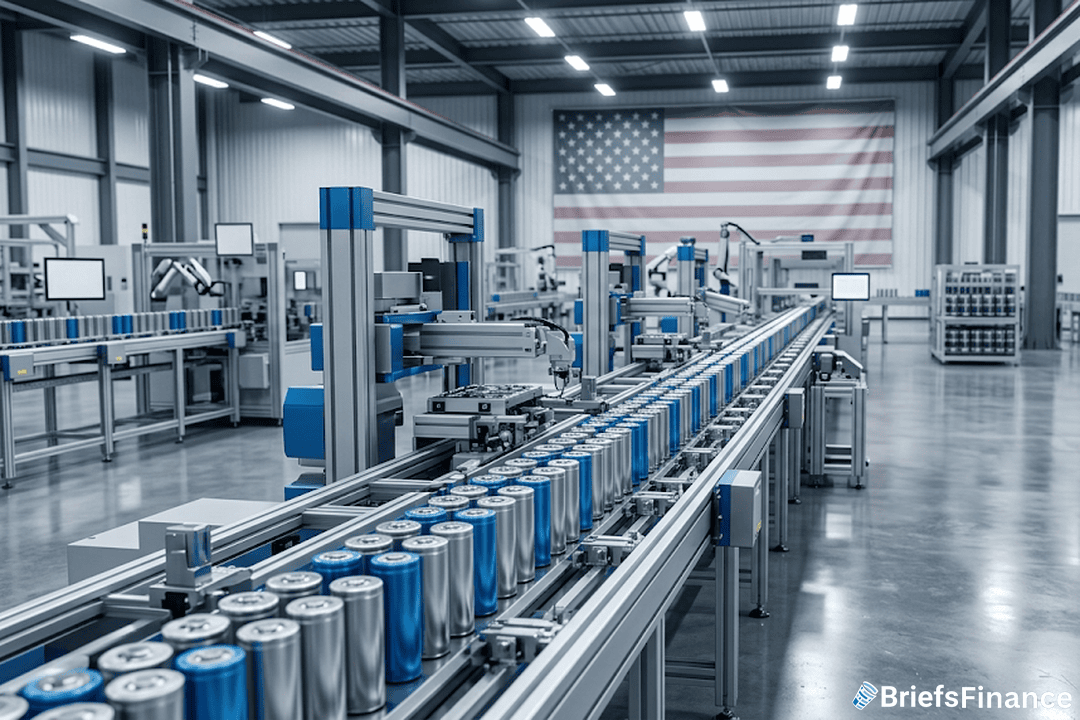
The Pentagon is lending $1.4 billion to Sila, a U.S. battery-materials company, to expand production of its silicon-carbon material.
Sila plans to scale its Washington factory fivefold, which would be enough material for more than 100,000 electric vehicles.
The same announcement included funding for three other companies working on scandium, magnets, and aluminum.
Why the Pentagon Is Putting Money Into Batteries
The U.S. military has a battery problem, and it is not the kind you can fix with a charger.
American buyers, from automakers to defense contractors, have struggled to find battery materials that are not made in China. That is a big deal because China dominates the supply chain for graphite, the standard material used in the negative end of a lithium-ion battery, known as the anode.
So on Friday, the Pentagon stepped in with a $1.4 billion loan to Sila, a U.S.-based company that makes a silicon-carbon alternative. The idea is simple: if the military and car companies want batteries without Chinese materials, somebody needs to build the factories to make them.
Sila's material replaces graphite with silicon, which can hold 20% to 40% more electric charge. That higher energy density means batteries could last longer, or they could shrink and get lighter. For drones, electric vehicles, and defense gear, that is a meaningful upgrade.
A Washington Factory Gets Much Bigger
Sila is not starting from scratch. Its Moses Lake, Washington, factory began operating in September and can already produce about 2 gigawatt-hours of material per year. For context, a gigawatt-hour is roughly enough electricity to power a small city for a day, so we are talking about a serious operation.
The company plans to expand that factory fivefold, which would give it enough material for more than 100,000 electric vehicles. That is still a fraction of what the global auto industry needs, but it is a real step toward a domestic supply chain.
Investors have already backed the expansion. In July, Sila raised $300 million in a funding round led by Atreides Management and Sutter Hill Ventures. PitchBook data shows the company has pulled in more than $1.5 billion in private funding so far, and it already has supply agreements with Mercedes and Panasonic.
The Pentagon loan could open another door. Defense contractors have been landing large deals as fighting continues in Iran and Ukraine, and having a Pentagon-backed battery supplier in the mix makes Sila a natural partner.
The Pentagon Spreads the Money Around
Sila was not the only company to get a check. The Defense Department funded three other businesses in the same announcement, each working on a different piece of the supply-chain puzzle.
Sunrise Energy Metals, an Australian miner, received a $400 million loan for scandium mining. Scandium is a rare-earth element used in lightweight alloys, which matters for aircraft and other military gear. Niron Magnetics, based in Minnesota, got a $150 million loan to make magnets without rare earths, which could go into phones, missiles, and electric motors. The government also took an $85 million equity stake in Strategic Bauxite, a miner of aluminum-bearing ore.
These investments reflect a broader shift in military thinking. For decades, the Pentagon relied on commercial markets for raw materials, assuming global trade would keep supply lines open. But recent disruptions - from trade wars to pandemic shutdowns - have exposed how fragile that assumption is. Now, the Defense Department is acting like a venture capitalist for critical minerals, seeding companies that can guarantee a domestic source for the metals and chemicals that go into everything from fighter jets to field radios.
Taken together, these deals show the Pentagon is thinking beyond just weapons and ammunition. It is building out the industrial base for critical materials, the same way it might stockpile fuel or spare parts.
The bottom line: For investors, this is a signal that government money is flowing into domestic battery materials in a serious way. That does not guarantee any single company will succeed, but it does mean the U.S. is willing to spend real cash to reduce its dependence on Chinese supply chains.
The bigger picture is about resilience. Whether it is an electric car, a drone, or a missile guidance system, everything runs on batteries. And the country that controls the materials controls the future. This loan is a bet that the U.S. wants to be in that game.
Anthropic has gone public at a valuation of about $1.5 trillion, while Amazon went public in 1997 at around $440 million. Anthropic has about $33 billion in revenue this year and no profit, and investors are paying more than 40 times its sales, against about 3 times for Amazon. Briefs Finance CEO Jaspreet Singh says nobody knows what comes next, and that long-term investors use downturns to buy instead of panic selling.
Tech stocks are selling off because investors don't know who will lead Nvidia, the company that has been funding the AI industry and selling it chips.
Inflation has the Federal Reserve planning to raise interest rates, with a hike expected in December, and that puts pressure on homebuyers, private equity and the $40 trillion national debt.
Briefs Finance CEO Jaspreet Singh says nobody has a crystal ball, so his rules are to buy when markets are low, hold long term and invest only what you're willing to lose.
The national debt is above $40 trillion, and the Federal Reserve has gone from sending Washington its profits to losing money.
President Trump's four-part plan leans on shorter-term debt, stablecoin companies buying Treasuries, a bigger balance sheet and government stakes in private companies.
The goal is to outgrow the debt, not pay it off, so Jaspreet Singh points investors to the seven industries where Washington wants growth.
The Fed makes its next rate decision on December 9 and is now talking about jumbo interest rate hikes of 0.5%, though one in December looks unlikely.
Washington will pay a record $1.05 trillion in interest this year on $40 trillion of debt, and that debt resets at higher rates as the Fed hikes.
Jaspreet Singh's five moves are to pay down variable-rate debt, earn interest on your savings, know which stocks feel the pressure, look at value and hedge.
Margin debt, the money investors borrow to buy stocks, is at a record of around 4.6% of GDP, up from 3.9% in 2021.
ETF money has more than tripled in five years to 7% of GDP, while corporate buybacks and 401(k) money sit below their earlier peaks.
Margin calls and panic selling can make the next downturn deeper, so Jaspreet Singh keeps buying broad market funds and says most investors should skip margin debt.
Jensen Huang is out at Nvidia over affairs with multiple people, and the company he founded has been the bank of American AI, with about $30 billion into OpenAI and $10 billion into Anthropic.
A hotter-than-expected inflation report has Fed officials talking about a possible 0.5% hike in December, and gold, silver, and bitcoin fell on the news.
President Trump said the US may not need a deal with Iran, keeping oil prices and inflation risk high. Jaspreet Singh breaks down what it all means for AI stocks and your portfolio.
Stocks are booming at the fastest pace in years, jobless claims just hit a 57-year low, and most investors still feel like nobody is hiring.
The Fed is protecting the dollar over the economy, oil swings on every Iran headline, and a few AI companies are carrying an S&P 500 where four of five stocks sit in a correction.
Jaspreet Singh explains why circular financing between Nvidia, OpenAI, Anthropic, and SpaceX rhymes with 2008's house of cards, and how his three investing pillars handle a stock market bubble.
The Fed has raised rates, cut them, then raised them again only twice in the last 60 years, and both times the economy fell into a recession and stocks crashed.
The same stop-and-go cycle is playing out now, with one big difference: US debt is 125% of GDP today versus about 30% in 1980.
In the 1970s gold rose roughly 24x, real estate 157%, stocks lagged, and cash lost half its value. Jaspreet Singh lays out five assets to consider before the next flip.
The IRS 2027 tax plan keeps the same seven rates but widens every bracket and lifts the married-filing-jointly standard deduction to $33,200.
The 0% long-term capital gains bracket rises to $102,100, so a household living on $135,300 of investment income could owe $0 in federal income tax.
C corporations still pay 21%, small businesses keep the 20% QBI deduction, and the 401(k) limit climbs to $25,500 with an $8,500 catch-up for investors over 50.
Make sure to check your inbox for the first email.
Before you go
We’re hosting our first ever livestream on how investors can use ChatGPT & Claude to invest like a pro. It’s on 11/17 and is hosted by our CEO Jaspreet Singh.