Free NewsletterPro Login
S&P 500 6,287 +0.42%
DOW 44,521 -0.18%
NASDAQ 21,103 +0.71%

Warning: Undefined variable $funds in /var/www/briefs.co/htdocs/wp-content/plugins/oxygen/component-framework/components/classes/code-block.class.php(133) : eval()'d code on line 491

Warning: foreach() argument must be of type array|object, null given in /var/www/briefs.co/htdocs/wp-content/plugins/oxygen/component-framework/components/classes/code-block.class.php(133) : eval()'d code on line 491
/* the link was here */
Home » Deep Briefs »  » What Is the Difference Between Stocks and Bonds?

What Is the Difference Between Stocks and Bonds?

Published: Feb 2, 2026 
Disclosure: Briefs Finance is not a broker-dealer or investment adviser. All content is general information and for educational purposes only, not individualized advice or recommendations to buy or sell any security. Investing involves significant risk, including possible loss of principal, and past performance does not guarantee future results. You are solely responsible for your investment decisions and should consult a licensed financial, legal, or tax professional before acting on any information provided.
Summary:

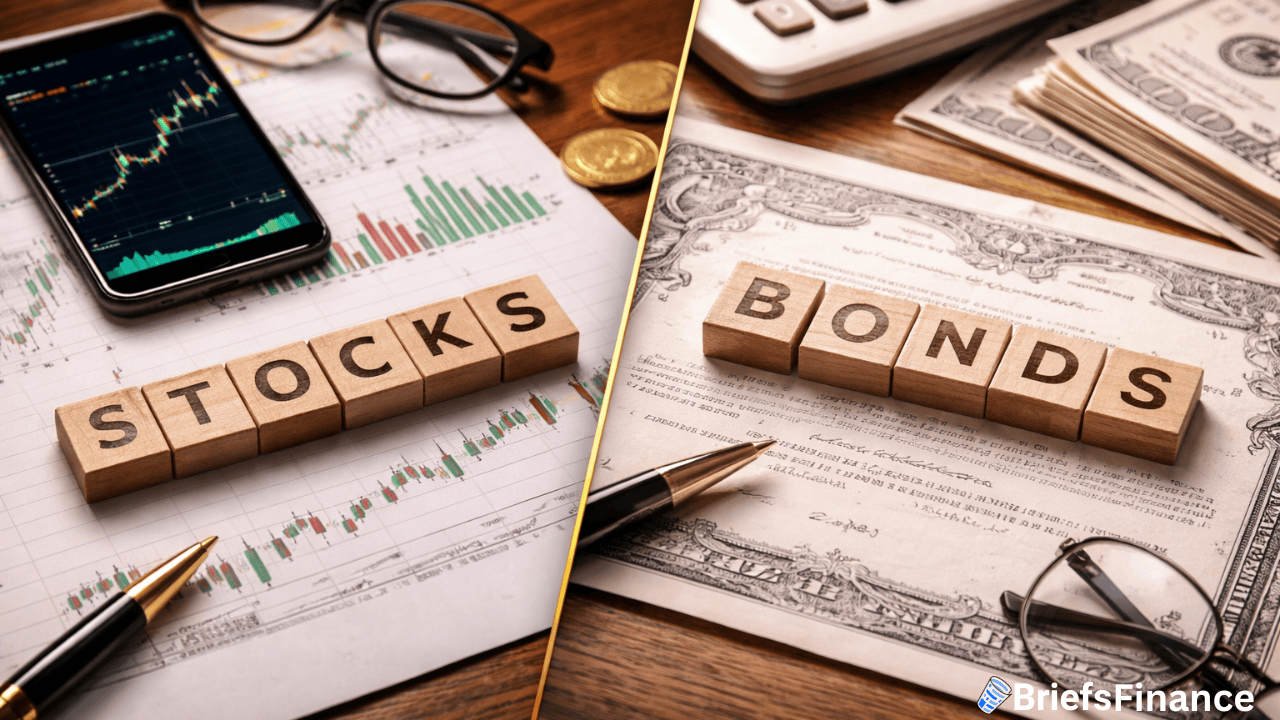
Stocks make you an owner of a company and bonds make you a lender to a company or government.

Stocks usually offer higher growth potential with more risk while bonds typically offer predictable income with lower risk.

Investors can choose one or choose a strategy that involves both.

There are lots of different tools investors use to build wealth.

Some love tangible things like real estate and gold.

Other investors might like paper assets like stocks and bonds.

But here's the thing: Understanding the difference between stocks and bonds isn't just cocktail party knowledge. 

Why? Because knowing the difference will help you determine what type of investor you’d like to be.

And once you know the difference - you can build a strategy and portfolio that works for you.

So let's break it down what each one is, the key differences, and the risks and returns of both.

Once you understand the difference between them, you can make the decision on which one you’d like to own.

We’re breaking down individual potential stock market opportunities every week in Market Briefs Pro.

These are stocks our analysts are watching right now - lean more and subscribe to Market Briefs Pro here.

What Are Stocks?

When you buy a stock, you're purchasing a security. A security represents ownership in a company.

This is a legal term,a s securities are regulated by the Securties and Exchange Commission (SEC).

Let's use McDonald's as an example. When you buy McDonald's stock, you own a tiny piece of McDonald's. The company's success directly impacts your investment's value.

A stock is considered an equity security. That’s just a fancy way of saying you have ownership in the asset.

Equity securities are:

  • Regulated by the SEC (Securities and Exchange Commission).
  • Subject to securities laws and disclosure requirements.
  • Valued based on company performance, earnings, and growth potential.
  • Income-producing through dividends (not every company has a dividend).
  • Backed by real companies with assets, employees, and operations.

How Stock Ownership Works

One stock = one share of ownership in a public company. That share lets you:

  • Participate in the company's growth - As McDonald's makes more money and performs better, you benefit as the share price goes up.
  • Vote in shareholder meetings - You have some say in company decisions (the more shares you own, the more say you have).
  • Potentially receive dividends - Some companies pay out a portion of their profits to shareholders regularly.

What else? You own the company on paper. You can't walk into a McDonald's location and tell employees to fix the ice cream machine. 

You don't manage the company day-to-day. You simply own it on paper and participate in its earnings.

Why Companies Sell Stock

Companies go public to raise money. When a company has its initial public offering (IPO), it's the first time that company and its shares are available to the public.

We've seen huge IPOs in the past, like Alibaba, who raised $21 billion in 2014.

Facebook (now Meta), Kraft, and UPS all went public to raise capital for growth.

How You Make Money with Stocks

You can get paid two ways:

1. Appreciation - The stock becomes more valuable as the company grows. If you buy Apple stock at $100 and it rises to $243, you've made money.

2. Dividends - Some companies pay out regular cash payments to shareholders, generally every quarter. 

Not every company pays dividends, but when they do, you get paid just for owning the stock.

What Are Bonds?

Bonds are debt instruments where you lend money to a government or corporation. They pay you interest at regular intervals and return your principal at maturity.

Think of it this way: When you buy a bond, you're the bank. Someone needs money, and you're lending it to them.

How Bonds Work

Let's say you buy a U.S. Treasury bond. That means you're literally loaning money to the United States government. 

In return:

  • The government pays you interest on a regular schedule.
  • At the end of the bond's term (maturity date), they give you back your original investment.

The same concept applies to corporate bonds. You loan money to a company like Apple or Coca-Cola, and they pay you interest until the bond matures.

Common Types of Bonds

U.S. Treasury bonds - Backed by the government, considered very safe.

Investment-grade corporate bonds - From financially strong companies.

Municipal bonds - Often tax-free, issued by state and local governments.

How You Make Money with Bonds

Bonds generate predictable income. If you buy a bond paying 3% interest, you'll receive that 3% annually (usually paid semi-annually) until the bond matures.

When the bond matures, you get your initial investment back.

The Key Differences Between Stocks and Bonds

FeatureStocksBonds
What You GetOwnership in a companyLoan to a company/government
Income TypeDividends (not guaranteed)Interest (fixed)
Return PotentialHigherLower
Risk LevelHigherLower
Regulatory BodySECSEC
Priority in BankruptcyLast in lineFirst in line
Voting RightsYesNo

Risk and Return: The Trade-Off

Stocks: Higher Risk, Higher Potential Reward

Stock prices can be volatile. They move up and down quickly because:

  • Markets are liquid - Anyone can buy and sell shares instantly.
  • They're easy to value - Anyone can open an app and buy stocks.
  • They can be manipulated - Company announcements or government news can swing prices dramatically

Historically though, stocks have delivered higher returns than bonds over the long term. Markets continue to rise despite multiple times where markets go down.

Bonds: Lower Risk, Predictable Income

Bonds offer very predictable income and lower risk than stocks. Benefits include:

  • Regular access to cash.
  • Protection against interest rate changes.
  • Predictable income.
  • Good for near-term needs.

But there are drawbacks:

  • Lower returns than stocks historically.
  • Vulnerable to inflation.
  • Interest rate risk (if rates rise, existing bonds lose value).

Investors consdiering bonds are usually doing so as a way to protect against a market downturn or gain steady income.

How to Invest in Stocks and Bonds

Buying Individual Stocks

Open a brokerage account and buy shares directly. You can start with any amount. Research companies, check their financials, and buy ownership.

Buying Stock ETFs

Exchange-traded funds let you invest in a basket of companies instead of picking individual stocks. Examples include:

  • VIG (Vanguard Dividend Appreciation ETF)
  • SCHD (Schwab U.S. Dividend Equity ETF)
  • SPY (tracks the S&P 500)

Buying Individual Bonds

You can buy Treasury bonds directly from TreasuryDirect.gov or corporate bonds through a brokerage account.

Buying Bond ETFs

Bond ETFs provide instant diversification across many bonds:

  • BND (Vanguard Total Bond Market ETF)
  • AGG (iShares Core U.S. Aggregate Bond ETF)
  • BNDX (Vanguard Total International Bond ETF)

Common Mistakes to Avoid With Stocks & Bonds

Mistake #1: Chasing high yields without research. High yields can be dangerous red flags. Companies often have high yields because the stock price has dropped or the dividend is unsustainable.

Mistake #2: Putting all your money in one asset type. If you'd put everything into energy stocks in 2020 when oil prices went negative, you'd have been devastated. Diversification is essential.

Mistake #3: Ignoring time horizon. Stocks are for long-term growth. Bonds are for stability and income. So they serve different purposes - decide which one makes more sense for you.

Mistake #4: Not rebalancing. If your stocks grow to 80% of your portfolio when your target is 70%, you may want to consider selling to get back on track. Rebalancing forces you to "sell high and buy low."

FAQs About Stocks and Bonds

Q: Are stocks riskier than bonds? Yes. Stocks have higher volatility but offer higher potential returns. Bonds provide predictable income but lower growth.

Q: Can I lose money with bonds? Yes. If interest rates rise, existing bond values fall. Also, if the company or government defaults, you could lose your principal.

Q: Should I invest in stocks or bonds first? Most financial advisors recommend a mix of both based on your age and risk tolerance. Younger investors typically hold more stocks. Older investors usually hold more bonds. Bot there’s no one size fits all approach. Do your own due diligence and make a decision that meets your investment goals and risk tolerance.

Q: Do bonds protect against inflation? Not all bonds. Fixed-rate bonds lose purchasing power during inflation. Treasury Inflation-Protected Securities (TIPS) are designed to protect against inflation.

Q: When should I sell stocks and buy bonds? Some investors choose bonds during a market crash or near retirement, since they’re focsued on income rather than growth. In the end, do what makes the most sense for you.

The Bottom Line On Stocks & Bonds

When you own a stock, you gain equity in that company, and are a partial owner.

If that company does well, your stock may appreciate in value - some stocks pay you a dividend just for owning it as well.

When you own a bond, you are are essentially a lneder to a government or company.

While they usually do not grow faster than stocks, they do provide income over time.

The bottom line: Find the right balance for your situation. Your age, risk tolerance, income needs, and time horizon should guide your allocation.

Some investors choose oe or the other while other investors like to have a balance of both. 

Both approaaches to stocks and bonds can work for certain investors, it just depends on if you’re looking for income, growth, or a little of both.

Want to find potential stock market investing opportunities? We’re breaking down a new market shift every week in Market Briefs Pro.

What’s that? Market Briefs Pro is our in-depth investing report that gives you all of the data and research you need to make smarter investment decisions.

Discover which stocks our analysts are watching by subscribing to Market Briefs Pro here.


Tag »

More Deep Briefs

What Is a Stop Loss Order? A Simple Guide

Best S&P 500 Index Fund: How to Choose One

What Are Penny Stocks? Risks and Rewards Explained

Best Stocks for Beginners With Little Money

Tech Stocks: A Simple Guide for New Investors

What Is a Joint Stock Company? A Simple Guide

Capital Gains Tax in California: A Simple Guide

Top Covered Call ETFs: How to Compare Them

What Are Stock Options? A Plain-English Guide

EBITDA Margin: What It Is and How to Calculate It

What Is Taxable Income? A Simple Guide for Investors

What Is a Covered Call? How the Strategy Works

What Is Gross Margin? A Simple Guide for Investors

What Is a Dividend? A Plain-English Guide for Investors

Financial Literacy Books That Actually Build Wealth

What Is a Roth Conversion? A Simple Guide

Trailing Stop Loss: How to Protect Your Gains

5 Types of Wealth: Why Money Is Only One of Them

How to Invest in Private Equity: A Beginner's Guide

What Is a Call Option? A Simple Guide With Examples

EBITDA Formula: How to Calculate It Step by Step

What Is a Stock Option? A Plain-English Guide

Put Option: What It Is and How It Works

Operating Margin: What It Is and How to Calculate It

Enterprise Value: What It Is and How to Calculate It

Free Cash Flow: What It Is and Why It Matters

What Is Working Capital? A Simple Guide for Investors

Covered Call: How This Income Strategy Actually Works

Gross Margin: What It Is and How to Calculate It

Backdoor Roth IRA: A Simple Guide for High Earners

Mega Backdoor Roth: A Simple Guide for Big Savers

Dividend Calculator: How to Estimate Your Dividend Income

How to Create Multiple Income Streams: A Beginner's Playbook

The 60/40 Portfolio Explained: A Beginner's Guide

How to Invest in Silver: A Beginner's Guide

Asset Allocation by Age: The Right Portfolio Mix at Every Stage of Life

Stablecoin Explained: Why Some Cryptocurrencies Actually Aren't Volatile

Buy Now, Pay Later Risks: Why This "Easy" Payment Method Is Dangerous to Your Wealth

Dividend Payout Ratio: The Secret Metric That Shows If a Stock Is Safe or Risky

Ethereum for Beginners: What It Is and Why Smart Investors Are Paying Attention

Dollar Cost Averaging Strategy: How to Beat Emotion and Build Wealth Steadily

The BRRRR Strategy: How to Build Real Estate Wealth Without Big Money Down

What Is GDP? A Beginner's Guide to Understanding Economic Growth

What Is Blockchain? A Plain English Guide For Investors

How To Negotiate Bills: The Script That Saves You Hundreds A Year

75 15 10 Rule: The Budget That Builds Wealth On Autopilot

How To Rebalance Portfolio: The Strategy That Forces You To Buy Low And Sell High

How To Buy Treasury Bonds: A Beginner's Guide

Forward Vs Futures Contracts: What's The Real Difference?

Alternative Investments Explained: What They Are And Why They Matter

How To Buy Bitcoin For Beginners: 3 Simple Ways

How To Follow Smart Money: The 5 Market Shifts Framework

Insider Trading Meaning: What It Really Is (And Why Some Of It Is Legal)

Core-Satellite Portfolio: The Best of Both Worlds

Bond Ladder Strategy: The Income Plan With Built-In Flexibility

Silver vs Gold Investing: Which One Belongs in Your Portfolio?

What Is a Dividend Reinvestment Plan? The Wealth Snowball Explained

How Tariffs Affect the Stock Market

What Is a 13F Filing? The Smart Money Tracker

Debt-to-Equity Ratio: The Number That Tells You If a Company Is Drowning

Non-Financial Analysis of Stocks: The 4-Step Method

SEC EDGAR Tutorial: The Free Tool the Pros Use

How to Read a 10-Q (Without Losing Your Mind)

What Is a Put Option? A Simple Guide for Investors

What Is Free Cash Flow? How To Find It & Why It's Important

Non Taxable Income: What It Is and Why Investors Care

Nasdaq Index Fund: A Beginner's Guide to Investing in the Nasdaq 100

What Is Wealth? It's Not What Most People Think

Micron Stock: The AI Memory Play Most Investors Are Missing

What Is Working Capital? What Investors Need To Know

What Is a Meme Stock? A Simple Guide for New Investors

Enterprise Value Formula: What It Is and How to Calculate It

Return on Equity: What It Is and How to Use It

Personal Finance Books That Actually Teach You to Build Wealth

How to Reduce Taxable Income: 6 Strategies Investors Actually Use

What Is a High-Yield Savings Account - and Is It Worth It?

Best Stocks to Buy Now: A Smarter Way to Think About It

How to Avoid Capital Gains Tax: 7 Legal Strategies Every Investor Should Know

How to Read a Balance Sheet (And Why Every Investor Should Know How)

What Is a Stock Broker? A Simple Guide for New Investors

Most Volatile Stocks: What They Are and Why They Move

ETF vs Mutual Fund - What's the Difference and Which One Should You Pick?

Nuclear Energy Stocks: Why Smart Money Is Betting on AI's Power Problem

What Is a Stock Symbol? Real Examples & How To Find One

SNDK Stock: The AI Play Most Investors Forgot About

What Is a 401k? Here's What You Actually Need to Know

Call vs. Put Options: What's the Difference and How Do They Work?

What Is Financial Literacy? The Real Skills That Build Wealth

How to Invest in Gold - 3 Simple Ways to Get Started

What Is a Dividend? What Beginner Investors Need To Know

What Time Does the Stock Market Open?

How to Buy Stocks: The 5-Step Plan To Stock Market Investing

What Is EBITDA? A Simple Guide for Investors

RDW Stock: Is Redwire Worth Watching in 2026?

How to Invest in the Nasdaq (Without Picking a Single Stock)

What Is a Cash Flow Statement? (And Why Investors Should Actually Care About It)

How to Retire a Millionaire: The 6 Step Plan For Investors

11 Ways to (Legally) Pay Less Taxes

MO Stock: The Dividend Stock The Market May Be Missing

How Much Should You Invest in Stocks? Here's Your Actual Answer

1 2 3

Get Market Briefs delivered to your inbox every morning for free!

No fluff. No noise. No politics. Just finance news you can read in 5 minutes.


Join Free

Blogs

June 29, 2026
Portfolio Diversification: Why Putting All Your Eggs in One Basket Destroys Wealth
  • Real diversification means spreading investments across all 11 economic sectors plus bonds, alternatives, and cash so no single bet can sink the portfolio.
  • Different sectors perform at different times, so a diversified portfolio captures upswings while smoothing the brutal drawdowns that wipe out concentrated bets.
  • Total market index funds offer the simplest path to diversification, and annual rebalancing is what keeps the structure working over time.
Read More
June 29, 2026
Non Taxable Income: What It Is and Why It Matters
  • Non taxable income is money you receive that you don't owe income tax on.
  • The tax code treats workers, investors, and business owners very differently, and investors often come out ahead.
  • Learning how income is taxed is a quiet superpower for keeping more of what you earn.
Read More
June 29, 2026
Semiconductor Stocks: A Simple Guide for Investors
  • Semiconductor stocks are companies that design and make computer chips, the brains inside nearly every modern device.
  • The AI boom has turned chips into one of the market's most important and most watched groups.
  • They offer big growth potential, but come with high valuations and a notoriously cyclical history.
Read More
June 25, 2026
How Stocks Work: A Simple Guide for Beginners
  • A stock is a slice of ownership in a company - buy one, and you own a piece of the business.
  • You make money two ways: the share price rising over time, and dividends paid to shareholders.
  • The simplest path for most beginners is buying into the whole market through a low-cost index fund.
Read More
June 25, 2026
Stop Loss vs Stop Limit: What's the Difference?
  • A stop loss order sells your stock once it hits a trigger price, prioritizing getting you out.
  • A stop limit order only sells within a price range you set, prioritizing price over a guaranteed exit.
  • The trade-off: a stop loss almost always executes; a stop limit might not if the price moves too fast.
Read More
June 25, 2026
Energy Stocks: A Simple Guide for Investors
  • Energy stocks are companies that produce and supply the power the world runs on, from oil and gas to newer sources.
  • They make up one of the 11 sectors of the market and tend to move with energy prices and big-picture shifts.
  • Like any sector, the key is diversification and understanding the forces driving demand.
Read More
June 18, 2026
What Is a Stop Loss Order? A Simple Guide
  • A stop loss order automatically sells a stock once it falls to a price you set.
  • It's a tool to cap losses or lock in gains without watching the market all day.
  • It works best for active strategies, and can backfire if used carelessly on long-term holdings.
Read More
June 18, 2026
Best S&P 500 Index Fund: How to Choose One
  • The best S&P 500 index fund for most investors is simply the cheapest, most established one that tracks the index well.
  • Funds like VOO, IVV, and SPY all hold the same 500 companies, so the biggest difference is the fee.
  • Pick one, automate your buys, and let time do the heavy lifting.
Read More
June 17, 2026
What Are Penny Stocks? Risks and Rewards Explained
  • Penny stocks are very low-priced shares of very small companies, often trading for just a few dollars or less.
  • They promise huge gains but carry huge risks: low liquidity, high failure rates, and wild price swings.
  • Most investors are better served by quality companies and funds than by chasing cheap shares.
Read More
June 17, 2026
Best Stocks for Beginners With Little Money
  • The best stocks for beginners with little money usually aren't individual stocks at all - they're low-cost index funds.
  • You can start with $100 or less and use small, regular investments to build wealth over time.
  • Focus on diversification and consistency, not on picking the next big winner.
Read More
1 2 3 24
Share via
Copy link