Warning: Undefined variable $stocks in /var/www/briefs.co/htdocs/wp-content/plugins/oxygen/component-framework/components/classes/code-block.class.php(133) : eval()'d code on line 448
Warning: foreach() argument must be of type array|object, null given in /var/www/briefs.co/htdocs/wp-content/plugins/oxygen/component-framework/components/classes/code-block.class.php(133) : eval()'d code on line 448
Warning: Undefined variable $funds in /var/www/briefs.co/htdocs/wp-content/plugins/oxygen/component-framework/components/classes/code-block.class.php(133) : eval()'d code on line 472
Warning: foreach() argument must be of type array|object, null given in /var/www/briefs.co/htdocs/wp-content/plugins/oxygen/component-framework/components/classes/code-block.class.php(133) : eval()'d code on line 472
/* the link was here */
×
Free investor livestream — Nov 17
How To Use ChatGPT & Claude To Research Stocks Like A Pro
Businesses invested over £11 billion ($15 billion) in UK digital infrastructure in the latest year, driven by AI data center demand.
The number of UK data centers grew by more than 400% between 2000 and 2024.
More than a third of UK firms with 10 or more employees now use AI, up from 12% in 2023.
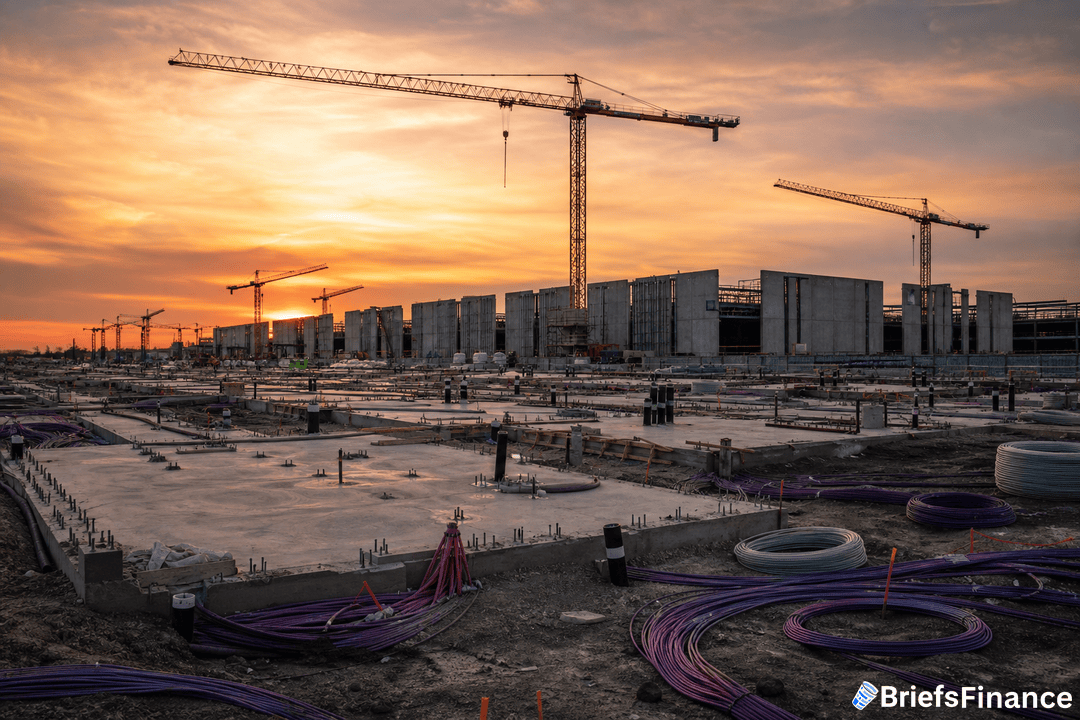
Something unusual is happening inside Britain's data centers, and the money piling into them looks like the year 2000.
The Office for National Statistics revised how it counts this kind of spending, and the new figures tell a much bigger story. Investment activity in 2024 and 2025 reached more than twice the levels recorded a decade prior, climbing back to peaks not seen since the dot-com boom.
According to the ONS, the change shows how data centers have become a crucial part of the country's digital backbone, driven by surging needs for AI, cloud services, and data storage. The revised totals are much higher than initial estimates, which used a narrower methodology.
The UK has long been a hub for data hosting, with the country itself serving as a major connectivity point. But the recent acceleration is tied directly to the explosion of generative AI, which requires massive parallel processing and high-speed data transfer. This shift has transformed data centers from simple storage facilities into power-hungry computing hubs, prompting a wave of new construction across the nation.
AI's compute requirements are met inside data centers, which house the necessary servers and power systems. Building out these facilities is essential for AI, as it demands vast computing and storage resources.
The previous methodology captured only a fraction of the true scale. Under the old counting system, much of the spending on servers, cooling, and networking equipment was classified as different, obscuring how rapidly the sector was expanding. The updated approach now recognizes that these facilities function as critical national infrastructure, similar to how earlier eras treated railways or the electricity grid. This reclassification matters because it gives policymakers and investors a clearer picture of where the economy is heading and which sectors are attracting serious capital.
The economic significance of this shift is profound. Data centers are no longer just storage warehouses; they are major consumers of energy and water, and their construction has ripple effects across construction, engineering, and power generation. As the ONS data shows, the scale of investment is not a statistical blip but a genuine structural change in the economy.
This surge has sparked worries about pressure on resources like energy and water. Bank of England Governor Andrew Bailey has warned that AI may need to be rationed, saying, "a lack of energy capacity will restrain the ability for every economic sector to deploy the technology."
The parallels to the late 1990s are hard to ignore. Back then, telecommunications companies laid fiber optic cable across the country at breakneck speed, betting that internet traffic would explode. Some of those bets paid off handsomely; many others ended in bankruptcy when the bubble burst.
Today's data center developers are making similar wagers on AI's growth trajectory, and the stakes are just as high. The difference is that AI adoption among businesses is already measurable and growing quickly, rather than being purely speculative. Still, the energy constraints Bailey highlighted could prove to be the bottleneck that separates sustainable growth from overbuilding.
What It Means for Investors
The revised figures suggest the UK is in the middle of a genuine infrastructure boom, not just a statistical anomaly. For investors, this means opportunities in construction, power generation, and cooling technology companies that support data centers. But it also carries risk.
If energy capacity cannot keep pace with construction, some projects may sit idle or operate below capacity, hurting returns. The dot-com comparison cuts both ways: it signals enormous potential, but also the possibility of overbuilding if the underlying demand assumptions prove too optimistic.
Anthropic has gone public at a valuation of about $1.5 trillion, while Amazon went public in 1997 at around $440 million. Anthropic has about $33 billion in revenue this year and no profit, and investors are paying more than 40 times its sales, against about 3 times for Amazon. Briefs Finance CEO Jaspreet Singh says nobody knows what comes next, and that long-term investors use downturns to buy instead of panic selling.
Tech stocks are selling off because investors don't know who will lead Nvidia, the company that has been funding the AI industry and selling it chips.
Inflation has the Federal Reserve planning to raise interest rates, with a hike expected in December, and that puts pressure on homebuyers, private equity and the $40 trillion national debt.
Briefs Finance CEO Jaspreet Singh says nobody has a crystal ball, so his rules are to buy when markets are low, hold long term and invest only what you're willing to lose.
The national debt is above $40 trillion, and the Federal Reserve has gone from sending Washington its profits to losing money.
President Trump's four-part plan leans on shorter-term debt, stablecoin companies buying Treasuries, a bigger balance sheet and government stakes in private companies.
The goal is to outgrow the debt, not pay it off, so Jaspreet Singh points investors to the seven industries where Washington wants growth.
The Fed makes its next rate decision on December 9 and is now talking about jumbo interest rate hikes of 0.5%, though one in December looks unlikely.
Washington will pay a record $1.05 trillion in interest this year on $40 trillion of debt, and that debt resets at higher rates as the Fed hikes.
Jaspreet Singh's five moves are to pay down variable-rate debt, earn interest on your savings, know which stocks feel the pressure, look at value and hedge.
Margin debt, the money investors borrow to buy stocks, is at a record of around 4.6% of GDP, up from 3.9% in 2021.
ETF money has more than tripled in five years to 7% of GDP, while corporate buybacks and 401(k) money sit below their earlier peaks.
Margin calls and panic selling can make the next downturn deeper, so Jaspreet Singh keeps buying broad market funds and says most investors should skip margin debt.
Jensen Huang is out at Nvidia over affairs with multiple people, and the company he founded has been the bank of American AI, with about $30 billion into OpenAI and $10 billion into Anthropic.
A hotter-than-expected inflation report has Fed officials talking about a possible 0.5% hike in December, and gold, silver, and bitcoin fell on the news.
President Trump said the US may not need a deal with Iran, keeping oil prices and inflation risk high. Jaspreet Singh breaks down what it all means for AI stocks and your portfolio.
Stocks are booming at the fastest pace in years, jobless claims just hit a 57-year low, and most investors still feel like nobody is hiring.
The Fed is protecting the dollar over the economy, oil swings on every Iran headline, and a few AI companies are carrying an S&P 500 where four of five stocks sit in a correction.
Jaspreet Singh explains why circular financing between Nvidia, OpenAI, Anthropic, and SpaceX rhymes with 2008's house of cards, and how his three investing pillars handle a stock market bubble.
The Fed has raised rates, cut them, then raised them again only twice in the last 60 years, and both times the economy fell into a recession and stocks crashed.
The same stop-and-go cycle is playing out now, with one big difference: US debt is 125% of GDP today versus about 30% in 1980.
In the 1970s gold rose roughly 24x, real estate 157%, stocks lagged, and cash lost half its value. Jaspreet Singh lays out five assets to consider before the next flip.
The IRS 2027 tax plan keeps the same seven rates but widens every bracket and lifts the married-filing-jointly standard deduction to $33,200.
The 0% long-term capital gains bracket rises to $102,100, so a household living on $135,300 of investment income could owe $0 in federal income tax.
C corporations still pay 21%, small businesses keep the 20% QBI deduction, and the 401(k) limit climbs to $25,500 with an $8,500 catch-up for investors over 50.
Make sure to check your inbox for the first email.
Before you go
We’re hosting our first ever livestream on how investors can use ChatGPT & Claude to invest like a pro. It’s on 11/17 and is hosted by our CEO Jaspreet Singh.