You check your portfolio one morning and see red everywhere. […]

A lower tariff rate sounds like relief for importers. For most of them, it won't be.
The White House is getting ready to rewrite the rules on how finished goods made with foreign steel and aluminum get taxed. An announcement could come within days.
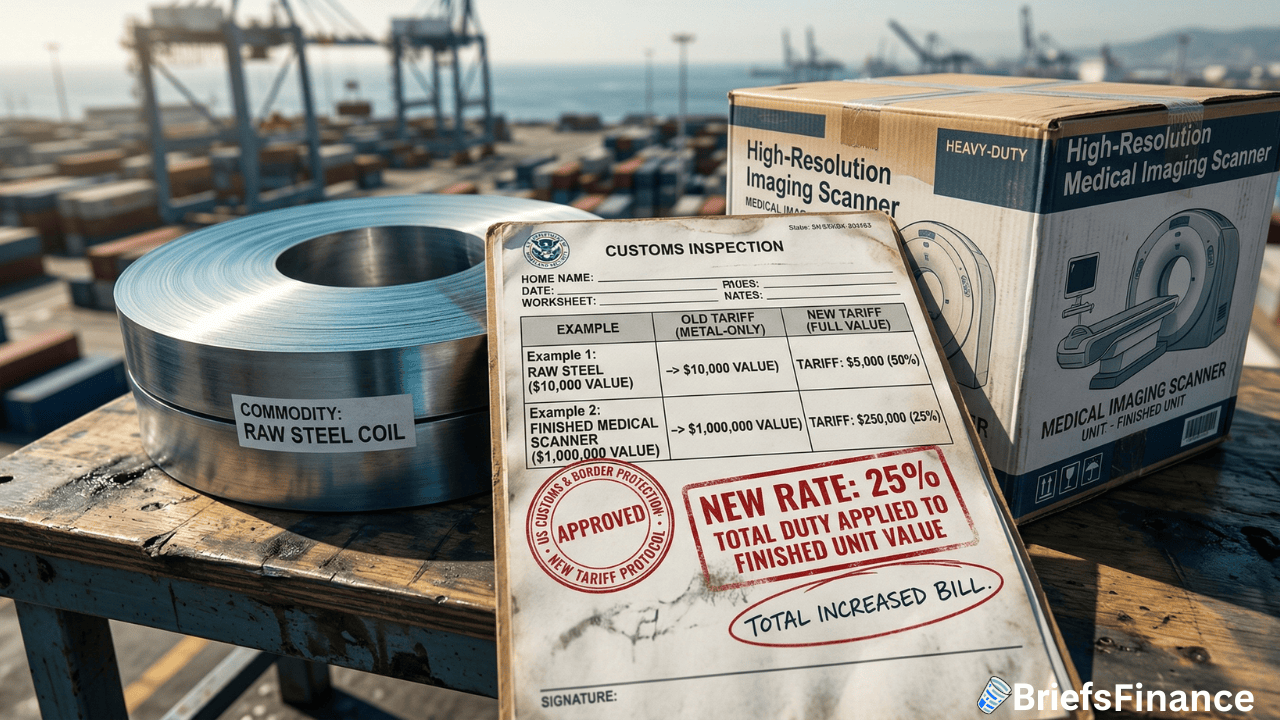
Right now, a finished product containing imported steel or aluminum gets hit with a 50% duty - but only on the value of the metal itself.
So if you import a $100 piece of equipment with $20 worth of steel inside it, you pay 50% of that $20. That's $10.
Under the new system, that same product would face a 25% tariff on its full $100 price tag. That's $25 - more than double what the old rate cost.
The rate goes down. The bill goes up.
The existing setup has created major problems for companies trying to stay compliant. Pinpointing exactly how much metal sits inside a finished product - anything from car parts to medical equipment - has been a costly guessing game for importers and customs officials.
One case that surfaced in internal discussions: dental floss. There's a tiny metal blade for cutting, but the rest of the product has no steel or aluminum at all.
Trying to calculate a metal-based tariff on something like that was a dead end.
The fix is straightforward - tax the whole product instead of hunting for the metal inside it. Products where steel and aluminum make up less than 15% of the total would owe nothing under the new setup.
Jon Toomey, who leads the Coalition for a Prosperous America - a group representing domestic steel and aluminum producers - said the overhaul should make these tariffs work the way they were designed: backing American manufacturing and its workforce.
This isn't just a trade policy tweak. It's a revenue play.
The federal government has been pulling in less tariff money since the Supreme Court knocked down several of Trump's country-specific trade penalties earlier this year. Broadening the base for steel and aluminum duties could help plug part of that hole.
Wall Street picked up on the shift fast. Alcoa and Century Aluminum both slid more than 1.5% after the closing bell, and Commercial Metals dropped roughly 1.4%.
Commodity-grade steel and aluminum still carry their 50% rate. Finished goods get a lower percentage on a much bigger number.
The bottom line lower rates = higher rates.
You check your portfolio one morning and see red everywhere. […]
Investing is not a one size fits all approach. Some […]
Everyone with an internet connection is using AI to better […]
You just opened your first brokerage account and you’re ready […]
Everyone knows AI needs chips. For a while, investment dollars […]
When you get your first, “real” job, it often comes […]
Most investors hear the word "options" and picture a Wall […]
Most of us grew up being taught the same thing: […]
Gold has been around longer than any stock market, any […]
Most people think the only way to make money in […]