Pro Login

The Corporate Bitcoin Bet Is Falling Apart. The Companies That Loaded Up Are Cashing Out.

Published Apr 2, 2026
Share:
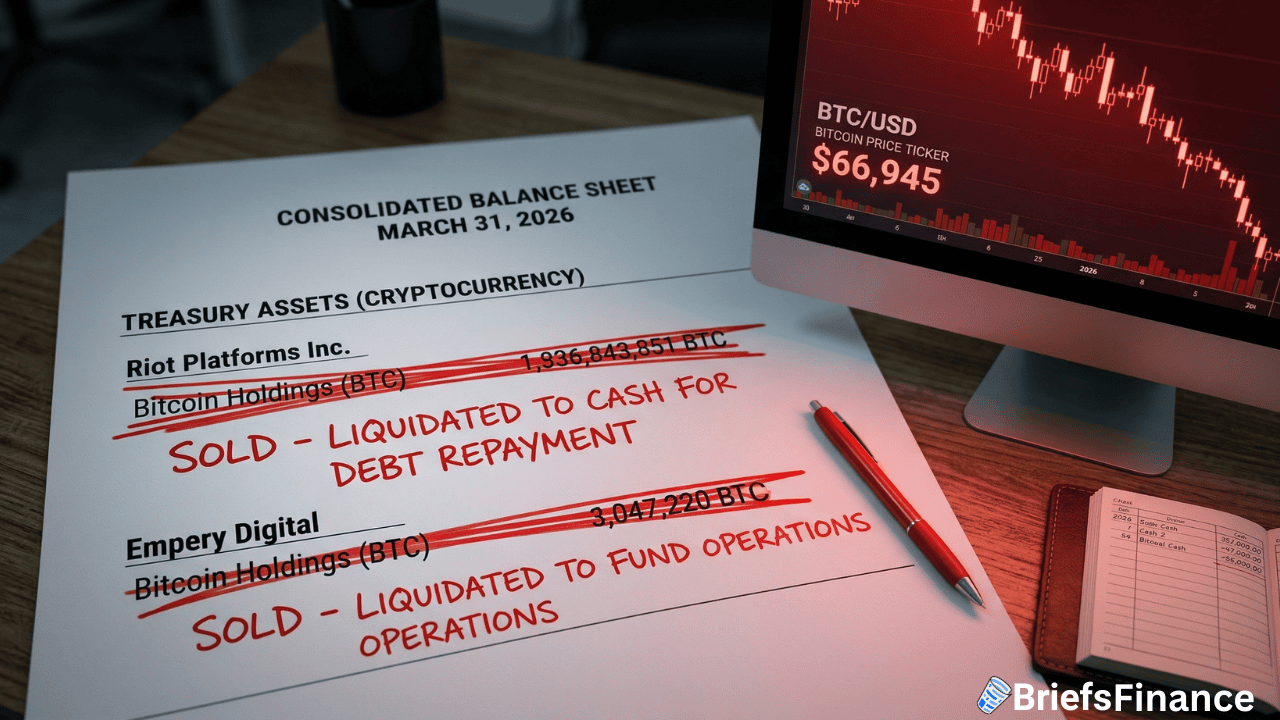
A balance sheet displays Corporate Bitcoin holdings for two companies cashing out to repay debt and fund operations, with a BTC price chart and $66,945 in the background.
Summary:
  • Several public companies sold off bitcoin this week to cover debt and fund new business plans, reversing the treasury strategy that took off in 2024 and 2025.
  • Bitcoin fell below $67,000 on Thursday as fears over the Iran conflict added pressure to an already weak market.
  • The CoinDesk 20 index dropped 4.5%, with all 20 tokens finishing in the red.

Two years ago, the playbook was simple. Buy bitcoin. Put it on your balance sheet. Watch your stock price rise.

That trade is running in reverse now.

This week alone, at least three public companies hit the sell button on their bitcoin stashes. They're not selling because they want to - they're selling because they have to.

The Exits Are Getting Crowded

Empery Digital dumped 370 coins on Wednesday for about $24.7 million. The company used the cash to pay off its term loan entirely and unlock roughly 1,800 coins that were tied up as security on the debt.

Empery's stock is down 75% from its peak last year. It stacked up close to 4,000 coins after it started buying in mid-2025. That bet hasn't paid off.

Genius Group went even further. The AI-focused education company unloaded its final 84 coins and put all of it toward an $8.5 million debt tab.

At one point last year, Genius held 440 bitcoin. Now it holds zero.

Then there's Riot Platforms - a major name in the bitcoin mining business. Riot shifted 500 coins off its books on Wednesday, a move worth around $34 million according to on-chain data.

Riot has been tapping its holdings for months, selling roughly $200 million worth in late 2025 to help fund its push into AI and high-performance computing.

Governments Are Selling Too

It's not just companies. Bhutan - whose government stacked more than 13,000 coins over several years by running its own mining rigs - has sold more than 3,100 bitcoin.

One sale on March 30 alone moved 375 coins. When a government that mined its own bitcoin starts cashing out, confidence isn't the problem. It's gone.

Where Things Sit Now

Bitcoin slipped under $67,000 on Thursday morning. The trigger: President Trump promising a fast, forceful military response against Iran over the coming weeks.

Crypto tends to sell off when the world feels less stable. The broader market reflected the same pain.

The CoinDesk 20 - an index tracking the top 20 tokens - fell 4.5% with every single coin in the red. Solana dropped nearly 7%. Uniswap lost close to 8%.

Public companies still hold about 1.16 million bitcoin altogether - roughly one out of every twenty coins that will ever be mined.

Worth Noting

The companies selling this week aren't panic-dumping. They're covering loans, paying down debt, and funding new strategies.

But the pattern is clear - the corporate bitcoin bet was built on rising prices, and falling prices are pulling it apart.

The ones who bought bitcoin to look smart are now selling it to stay alive.
Disclosure

Get Market Briefs delivered to your inbox every morning for free!

No fluff. No noise. No politics. Just finance news you can read in 5 minutes.

Blogs

April 15, 2026
What Is a Put Option? A Simple Guide for Investors
  • A put option is a contract that gives you the right to sell a stock at a set price before a set date.
  • Investors use put options to protect their portfolio against losses or to profit when they think a stock will drop.
  • The most you can lose when buying a put option is the premium you paid for the contract.
Read More
April 13, 2026
What Is Free Cash Flow? How To Find It & Why It's Important
  • Free cash flow is the cash a company has left after paying its bills and putting money back into the business.
  • Investors use free cash flow to figure out what a company is really worth - and if the stock is a good deal.
  • You can find free cash flow on a company's cash flow report, one of three key reports every public company files.
Read More
April 13, 2026
Non Taxable Income: What It Is and Why Investors Care

Non taxable income is money you earn that the IRS does not tax - like Roth IRA cash, muni bond interest, and certain investment gains. The U.S. tax code taxes workers, investors, and business owners at very different rates. Tools like Roth accounts, muni bonds, and real estate write-offs can help you keep more of what you earn.

Read More
April 11, 2026
Nasdaq Index Fund: A Beginner's Guide to Investing in the Nasdaq 100
  • A Nasdaq index fund lets you invest in the 100 biggest non-bank companies on the stock market all at once.
  • You can access the Nasdaq through index funds, mutual funds, or ETFs like QQQ - each with its own fees, trading rules, and style.
  • Picking the right Nasdaq index fund comes down to three things: who runs it, what is in it, and what it costs.
Read More
April 11, 2026
What Is Wealth? It's Not What Most People Think
  • Wealth is about owning assets that grow and pay you - not just earning a high salary.
  • In a capitalist system, there are two ways to get paid: from your labor and from your capital.
  • Building wealth takes a shift in mindset, a money system, and the habit of investing before you spend.
Read More
April 10, 2026
Micron Stock: The AI Memory Play Most Investors Are Missing
  • Micron (MU) is the only U.S. company that makes HBM chips - the short-term memory layer that AI systems need to run.
  • By early 2026, data centers were using about 70% of all memory chips made in the world, creating an 18-month backlog for new orders.
  • Micron's DRAM - or short-term memory chip - revenue jumped 69% year over year, and the company shifted away from consumer products to focus almost entirely on AI.
Read More
April 10, 2026
What Is Working Capital? What Investors Need To Know
  • Working capital is current assets minus current liabilities - it shows if a business can pay its short-term bills.
  • You find it on a company's balance sheet inside its 10-K report.
  • Changes in working capital show up on the cash flow statement and affect how much cash a business really makes.
Read More
April 9, 2026
What Is a Meme Stock? A Simple Guide for New Investors

You've probably heard the term "meme stock" thrown around on […]

Read More
April 9, 2026
Enterprise Value Formula: What It Is and How to Calculate It
  • Enterprise value (EV) shows what a company is really worth - debt and cash included - not just its stock price
  • The enterprise value formula is: Market Cap + Total Debt - Cash and Cash Equivalents
  • Investors use EV with metrics like EBITDA to compare stocks more fairly than market cap alone
Read More
April 8, 2026
Return on Equity: What It Is and How to Use It
  • Return on equity (ROE) measures how much profit a company earns for every dollar of shareholder equity
  • The formula is simple: net income divided by shareholder equity
  • A higher ROE can signal a company that is good at turning investor money into profit - but it is not the full picture
Read More
1 2 3 17
Share via
Copy link












