Free NewsletterPro Login

The Supreme Court Killed Trump's Tariffs. Getting a Refund Is Another Story.

A stylized illustration of a cylindrical cup with blue arrows and lines indicating a swirling or rotational motion inside the cup.
Published Mar 2, 2026
Share:
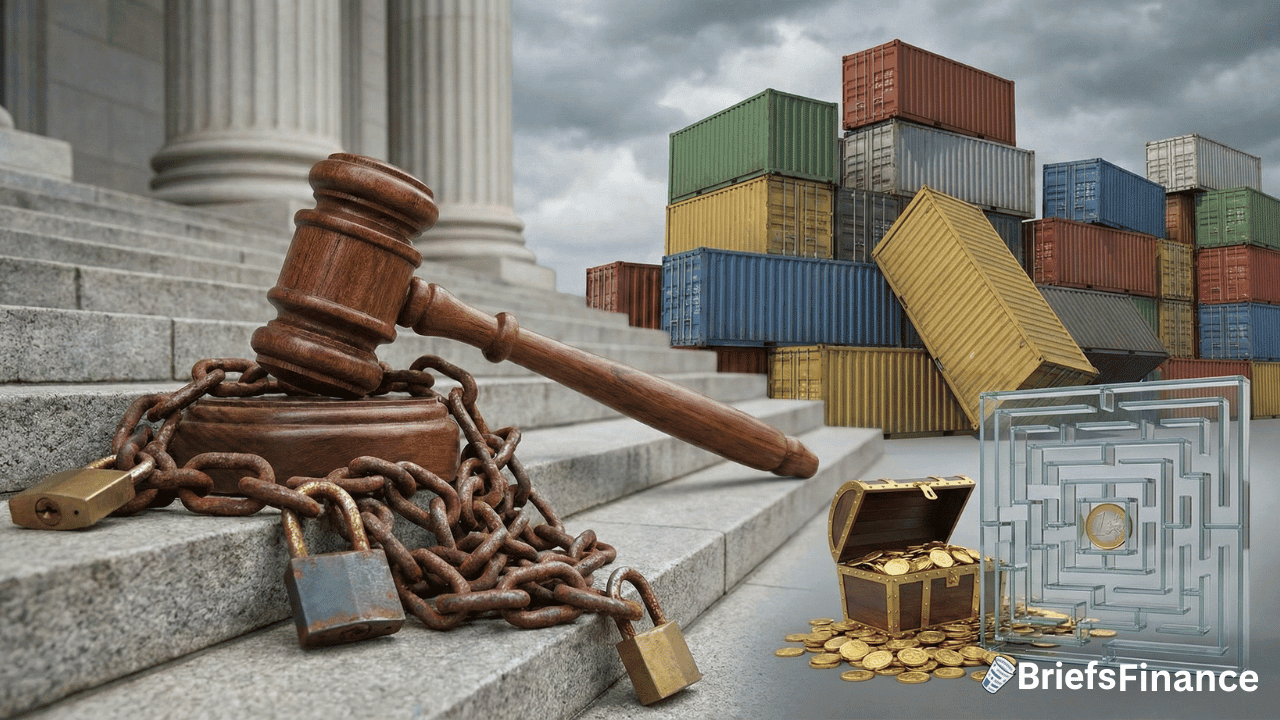
A judge's gavel with chains, shipping containers, a treasure chest with gold coins symbolizing Tariff Refunds, a metal maze, and the BriefsFinance logo, all arranged on Supreme Court steps under cloudy skies.
Summary:

  • The Supreme Court struck down Trump's blanket tariffs, but refunds for companies won't come easy.
  • Trump signaled he won't hand money back willingly — and said the issue will likely take years to litigate.
  • More than 1,500 companies have already filed lawsuits to protect their place in line.

The Supreme Court ruled Friday that Trump's sweeping tariffs were illegal. Companies that paid billions in duties are now asking the obvious question: do we get our money back?

Don't Hold Your Breath

The court's ruling was silent on refunds entirely, leaving companies in limbo. Trump made his position clear at a press conference, saying the issue would probably get "litigated for the next two years."

Trade lawyer Ted Murphy of Sidley Austin told clients the ruling does create "a refund opportunity for importers" — but warned it would be neither automatic nor fast. The path forward likely runs through the US Court of International Trade, the same three-judge panel that originally ruled the tariffs illegal in 2025.

Terry Haines of Pangaea Policy was blunter: "Those who think market participants are getting rebates any time soon — or at all — are dreaming."

The Stakes Are Enormous

The Penn Wharton Budget Model estimates a full reversal could generate up to $175 billion in refunds. That's not a rounding error — and it explains why companies have been lawyering up for months.

Costco is one of more than 1,500 companies that have already filed preemptive lawsuits at the Court of International Trade, racing to protect their eligibility before the government closes the window through a process called "liquidation" — a final, binding calculation of tariffs owed.

Trump also moved fast after the ruling, signing an executive order imposing a new 10% global tariff under a different legal authority, then bumping it to 15% the following day.

The money may be recoverable. Getting it back will cost you.
Disclosure

Get Market Briefs delivered to your inbox every morning for free!

No fluff. No noise. No politics. Just finance news you can read in 5 minutes.

Blogs

May 30, 2026
Financial Literacy Books That Actually Build Wealth
  • The best financial literacy books don't just teach budgeting, they shift how you think about money.
  • Two classics stand out: The Intelligent Investor for valuing investments, and Rich Dad Poor Dad for the owner's mindset.
  • Reading is only step one. The real wealth comes from acting on what you learn.
Read More
May 30, 2026
What Is a Roth Conversion? A Simple Guide
  • A Roth conversion moves money from a traditional retirement account into a Roth account.
  • You pay taxes on the money now, in exchange for tax-free growth and withdrawals later.
  • It can pay off if you expect higher taxes or more income in the future, but the timing and tax hit matter a lot.
Read More
May 30, 2026
Trailing Stop Loss: How to Protect Your Gains
  • A trailing stop loss is an order that automatically sells a stock if it falls a set percentage from its recent high.
  • As the stock rises, the sell point rises with it, locking in gains while capping losses.
  • It's most useful for active strategies like momentum investing, not for long-term buy-and-hold.
Read More
May 30, 2026
5 Types of Wealth: Why Money Is Only One of Them
  • Real wealth is more than a bank balance. It spans your finances, health, mind, purpose, and freedom.
  • Money is powerful, but it amplifies the life you already have rather than fixing a broken one.
  • True financial wealth means your cash flow covers your expenses, so your money works while you live.
Read More
May 30, 2026
How to Invest in Private Equity: A Beginner's Guide
  • Private equity means investing in companies that aren't listed on the stock market.
  • Traditional private equity is built for experienced, high-net-worth investors with large amounts to invest.
  • New rules have opened more accessible paths, like startup crowdfunding and real estate deals, often starting around $100.
Read More
May 30, 2026
What Is a Call Option? A Simple Guide With Examples
  • A call option gives you the right to buy a stock at a set price by a set date.
  • Investors buy calls when they expect a stock to rise, using less money than buying the shares outright.
  • The most you can lose buying a call is the premium, but time works against you, so it's an advanced tool.
Read More
May 30, 2026
EBITDA Formula: How to Calculate It Step by Step
  • EBITDA stands for Earnings Before Interest, Taxes, Depreciation, and Amortization, a measure of a company's core profit.
  • The formula adds those four items back to net income to show what the underlying business earns.
  • Investors use EBITDA to compare companies and to judge how many times earnings a stock is selling for.
Read More
May 30, 2026
What Is a Stock Option? A Plain-English Guide
  • A stock option is a contract giving you the right, but not the obligation, to buy or sell a stock at a set price by a set date.
  • There are two types: calls (the right to buy) and puts (the right to sell).
  • Options are powerful but risky, so they suit investors who already have the basics down.
Read More
May 30, 2026
Put Option: What It Is and How It Works
  • A put option gives you the right to sell a stock at a set price by a set date.
  • Investors use puts to bet a stock will fall, or as insurance to protect shares they own.
  • The most you can lose buying a put is the premium you paid, which makes it a defined-risk tool.
Read More
May 30, 2026
Operating Margin: What It Is and How to Calculate It
  • Operating margin shows how much profit a company keeps from its core business after paying its running costs.
  • The formula is operating income divided by revenue, shown as a percent.
  • A strong, steady operating margin signals a well-run business that controls its costs.
Read More
1 2 3 22
Share via
Copy link










