Free NewsletterPro Login

The Supreme Court Killed Trump's Tariffs. Getting a Refund Is Another Story.

A stylized illustration of a cylindrical cup with blue arrows and lines indicating a swirling or rotational motion inside the cup.
Published Mar 2, 2026
Share:
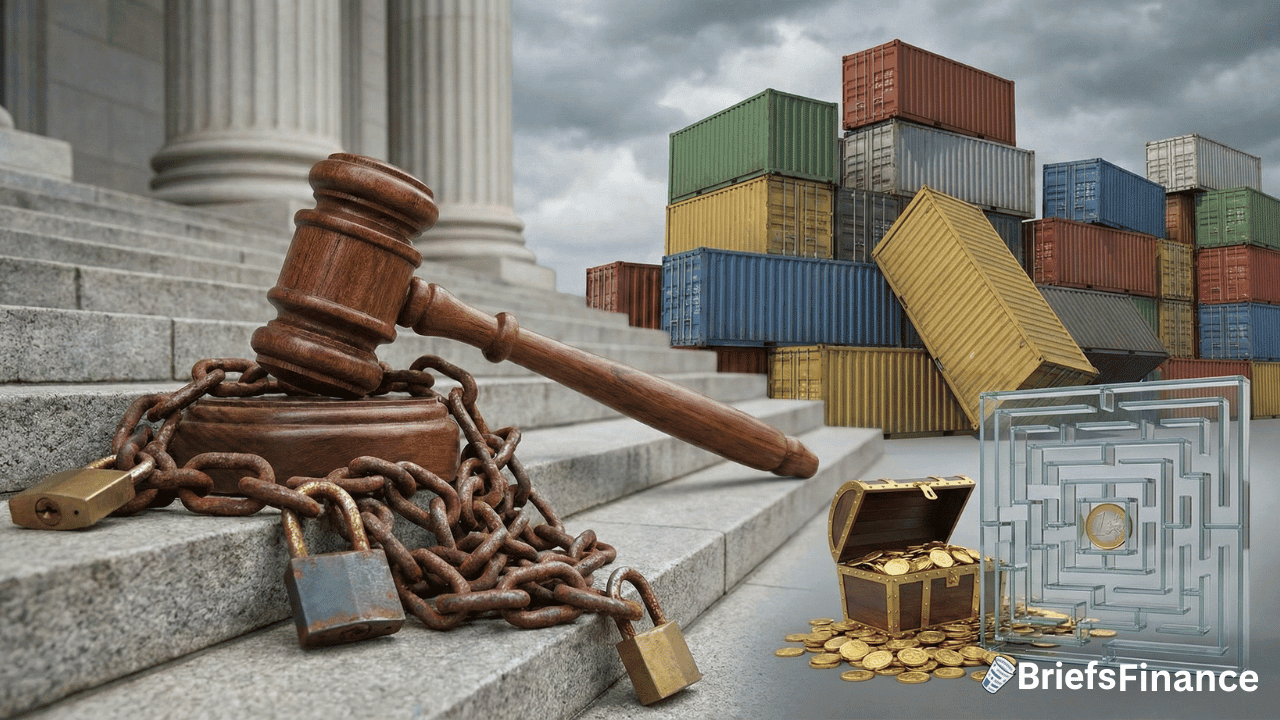
A judge's gavel with chains, shipping containers, a treasure chest with gold coins symbolizing Tariff Refunds, a metal maze, and the BriefsFinance logo, all arranged on Supreme Court steps under cloudy skies.
Summary:

  • The Supreme Court struck down Trump's blanket tariffs, but refunds for companies won't come easy.
  • Trump signaled he won't hand money back willingly — and said the issue will likely take years to litigate.
  • More than 1,500 companies have already filed lawsuits to protect their place in line.

The Supreme Court ruled Friday that Trump's sweeping tariffs were illegal. Companies that paid billions in duties are now asking the obvious question: do we get our money back?

Don't Hold Your Breath

The court's ruling was silent on refunds entirely, leaving companies in limbo. Trump made his position clear at a press conference, saying the issue would probably get "litigated for the next two years."

Trade lawyer Ted Murphy of Sidley Austin told clients the ruling does create "a refund opportunity for importers" — but warned it would be neither automatic nor fast. The path forward likely runs through the US Court of International Trade, the same three-judge panel that originally ruled the tariffs illegal in 2025.

Terry Haines of Pangaea Policy was blunter: "Those who think market participants are getting rebates any time soon — or at all — are dreaming."

The Stakes Are Enormous

The Penn Wharton Budget Model estimates a full reversal could generate up to $175 billion in refunds. That's not a rounding error — and it explains why companies have been lawyering up for months.

Costco is one of more than 1,500 companies that have already filed preemptive lawsuits at the Court of International Trade, racing to protect their eligibility before the government closes the window through a process called "liquidation" — a final, binding calculation of tariffs owed.

Trump also moved fast after the ruling, signing an executive order imposing a new 10% global tariff under a different legal authority, then bumping it to 15% the following day.

The money may be recoverable. Getting it back will cost you.

Disclosure

Get Market Briefs delivered to your inbox every morning for free!

No fluff. No noise. No politics. Just finance news you can read in 5 minutes.

Blogs

April 28, 2026
Core-Satellite Portfolio: The Best of Both Worlds
  • A core-satellite portfolio splits investments into stable core holdings and higher-risk satellite picks.
  • The core is usually 60% of the portfolio, with satellites at 40%.
  • It blends passive index investing with active opportunity bets.

Read More
April 28, 2026
Bond Ladder Strategy: The Income Plan With Built-In Flexibility
  • A bond ladder is a series of bonds with staggered maturity dates, often one to five years apart.
  • It gives you regular access to cash, predictable income, and protection from rate changes.
  • It works for Treasuries, corporate bonds, municipal bonds, and CDs.
Read More
April 28, 2026
Silver vs Gold Investing: Which One Belongs in Your Portfolio?
  • Gold is the stable store of value, used as crisis insurance during recessions and conflict.
  • Silver is both a precious metal and an industrial metal, with more volatile pricing.
  • Most investors hold a mix in their alternative investment allocation, often 5% to 12% of portfolio.
Read More
April 28, 2026
What Is a Dividend Reinvestment Plan? The Wealth Snowball Explained
  • A dividend reinvestment plan, or DRIP, automatically uses dividend payments to buy more shares.
  • DRIPs power compound growth - dividends buy shares that pay dividends that buy more shares.
  • Most brokerages offer DRIPs free, and many include fractional shares so every penny goes back in.
Read More
April 28, 2026
How Tariffs Affect the Stock Market
  • Tariffs are extra fees on goods imported into a country, and they hit company profit margins.
  • The S&P 500 dropped over 3% in one day after the 2025 tariff announcement.
  • Tariffs reshape trade flows, creating both losers and unexpected winners.
Read More
April 28, 2026
What Is a 13F Filing? The Smart Money Tracker
  • A 13F filing is a quarterly disclosure of stock holdings from large institutional investors.
  • It shows what hedge funds and asset managers bought, sold, and held last quarter.
  • You can find any 13F free on SEC EDGAR.
Read More
April 28, 2026
Debt-to-Equity Ratio: The Number That Tells You If a Company Is Drowning
  • The debt-to-equity ratio compares what a company owes to what shareholders own.
  • The formula is total liabilities divided by total shareholder equity.
  • Lower ratios mean less risk - one of the value markers Warren Buffett looks for.
Read More
April 28, 2026
Non-Financial Analysis of Stocks: The 4-Step Method
  • Non-financial analysis evaluates a company's business, not its financial ratios.
  • It covers four things: business model, CEO, innovation, and moat.
  • It's how investors find companies with long-term staying power.
Read More
April 28, 2026
SEC EDGAR Tutorial: The Free Tool the Pros Use
  • SEC EDGAR is the official free database of public company filings.
  • You can pull 10-Ks, 10-Qs, 8-Ks, and insider trades by ticker or company name.
  • It's the source journalists and analysts use to write their stock stories.
Read More
April 28, 2026
How to Read a 10-Q (Without Losing Your Mind)
  • A 10-Q is a public company's three-month financial update, filed with the SEC.
  • It shows revenue, profits, debt, and cash flow between yearly reports.
  • You can find any company's 10-Q for free on the SEC's EDGAR site.
Read More
1 2 3 18
Share via
Copy link