Free NewsletterPro Login
S&P 500 6,287 +0.42%
DOW 44,521 -0.18%
NASDAQ 21,103 +0.71%

Warning: Undefined variable $funds in /var/www/briefs.co/htdocs/wp-content/plugins/oxygen/component-framework/components/classes/code-block.class.php(133) : eval()'d code on line 491

Warning: foreach() argument must be of type array|object, null given in /var/www/briefs.co/htdocs/wp-content/plugins/oxygen/component-framework/components/classes/code-block.class.php(133) : eval()'d code on line 491
/* the link was here */

Tehran and Oman Near Accord on Hormuz Lanes, Yet Tanker Transit Remains Uncertain

Published Aug 8, 2026
[tts_player]
Share:
Summary:
  • Iran's foreign minister says Tehran and Oman are close to agreeing on temporary shipping lanes through the Strait of Hormuz.
  • Abbas Araghchi says full reopening depends on conditions, including compensation from Washington over the lapsed Islamabad Agreement.
  • Oil prices are still swinging as attacks on shippers continue and traders wait for a final deal.

Iran and Oman Are Close to a Shipping Deal

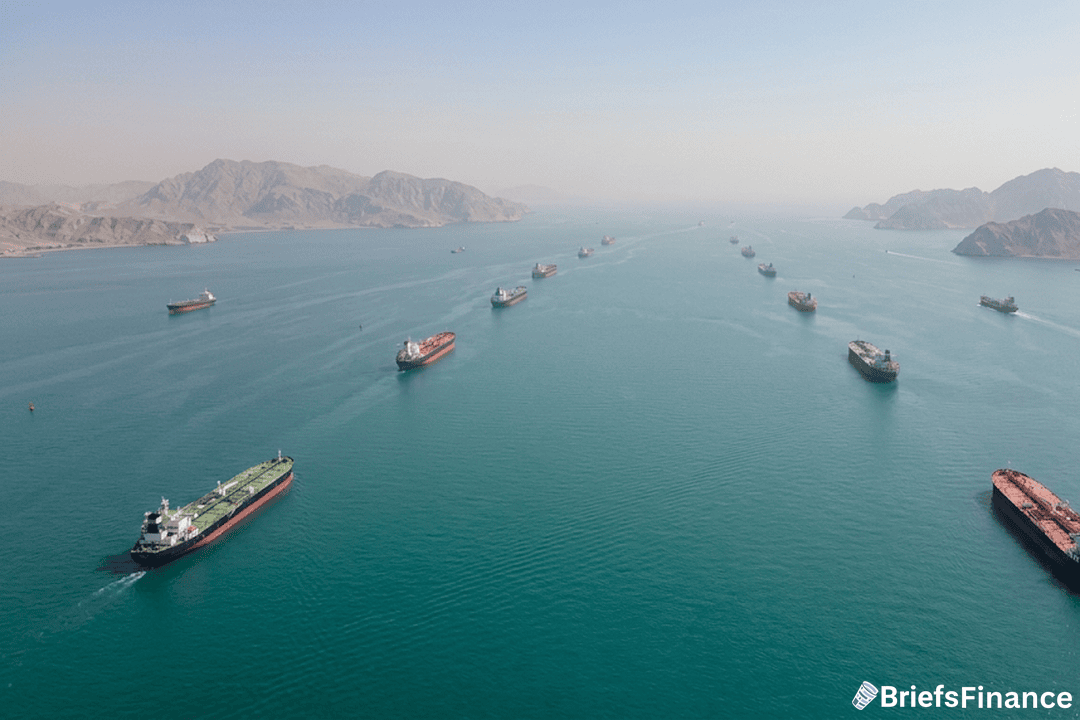
On Saturday, August 8, 2026, Iran's foreign minister said Tehran and Oman are on the verge of agreeing on temporary shipping lanes through the Strait of Hormuz. That narrow waterway connects the Persian Gulf to the rest of the world, and it is a critical oil route for the whole planet.

Abbas Araghchi said the talks are near a deal for temporary lanes for ships entering and leaving the Persian Gulf. But he warned that the accord would not reopen the strait immediately, because reopening depends on other conditions.

His condition points back to Washington. Araghchi said the US must provide compensation for violating the Islamabad Agreement, a memorandum of understanding from June that has since lapsed.

"The opening of the Strait is subject to other conditions, including the compensation for the US's violations of the Islamabad Agreement," Araghchi said. He tied that demand to the June memorandum, which has since expired.

Hormuz is a central chokepoint for global crude shipments. The current conflict has shut down most normal traffic, and the remaining movement is often hard to track.

The backdrop makes this harder than it sounds. The US-Iran ceasefire broke down in less than a month over who controls Hormuz, and Iran insists Washington is not part of the new deal, leaving the US response unclear.

President Donald Trump has spent months insisting the strait must be fully reopened without interference, and he has threatened more strikes if that does not happen.

Any agreement still needs approval from Iran's Supreme Leader Mojtaba Khamenei. Iranian officials say reaching him takes time, which may delay an announcement, and there is no sign yet that he has approved current plans.

Get the free Always Be Buying eBook and learn the simple system for building wealth on any income

Oil Markets Are Watching Every Move

Traders are treating this as a wait-and-see moment. Brent crude, the global benchmark, ended above $83 a barrel this week. It has now fallen for a third week in a row.

A deal could restore millions of barrels of Persian Gulf supply to the market. Hormuz traffic has mostly been blocked since the war began, and while some ships still move through under a US-backed shuttle program, many sail with their transponders off, making their trips hard to track.

There are now two proposed corridors through the strait, one from Iran and another from a Western naval group.

Under international rules, coastal states can claim the waters within 12 nautical miles of their coast as their own territory. That is why the exact route matters so much.

The US also maintains a naval blockade of Iranian ports. Reuters, citing a US official, said the blockade will end once Oman and Iran announce an agreement to resume commercial shipping, and that deal is expected soon.

Meanwhile, the risks for shippers are not just hypothetical. Abu Dhabi National Oil Co., the UAE's biggest oil producer, said a company ship came under missile attack early Saturday while crossing the strait.

Renewed Fighting in Yemen and the Red Sea

The trouble does not stop at Hormuz. Yemen's government said its military launched a nighttime operation targeting Houthi forces, the Iran-backed group that holds much of the country, in what it called the first known retaliation for this week's attacks.

Recent weeks brought renewed hostilities, including in the Red Sea, where the majority of Saudi oil exports have been leaving since the strait closed.

What It Means for Your Money

Investors are caught between hope and worry. "Deals to reopen the Strait of Hormuz remain elusive, with investors teetering in the balance," said Rob Haworth, who holds a senior role focused on investment strategy at US Bank Wealth Management. "Traffic remains low and the path to a durable deal remains unclear," he added.

That uncertainty is the story for your money. If a real deal happens, fuel and shipping costs could ease.

If talks stall again, oil prices could keep swinging, and those swings can reach your portfolio and your monthly fuel bill.

The strait may feel far away, but the market for oil is global. What happens in that narrow stretch of water matters in places as ordinary as the gas station.

Download the free Always Be Buying eBook and start putting your money to work today
Disclosure

Recent News

1 2 3 51

Get Market Briefs delivered to your inbox every morning for free!

No fluff. No noise. No politics. Just finance news you can read in 5 minutes.

Blogs

June 29, 2026
Portfolio Diversification: Why Putting All Your Eggs in One Basket Destroys Wealth
  • Real diversification means spreading investments across all 11 economic sectors plus bonds, alternatives, and cash so no single bet can sink the portfolio.
  • Different sectors perform at different times, so a diversified portfolio captures upswings while smoothing the brutal drawdowns that wipe out concentrated bets.
  • Total market index funds offer the simplest path to diversification, and annual rebalancing is what keeps the structure working over time.
Read More
June 29, 2026
Non Taxable Income: What It Is and Why It Matters
  • Non taxable income is money you receive that you don't owe income tax on.
  • The tax code treats workers, investors, and business owners very differently, and investors often come out ahead.
  • Learning how income is taxed is a quiet superpower for keeping more of what you earn.
Read More
June 29, 2026
Semiconductor Stocks: A Simple Guide for Investors
  • Semiconductor stocks are companies that design and make computer chips, the brains inside nearly every modern device.
  • The AI boom has turned chips into one of the market's most important and most watched groups.
  • They offer big growth potential, but come with high valuations and a notoriously cyclical history.
Read More
June 25, 2026
How Stocks Work: A Simple Guide for Beginners
  • A stock is a slice of ownership in a company - buy one, and you own a piece of the business.
  • You make money two ways: the share price rising over time, and dividends paid to shareholders.
  • The simplest path for most beginners is buying into the whole market through a low-cost index fund.
Read More
June 25, 2026
Stop Loss vs Stop Limit: What's the Difference?
  • A stop loss order sells your stock once it hits a trigger price, prioritizing getting you out.
  • A stop limit order only sells within a price range you set, prioritizing price over a guaranteed exit.
  • The trade-off: a stop loss almost always executes; a stop limit might not if the price moves too fast.
Read More
June 25, 2026
Energy Stocks: A Simple Guide for Investors
  • Energy stocks are companies that produce and supply the power the world runs on, from oil and gas to newer sources.
  • They make up one of the 11 sectors of the market and tend to move with energy prices and big-picture shifts.
  • Like any sector, the key is diversification and understanding the forces driving demand.
Read More
June 18, 2026
What Is a Stop Loss Order? A Simple Guide
  • A stop loss order automatically sells a stock once it falls to a price you set.
  • It's a tool to cap losses or lock in gains without watching the market all day.
  • It works best for active strategies, and can backfire if used carelessly on long-term holdings.
Read More
June 18, 2026
Best S&P 500 Index Fund: How to Choose One
  • The best S&P 500 index fund for most investors is simply the cheapest, most established one that tracks the index well.
  • Funds like VOO, IVV, and SPY all hold the same 500 companies, so the biggest difference is the fee.
  • Pick one, automate your buys, and let time do the heavy lifting.
Read More
June 17, 2026
What Are Penny Stocks? Risks and Rewards Explained
  • Penny stocks are very low-priced shares of very small companies, often trading for just a few dollars or less.
  • They promise huge gains but carry huge risks: low liquidity, high failure rates, and wild price swings.
  • Most investors are better served by quality companies and funds than by chasing cheap shares.
Read More
June 17, 2026
Best Stocks for Beginners With Little Money
  • The best stocks for beginners with little money usually aren't individual stocks at all - they're low-cost index funds.
  • You can start with $100 or less and use small, regular investments to build wealth over time.
  • Focus on diversification and consistency, not on picking the next big winner.
Read More
1 2 3 24
Share via
Copy link













