Free NewsletterPro Login

Reese's Changed the Recipe. The Founder's Grandson Is Not Happy About It.

A stylized illustration of a cylindrical cup with blue arrows and lines indicating a swirling or rotational motion inside the cup.
Published Mar 3, 2026
Share:
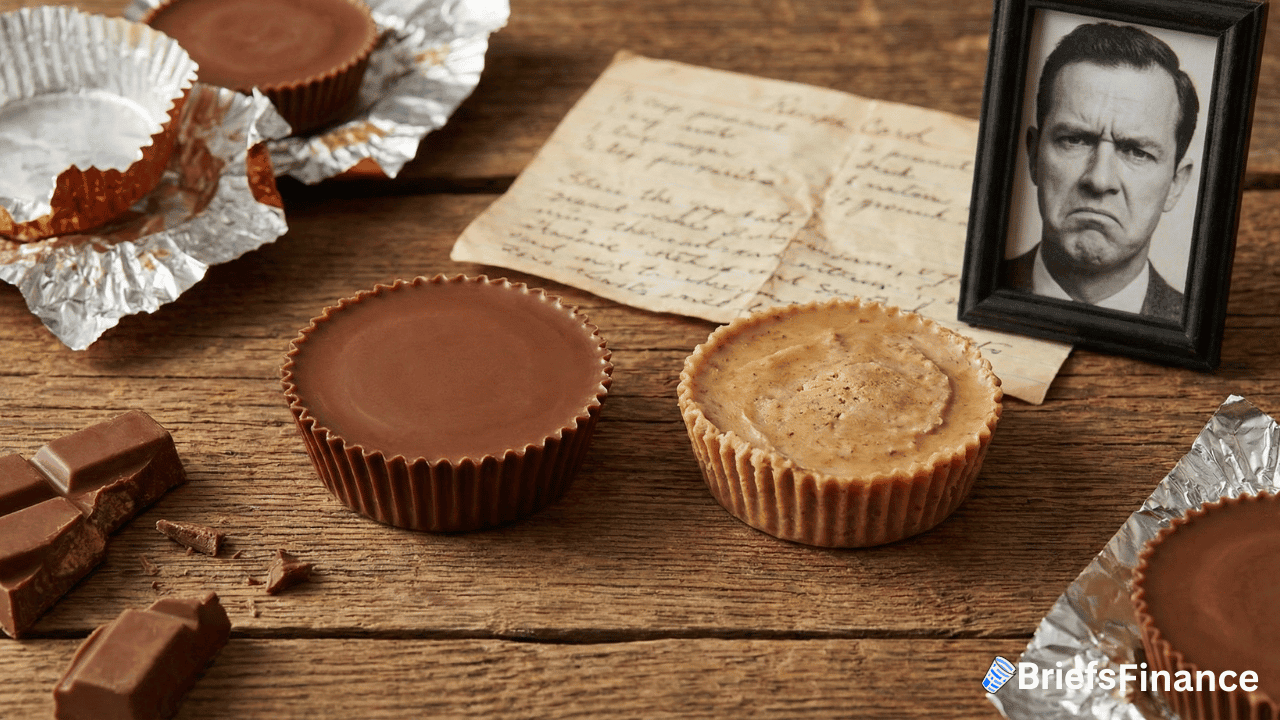
Two Reese's peanut butter cups, chocolate and caramel, sit on a wooden table with chocolate pieces, foil wrappers, a handwritten note about a recipe change, and a black-and-white photo of the founder's grandson frowning.
Summary:

  • Brad Reese, grandson of the Reese's Peanut Butter Cup creator, is publicly calling out Hershey for swapping real chocolate and peanut butter for cheaper substitutes.
  • It's a textbook example of skimpflation — quietly cutting ingredient quality instead of raising prices.
  • A 2024 study found shrinkflation and skimpflation accounted for as much as 10% of inflation in some product categories.

Brad Reese bought a bag of Reese's Mini Hearts for Valentine's Day. One bite in, he knew something was wrong.

What Hershey Did

The mini hearts weren't made with milk chocolate and peanut butter — the ingredients that made Reese's famous. Instead, the label listed "chocolate candy" and "peanut butter creme." Those are cheaper formulations that don't meet the FDA's standards to be called the real thing.

Reese, whose grandfather H.B. Reese invented Reese's Peanut Butter Cups, went public with his outrage — open letter, media appearances, a revamped website declaring him the defender of "Reese's Brand Integrity," and an orange baseball cap that says "Make Reese's Great Again."

Hershey's response? They called it an innovation.

Why This Is Bigger Than Candy

What Brad Reese is describing has a name: skimpflation. It's what happens when a company faces rising costs and, instead of raising prices or shrinking the package, quietly downgrades the product itself — and hopes no one notices.

Lindsay Owens, executive director of the Groundwork Collaborative, found that shrinkflation alone accounted for as much as 10% of inflation in certain product categories in 2024, including snacks, paper towels, and toilet paper. She argues these reformulations often mean more processed ingredients — which carries real health implications, not just taste ones.

Hershey had real cost pressures to deal with. Cocoa prices hit record highs in late 2024, driven by climate-related crop failures in West Africa, where about 70% of the world's cocoa is grown. The Trump administration's tariffs on cocoa-producing nations made things worse — though cocoa was eventually exempted in November.

The cost crunch is real. But so is the swap.
Disclosure

Get Market Briefs delivered to your inbox every morning for free!

No fluff. No noise. No politics. Just finance news you can read in 5 minutes.

Blogs

June 17, 2026
What Are Penny Stocks? Risks and Rewards Explained
  • Penny stocks are very low-priced shares of very small companies, often trading for just a few dollars or less.
  • They promise huge gains but carry huge risks: low liquidity, high failure rates, and wild price swings.
  • Most investors are better served by quality companies and funds than by chasing cheap shares.
Read More
June 17, 2026
Best Stocks for Beginners With Little Money
  • The best stocks for beginners with little money usually aren't individual stocks at all - they're low-cost index funds.
  • You can start with $100 or less and use small, regular investments to build wealth over time.
  • Focus on diversification and consistency, not on picking the next big winner.
Read More
June 16, 2026
Tech Stocks: A Simple Guide for New Investors
  • Tech stocks are companies in the information technology and related sectors, from software to chips to the internet giants.
  • They've driven much of the market's growth, but they can be volatile and richly valued.
  • The smart approach is to understand what you own and not let one sector run your whole portfolio.
Read More
June 16, 2026
What Is a Joint Stock Company? A Simple Guide
  • A joint stock company is a business owned by many people, each holding shares of stock that represent a slice of ownership.
  • It's the basic idea behind every public company you can buy on the stock market today.
  • Owning a share makes you a part-owner, entitled to a piece of the profits and growth.
Read More
June 16, 2026
Capital Gains Tax in California: A Simple Guide
  • Capital gains tax is what you owe when you sell an investment for more than you paid for it.
  • How long you held it matters: long-term gains are taxed more gently than short-term gains at the federal level.
  • Smart investors lower the bill with tools like tax-loss harvesting and holding for the long run.
Read More
June 15, 2026
Top Covered Call ETFs: How to Compare Them
  • Top covered call ETFs are income funds that own stocks and sell call options against them to generate steady cash.
  • The best one for you is the fund whose income, holdings, and fees fit your goals, not simply the one with the flashiest yield.
  • They all share one trade-off: more income today, less upside in a big rally.
Read More
June 15, 2026
What Are Stock Options? A Plain-English Guide
  • Stock options are contracts that give you the right, but not the obligation, to buy or sell a stock at a set price by a set date.
  • There are two kinds: calls (the right to buy) and puts (the right to sell).
  • Options can multiply gains or wipe out your money fast, so they suit investors who already know the basics.
Read More
June 15, 2026
EBITDA Margin: What It Is and How to Calculate It
  • EBITDA margin measures how much core profit a company keeps from each dollar of sales, before interest, taxes, and accounting deductions.
  • The formula is EBITDA divided by revenue, shown as a percent.
  • A higher, steadier EBITDA margin usually signals a more efficient, more durable business.
Read More
June 15, 2026
What Is Taxable Income? A Simple Guide for Investors
  • Taxable income is the portion of your money the government can tax after deductions are applied.
  • Not all income is taxed the same: job income, investment income, and passive income face different rates.
  • Investors and business owners get more tools to legally lower their taxable income, which is a big edge over time.
Read More
June 15, 2026
What Is a Covered Call? How the Strategy Works
  • A covered call is an options strategy where you own a stock and sell someone the right to buy it from you at a higher price.
  • You collect cash, called the premium, up front, and keep it no matter what happens.
  • The trade-off: if the stock soars, your shares get sold at the set price and you miss the extra upside.
Read More
1 2 3 23
Share via
Copy link










