Free NewsletterPro Login

Crypto Markets Are Waiting on One Bill. JPMorgan Says It Could Change Everything.

A stylized illustration of a cylindrical cup with blue arrows and lines indicating a swirling or rotational motion inside the cup.
Published Mar 3, 2026
Share:
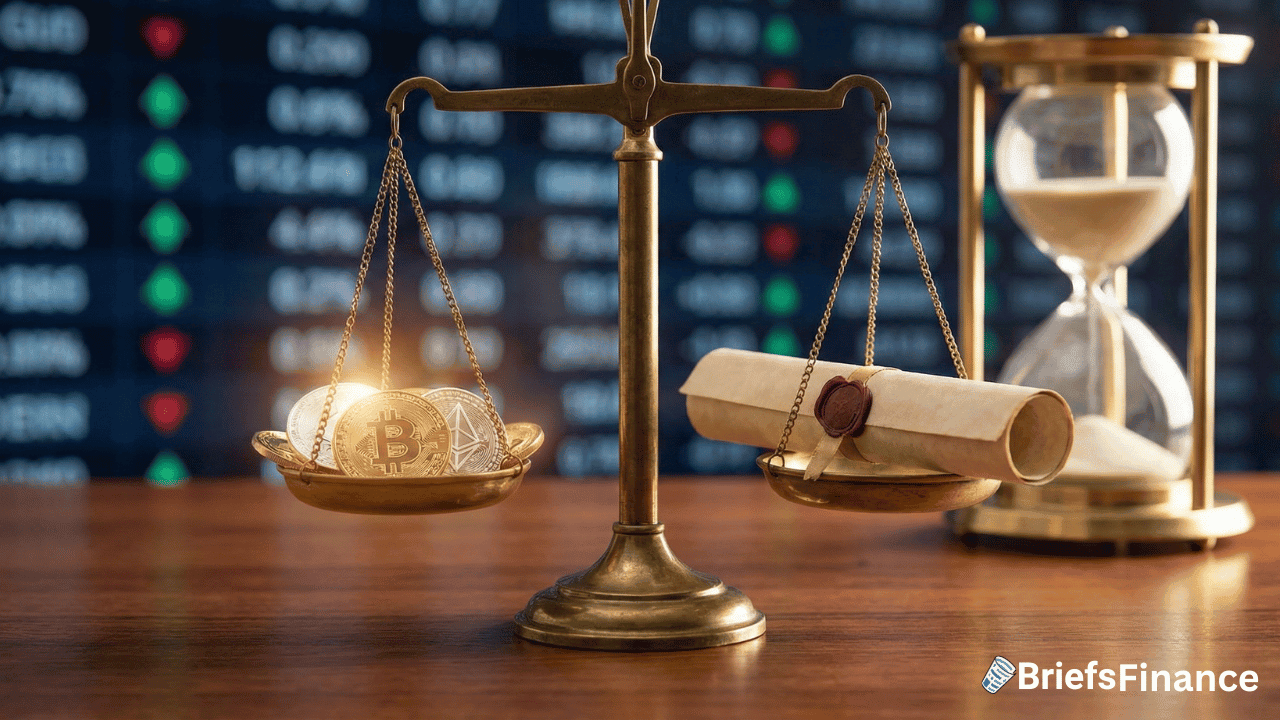
A balance scale with cryptocurrency coins on one side and a sealed scroll, symbolizing a crypto bill, on the other, an hourglass in the background, and a stock market screen—hinting at Crypto Markets—displayed behind them.
Summary:

  • JPMorgan says the CLARITY Act — if passed by mid-2026 — could be the catalyst that kicks off a crypto rally in the second half of the year.
  • The bill has stalled in the Senate after Coinbase withdrew support over stablecoin yield restrictions.
  • Odds of passage on Polymarket have dropped from 82% to 63% since late February.

Crypto has been sitting in a holding pattern. The catalyst JPMorgan thinks could break it loose is stuck in the Senate.

What the CLARITY Act Would Actually Do

The Digital Asset Market CLARITY Act passed the House in June 2025. It would split oversight of crypto between two regulators: the Commodity Futures Trading Commission (CFTC) and the Securities and Exchange Commission (SEC). Under the bill, tokens would be classified as either commodities or securities depending on their nature — a change that would end years of legal gray area where the SEC pursued enforcement actions without clear rules.

JPMorgan analysts led by Nikolaos Panigirtzoglou said the bill would "reshape market structure by providing regulatory clarity, ending 'regulation by enforcement,' promoting tokenization, and facilitating greater institutional participation." They called it the most likely catalyst for a second-half rally in crypto markets.

Why It's Stalled

The bill hit a wall in the Senate over a seemingly narrow issue: stablecoin yields. Banks are pushing to restrict whether dollar-pegged stablecoins can pay interest to holders, fearing it would pull deposits away from savings accounts. Crypto firms argue the restriction would push innovation overseas.

Coinbase withdrew its support in January after the Senate revised the bill's text, calling the amendments a threat to competition and innovation. The Senate Banking Committee postponed its markup the same day — and hasn't rescheduled since. Baker McKenzie noted that the momentum evaporated almost overnight once Coinbase went public with its opposition.

What's Left to Watch

Senate markup is now expected sometime in mid-to-late March, with a soft deadline of July before election-cycle gridlock sets in. Ripple CEO Brad Garlinghouse put odds of passage at 80–90% by late April. Polymarket traders are less optimistic — odds have fallen to 63%, down from 82% just two weeks ago.

If it passes, JPMorgan expects institutional investors — pension funds, asset managers, insurers — to move from cautious allocations into larger positions. If it stalls, the uncertainty that has kept crypto range-bound could drag into 2027.

The bill already missed its March 1 deadline. The clock is ticking.
Disclosure

Get Market Briefs delivered to your inbox every morning for free!

No fluff. No noise. No politics. Just finance news you can read in 5 minutes.

Blogs

May 30, 2026
Financial Literacy Books That Actually Build Wealth
  • The best financial literacy books don't just teach budgeting, they shift how you think about money.
  • Two classics stand out: The Intelligent Investor for valuing investments, and Rich Dad Poor Dad for the owner's mindset.
  • Reading is only step one. The real wealth comes from acting on what you learn.
Read More
May 30, 2026
What Is a Roth Conversion? A Simple Guide
  • A Roth conversion moves money from a traditional retirement account into a Roth account.
  • You pay taxes on the money now, in exchange for tax-free growth and withdrawals later.
  • It can pay off if you expect higher taxes or more income in the future, but the timing and tax hit matter a lot.
Read More
May 30, 2026
Trailing Stop Loss: How to Protect Your Gains
  • A trailing stop loss is an order that automatically sells a stock if it falls a set percentage from its recent high.
  • As the stock rises, the sell point rises with it, locking in gains while capping losses.
  • It's most useful for active strategies like momentum investing, not for long-term buy-and-hold.
Read More
May 30, 2026
5 Types of Wealth: Why Money Is Only One of Them
  • Real wealth is more than a bank balance. It spans your finances, health, mind, purpose, and freedom.
  • Money is powerful, but it amplifies the life you already have rather than fixing a broken one.
  • True financial wealth means your cash flow covers your expenses, so your money works while you live.
Read More
May 30, 2026
How to Invest in Private Equity: A Beginner's Guide
  • Private equity means investing in companies that aren't listed on the stock market.
  • Traditional private equity is built for experienced, high-net-worth investors with large amounts to invest.
  • New rules have opened more accessible paths, like startup crowdfunding and real estate deals, often starting around $100.
Read More
May 30, 2026
What Is a Call Option? A Simple Guide With Examples
  • A call option gives you the right to buy a stock at a set price by a set date.
  • Investors buy calls when they expect a stock to rise, using less money than buying the shares outright.
  • The most you can lose buying a call is the premium, but time works against you, so it's an advanced tool.
Read More
May 30, 2026
EBITDA Formula: How to Calculate It Step by Step
  • EBITDA stands for Earnings Before Interest, Taxes, Depreciation, and Amortization, a measure of a company's core profit.
  • The formula adds those four items back to net income to show what the underlying business earns.
  • Investors use EBITDA to compare companies and to judge how many times earnings a stock is selling for.
Read More
May 30, 2026
What Is a Stock Option? A Plain-English Guide
  • A stock option is a contract giving you the right, but not the obligation, to buy or sell a stock at a set price by a set date.
  • There are two types: calls (the right to buy) and puts (the right to sell).
  • Options are powerful but risky, so they suit investors who already have the basics down.
Read More
May 30, 2026
Put Option: What It Is and How It Works
  • A put option gives you the right to sell a stock at a set price by a set date.
  • Investors use puts to bet a stock will fall, or as insurance to protect shares they own.
  • The most you can lose buying a put is the premium you paid, which makes it a defined-risk tool.
Read More
May 30, 2026
Operating Margin: What It Is and How to Calculate It
  • Operating margin shows how much profit a company keeps from its core business after paying its running costs.
  • The formula is operating income divided by revenue, shown as a percent.
  • A strong, steady operating margin signals a well-run business that controls its costs.
Read More
1 2 3 22
Share via
Copy link










