Free NewsletterPro Login

A Super El Nino Could Collide With the Iran War to Create a Global Food Crisis

Published Apr 9, 2026
Share:
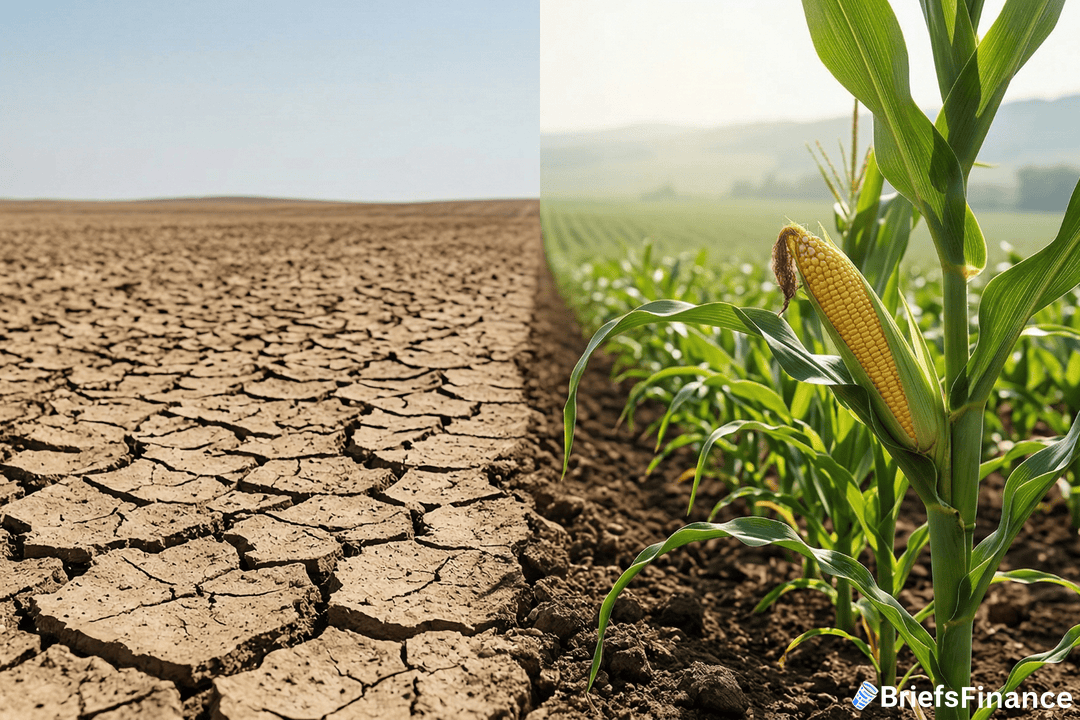
A split image showing dry, cracked soil on the left and healthy green corn growing in fertile soil on the right, illustrating a contrast in agricultural conditions.
Summary:
  • U.S. meteorologists estimate a 1-in-3 chance of a "strong" El Nino forming between October and December 2026, with European models suggesting even higher odds of a "super" event.
  • The Iran war has disrupted roughly one-third of the world's seaborne fertilizer trade through the Strait of Hormuz, right as the US planting season begins.
  • The World Food Programme warns acute hunger could jump by 45 million people if the conflict persists beyond June and oil stays above $100 per barrel.

The world's food supply is getting squeezed from two directions at once. A powerful weather pattern may develop later this year, while the Iran war is already choking off fertilizer shipments.

Together, they could trigger a food crisis affecting hundreds of millions of people. The math is sobering: 318 million people are already food insecure globally.

The El Nino Wildcard

El Nino is a warming pattern in the tropical Pacific that shifts weather worldwide.

When it hits, it typically pushes cocoa, food oils, rice, and sugar prices higher by disrupting growing conditions from Southeast Asia to South America. U.S. meteorologists estimate a 1-in-3 chance of a "strong" El Nino forming between October and December.

European models put the probability even higher, with some suggesting a "super El Nino" - an exceptionally powerful version.

Paul Donovan, chief economist at UBS, warned: "2026 might produce a super El Nino weather pattern. In that case, drought and limited water supply might be more important than shortages of nitrogen."

The Fertilizer Crunch

About one-third of all seaborne fertilizer trade normally passes through the Strait of Hormuz.

Since the blockade began on Feb 28, that shipping has virtually stopped.

Fertilizer is to modern farming what gas is to a car - no supply, no growth. This is hitting at the worst possible time as the U.S. planting season begins.

Dawid Heyl, an analyst at investment firm Ninety One, put it bluntly: "I am a lot more concerned about this time around because of the impact on nitrogen, fertilizer production."

The World Food Programme estimates acute hunger could jump by 45 million people if the conflict persists beyond June.

What to Watch

Three signals matter: El Nino formation indicators from October through December, Strait of Hormuz shipping data showing whether fertilizer is flowing again, and global commodity prices for rice, sugar, cocoa, and cooking oils.

If all three move the wrong direction at once, food inflation accelerates fast.
Disclosure

Get Market Briefs delivered to your inbox every morning for free!

No fluff. No noise. No politics. Just finance news you can read in 5 minutes.

Blogs

May 30, 2026
Financial Literacy Books That Actually Build Wealth
  • The best financial literacy books don't just teach budgeting, they shift how you think about money.
  • Two classics stand out: The Intelligent Investor for valuing investments, and Rich Dad Poor Dad for the owner's mindset.
  • Reading is only step one. The real wealth comes from acting on what you learn.
Read More
May 30, 2026
What Is a Roth Conversion? A Simple Guide
  • A Roth conversion moves money from a traditional retirement account into a Roth account.
  • You pay taxes on the money now, in exchange for tax-free growth and withdrawals later.
  • It can pay off if you expect higher taxes or more income in the future, but the timing and tax hit matter a lot.
Read More
May 30, 2026
Trailing Stop Loss: How to Protect Your Gains
  • A trailing stop loss is an order that automatically sells a stock if it falls a set percentage from its recent high.
  • As the stock rises, the sell point rises with it, locking in gains while capping losses.
  • It's most useful for active strategies like momentum investing, not for long-term buy-and-hold.
Read More
May 30, 2026
5 Types of Wealth: Why Money Is Only One of Them
  • Real wealth is more than a bank balance. It spans your finances, health, mind, purpose, and freedom.
  • Money is powerful, but it amplifies the life you already have rather than fixing a broken one.
  • True financial wealth means your cash flow covers your expenses, so your money works while you live.
Read More
May 30, 2026
How to Invest in Private Equity: A Beginner's Guide
  • Private equity means investing in companies that aren't listed on the stock market.
  • Traditional private equity is built for experienced, high-net-worth investors with large amounts to invest.
  • New rules have opened more accessible paths, like startup crowdfunding and real estate deals, often starting around $100.
Read More
May 30, 2026
What Is a Call Option? A Simple Guide With Examples
  • A call option gives you the right to buy a stock at a set price by a set date.
  • Investors buy calls when they expect a stock to rise, using less money than buying the shares outright.
  • The most you can lose buying a call is the premium, but time works against you, so it's an advanced tool.
Read More
May 30, 2026
EBITDA Formula: How to Calculate It Step by Step
  • EBITDA stands for Earnings Before Interest, Taxes, Depreciation, and Amortization, a measure of a company's core profit.
  • The formula adds those four items back to net income to show what the underlying business earns.
  • Investors use EBITDA to compare companies and to judge how many times earnings a stock is selling for.
Read More
May 30, 2026
What Is a Stock Option? A Plain-English Guide
  • A stock option is a contract giving you the right, but not the obligation, to buy or sell a stock at a set price by a set date.
  • There are two types: calls (the right to buy) and puts (the right to sell).
  • Options are powerful but risky, so they suit investors who already have the basics down.
Read More
May 30, 2026
Put Option: What It Is and How It Works
  • A put option gives you the right to sell a stock at a set price by a set date.
  • Investors use puts to bet a stock will fall, or as insurance to protect shares they own.
  • The most you can lose buying a put is the premium you paid, which makes it a defined-risk tool.
Read More
May 30, 2026
Operating Margin: What It Is and How to Calculate It
  • Operating margin shows how much profit a company keeps from its core business after paying its running costs.
  • The formula is operating income divided by revenue, shown as a percent.
  • A strong, steady operating margin signals a well-run business that controls its costs.
Read More
1 2 3 22
Share via
Copy link











