Free NewsletterPro Login

Warning: Undefined variable $stocks in /var/www/briefs.co/htdocs/wp-content/plugins/oxygen/component-framework/components/classes/code-block.class.php(133) : eval()'d code on line 448

Warning: foreach() argument must be of type array|object, null given in /var/www/briefs.co/htdocs/wp-content/plugins/oxygen/component-framework/components/classes/code-block.class.php(133) : eval()'d code on line 448

Warning: Undefined variable $funds in /var/www/briefs.co/htdocs/wp-content/plugins/oxygen/component-framework/components/classes/code-block.class.php(133) : eval()'d code on line 472

Warning: foreach() argument must be of type array|object, null given in /var/www/briefs.co/htdocs/wp-content/plugins/oxygen/component-framework/components/classes/code-block.class.php(133) : eval()'d code on line 472
/* the link was here */
Home » Deep Briefs »  » Dividend Aristocrats List 2026: What They Are & Stock Breakdown

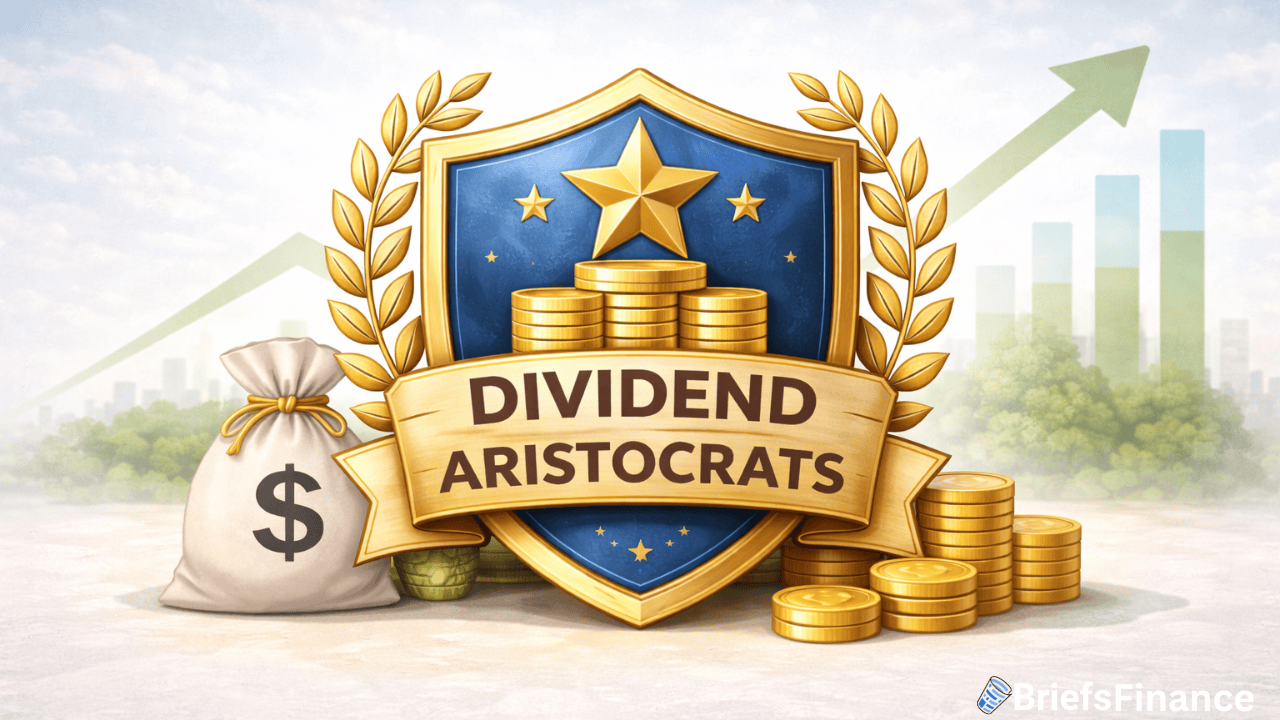
Dividend Aristocrats List 2026: What They Are & Stock Breakdown

Published: Feb 23, 2026 
Disclosure: Briefs Finance is not a broker-dealer or investment adviser. All content is general information and for educational purposes only, not individualized advice or recommendations to buy or sell any security. Investing involves significant risk, including possible loss of principal, and past performance does not guarantee future results. You are solely responsible for your investment decisions and should consult a licensed financial, legal, or tax professional before acting on any information provided.
Summary:

Dividend Aristocrats are S&P 500 companies that have raised their dividend every single year for at least 25 years straight.

As of early 2026, there are 69 Dividend Aristocrats.

Below you'll find the full list, the education behind why they matter, and exactly how to think about them.

First Things First: What Is a Dividend?

Before we talk about Aristocrats, let's back up.

A dividend is cash a company pays you just for owning its stock. 

You don't have to sell anything. You don't have to do anything. You just hold the shares, and the money shows up in your account - usually every quarter.

Dividends are paid out of a company’s profits - and not every company pays a dividend.

That’s because companies are not legally obligated to pay a dividend. Many companies have paid dividends for years.

For instance, Dividend Kings have paid dividends for at least 50+ years.

And while there are around 57 recognized Dividend Kings, there are plenty of other companies that have been paying dividends for 25+ years.

Companies with 25+ years of paying dividends in the S&P 500 are known as Dividend Aritocrats.

The point? These are companies that have proven track records of returning profits to shareholders.

Know these companies literally pays - so let’s break down what a dividend aristocrat is, the full list, and how investors can actually buy shares in these companies.

Dividend Aristocrats are just one potential investment opportunity for investors.

Our market analysts are researching new stocks every week in Market Briefs Pro.

Click here to subscribe and find out which stocks our analysts are watching right now.

What Is a Dividend Aristocrat?

Not every company pays a dividend. And not every company that pays a dividend keeps raising it.

A Dividend Aristocrat is a company in the S&P 500 that has increased its dividend every single year for at least 25 consecutive years. 

That's two-plus decades of commitment - through recessions, market crashes, pandemics, and interest rate cycles.

These companies raised their payouts through the dot-com crash, the 2008 financial crisis, and even COVID-19 in 2020. 

That kind of consistency doesn't happen by accident. It signals a business with strong cash flow, disciplined management, and real staying power.

As of 2026, there are 69 Dividend Aristocrats on the S&P 500.

Why Do Dividend Aristocrats Matter to You?

When you invest in a Dividend Aristocrat, you're not just buying a stock. You're buying a track record. 

You're buying a business that has weathered every major financial storm of the last quarter century and still found a way to pay shareholders more each time.

Dividends are also one of the best ways to fight inflation. While a fixed savings account stays frozen in place, a growing dividend keeps up with rising prices.

Most Dividend Aristocrats also let you enroll in a DRIP - a Dividend Reinvestment Plan. 

That means every dividend payment automatically buys you more shares. 

More shares generate more dividends. Which buys more shares. It's the compound growth snowball, and it's powerful.

The Full Dividend Aristocrats List 2026

Here are all 69 Dividend Aristocrats, organized alphabetically so you can find them quickly. Yields are current as of early 2026.

CompanyTickerConsecutive Years of Dividend IncreasesDividend Yield
A.O. SmithAOS321.8%
AflacAFL422.2%
Air Products & ChemicalsAPD432.6%
AlbemarleALB310.9%
AmcorAMCR415.2%
Archer-Daniels-MidlandADM50~3.8%
Atmos EnergyATO412.2%
Automatic Data ProcessingADP50~2.1%
Brown & BrownBRO311.0%
Brown-FormanBF.B413.2%
Cardinal HealthCAH400.9%
CaterpillarCAT320.8%
C.H. RobinsonCHRW271.4%
ChevronCVX383.9%
ChubbCB311.2%
Church & DwightCHD291.2%
Cincinnati FinancialCINF64~2.9%
CintasCTAS420.9%
CloroxCLX47~3.6%
Coca-ColaKO63~3.1%
Colgate-PalmoliveCL62~2.3%
Consolidated EdisonED50~3.5%
Dover CorporationDOV70~1.4%
EcolabECL331.0%
Emerson ElectricEMR48~2.0%
Erie IndemnityERIE372.1%
Essex Property TrustESS314.0%
Eversource EnergyES254.4%
Expeditors InternationalEXPD311.0%
ExxonMobilXOM422.7%
FactSet Research SystemsFDS252.2%
FastenalFAST262.1%
Federal Realty Investment TrustFRT57~4.3%
Franklin ResourcesBEN444.7%
General DynamicsGD321.7%
Genuine PartsGPC69~3.2%
Hormel FoodsHRL59~4.0%
IBMIBM302.6%
Illinois Tool WorksITW61~2.5%
J.M. SmuckerSJM24*4.2%
Johnson & JohnsonJNJ63~3.1%
Kimberly-ClarkKMB52~3.8%
LindeLIN331.2%
Lowe'sLOW62~2.0%
McCormickMKC392.8%
MedtronicMDT472.9%
NextEra EnergyNEE302.7%
NordsonNDSN61~1.2%
NucorNUE51~1.5%
Ohio Art (Leggett & Platt)LEG53~9.0%
PentairPNR48~1.2%
People's United FinancialPBCT30~4.3%
PPG IndustriesPPG54~2.0%
Procter & GamblePG68~2.5%
Realty IncomeO315.0%
Roper TechnologiesROP321.1%
S&P GlobalSPGI51~0.8%
Sherwin-WilliamsSHW470.9%
Stanley Black & DeckerSWK57~4.1%
SyscoSYY55~2.9%
T. Rowe PriceTROW385.5%
TargetTGT56~4.1%
V.F. CorporationVFC51~7.5%
W.W. GraingerGWW53~0.8%
WalmartWMT52~1.3%
West Pharmaceutical ServicesWST320.3%
Xcel EnergyXEL52~3.2%

*J.M. Smucker note: S&P added them to the index in 2023 despite a 21-year streak at the time. Their dividend was paused in the 1990s but has grown without interruption since.

Yields marked with ~ are approximated based on available 2025–2026 data and may have changed. Always verify current yields on a financial platform like Yahoo Finance or your brokerage before investing.

Dividend Aristocrats vs. Dividend Kings

You might see "Dividend Kings" mentioned alongside Aristocrats. Here's the quick breakdown:

Dividend Aristocrats → 25+ consecutive years of dividend increases, must be in the S&P 500.

Dividend Kings → 50+ consecutive years of dividend increases (the truly elite tier).

All Dividend Kings are essentially Aristocrats (or would be), but not all Aristocrats have reached King status yet. 

Companies like Procter & Gamble, Coca-Cola, and Johnson & Johnson sit comfortably in the King tier with 60+ year streaks.

How Do You Actually Invest in Dividend Aristocrats?

You have two main routes.

Option 1: Pick individual stocks. Go through the list above, research the companies that interest you, and build your own portfolio. 

This gives you full control over which names you hold and at what weights.

Option 2: Consider ETFs. The NOBL ETF allows investors to invest in multiple Dividend Aristocrats, all at once.

There’s also general ETFs for dividends as well, such as VYM and VIG - while not exclusive to Dividend Aritocrats, investors can gain exposure to dividend companies and companies with high dividend yields.

What to Watch Out For

Dividend Aristocrats are some of the most reliable income stocks in the market. 

But "reliable" doesn't mean "risk-free."

Dividend cuts happen. Even Aristocrats can be removed from the list if business conditions deteriorate. 

During COVID in 2020, ExxonMobil - a 40+ year Aristocrat - kept its dividend flat (not growing) rather than cutting it entirely. 

They held on. Others didn't. 

Airlines, retailers, and banks slashed dividends across the board.

High yields can be a warning sign. A yield of 7%, 8%, or 9% often means the stock price has dropped significantly, which automatically inflates the yield percentage. 

That can signal trouble. The Aristocrat list includes a few high-yielders worth examining closely.

Taxes matter. Dividends are taxable income. 

Qualified dividends (which most Aristocrat dividends are) get taxed at preferential capital gains rates - 0%, 15%, or 20% depending on your income bracket. 

If you're investing in a taxable brokerage account, keep this in mind. 

Tax-advantaged accounts like IRAs shelter dividend income from annual taxes, which can significantly improve long-term returns.

Dividend Aritocrats: The Bottom Line

Dividend Aristocrats are not flashy. They're not the AI stocks dominating headlines. They're not going to 10x in a year.

What they will do is pay you - and pay you more - year after year, through good markets and bad. 

Over 25, 30, or 40 years of compounding, that consistency can build serious wealth.

Keep in mind though: Dividends are never guaranteed. 

Dividends Kings and Aristocrats have managed to keep paying dividends for decades, but that does not mean they always will.

Still Dividend Aristocrats could be a potential opportunity for some investors seeking income and cash flow from their assets. 

Looking for more potential opportunities?

Subscribe to Market Briefs Pro.


Tag »

More Deep Briefs

The Strategic Bitcoin Reserve: Why the Government Wants Bitcoin to Explode

BRIEFS EXCLUSIVE: 43% Of Respondents Say Bills Outran Their Income Over Past Two Years

The Economy Is Booming. So Why Did Stocks and Bonds Fall Together?

The 2026 Economic Reset Is Starting: Are We in a Recession, or Is the Pain Still Ahead?

Are We in a Recession? Without AI, America Might Already Be in One - and Washington Knows It

Will Interest Rates Go Down in 2026? Where the Money Moves Either Way

How the Federal Reserve Makes Money - and Why It Just Posted Its Biggest Loss Ever

Kevin Warsh Just Defied Trump: What the Fed Rate Hike Means for Your Money

Why America Bailed Out the Yen: The Japan Carry Trade, the Dollar and Your Mortgage Rate

Treasury Yields Are Spiking Because Lenders Are Backing Away From U.S. Debt

Fiat Currency Runs on Trust, and the World Just Stopped Trusting the Dollar

Why RAM Prices Are Soaring - and Where the Money Is Moving

How Is the Economy Doing? Washington Says It's Fixed, but the Numbers Don't Agree

US National Debt Hits $40 Trillion: Why the Economy Hasn't Collapsed Yet

Your 401k Is Fueling the AI Bubble

What Is Wealth Preservation? How To Protect Your Money From Anything

Why Is Everything So Expensive? Why Prices May Never Come Back Down

The U.S. Housing Market Just Flipped: Renting a Home Now Beats Buying One

An Interest Rate Hike in 2026? The Fed Just Broke Its Own Script

5 Passive Income Ideas That Pay You Whether You Work or Not

The Best Way to Invest 10k: Three Options To Transform 10K into 10 Million

The Tax Write Offs the Rich Are Using in 2026 While the IRS Shrinks

America Is Running Out of Debt Buyers. Treasury Bills Are the Government's Fix

How to Get the Most From Your Guideline 401k

Principal 401k: What to Know About Your Plan

What a Tariff Dividend Means for Your Money

No Tax on Overtime: How Overtime Pay Is Taxed

Reading the Silver Price Forecast for 2026

What to Do When Reddit Stocks Go Viral

Why Is Bitcoin Dropping Right Now?

The Fidelity 500 Index Fund, Made Simple for Beginners

USA Penny Stocks: Risks and Rewards Explained

Finding Cheap Stocks to Buy Now Without Getting Burned

Best Dividend Stocks: A Beginner's Playbook

Roth 401k, Explained for New Investors

How a Roth IRA Calculator Shows Your Future Wealth

Portfolio Diversification: Why Putting All Your Eggs in One Basket Destroys Wealth

Non Taxable Income: What It Is and Why It Matters

Semiconductor Stocks: A Simple Guide for Investors

How Stocks Work: A Simple Guide for Beginners

Stop Loss vs Stop Limit: What's the Difference?

Energy Stocks: A Simple Guide for Investors

What Is a Stop Loss Order? A Simple Guide

Best S&P 500 Index Fund: How to Choose One

What Are Penny Stocks? Risks and Rewards Explained

Best Stocks for Beginners With Little Money

Tech Stocks: A Simple Guide for New Investors

What Is a Joint Stock Company? A Simple Guide

Capital Gains Tax in California: A Simple Guide

Top Covered Call ETFs: How to Compare Them

What Are Stock Options? A Plain-English Guide

EBITDA Margin: What It Is and How to Calculate It

What Is Taxable Income? A Simple Guide for Investors
What Is a Covered Call? How the Strategy Works

What Is Gross Margin? A Simple Guide for Investors

What Is a Dividend? A Plain-English Guide for Investors

Financial Literacy Books That Actually Build Wealth

What Is a Roth Conversion? A Simple Guide

Trailing Stop Loss: How to Protect Your Gains

5 Types of Wealth: Why Money Is Only One of Them

How to Invest in Private Equity: A Beginner's Guide

What Is a Call Option? A Simple Guide With Examples

EBITDA Formula: How to Calculate It Step by Step

What Is a Stock Option? A Plain-English Guide

Put Option: What It Is and How It Works

Operating Margin: What It Is and How to Calculate It

Enterprise Value: What It Is and How to Calculate It

Free Cash Flow: What It Is and Why It Matters

What Is Working Capital? A Simple Guide for Investors

Covered Call: How This Income Strategy Actually Works

Gross Margin: What It Is and How to Calculate It

Backdoor Roth IRA: A Simple Guide for High Earners

Mega Backdoor Roth: A Simple Guide for Big Savers

Dividend Calculator: How to Estimate Your Dividend Income

How to Create Multiple Income Streams: A Beginner's Playbook

The 60/40 Portfolio Explained: A Beginner's Guide

How to Invest in Silver: A Beginner's Guide

Asset Allocation by Age: The Right Portfolio Mix at Every Stage of Life

Stablecoin Explained: Why Some Cryptocurrencies Actually Aren't Volatile

Buy Now, Pay Later Risks: Why This "Easy" Payment Method Is Dangerous to Your Wealth

Dividend Payout Ratio: The Secret Metric That Shows If a Stock Is Safe or Risky

Ethereum for Beginners: What It Is and Why Smart Investors Are Paying Attention

Dollar Cost Averaging Strategy: How to Beat Emotion and Build Wealth Steadily

The BRRRR Strategy: How to Build Real Estate Wealth Without Big Money Down

What Is GDP? A Beginner's Guide to Understanding Economic Growth

What Is Blockchain? A Plain English Guide For Investors

How To Negotiate Bills: The Script That Saves You Hundreds A Year

75 15 10 Rule: The Budget That Builds Wealth On Autopilot

How To Rebalance Portfolio: The Strategy That Forces You To Buy Low And Sell High

How To Buy Treasury Bonds: A Beginner's Guide

Forward Vs Futures Contracts: What's The Real Difference?

Alternative Investments Explained: What They Are And Why They Matter

How To Buy Bitcoin For Beginners: 3 Simple Ways

How To Follow Smart Money: The 5 Market Shifts Framework

Insider Trading Meaning: What It Really Is (And Why Some Of It Is Legal)

Core-Satellite Portfolio: The Best of Both Worlds

Bond Ladder Strategy: The Income Plan With Built-In Flexibility

Silver vs Gold Investing: Which One Belongs in Your Portfolio?

What Is a Dividend Reinvestment Plan? The Wealth Snowball Explained

How Tariffs Affect the Stock Market

1 2 3

Get Market Briefs delivered to your inbox every morning for free!

No fluff. No noise. No politics. Just finance news you can read in 5 minutes.
Join Free

Blogs

October 5, 2026
What Is the Briefs Connector? A Simple Guide
  • The Briefs Connector lets your favorite AI read Briefs research, like Pro reports and the Briefs Score.
  • Without it, an AI asked about investing can give answers that sound right but aren't backed by that research.
  • It explains the research, but it won't tell you what to buy or sell.
Read More
October 5, 2026
Is a Recession Coming? What the Last Five Rate Hiking Cycles Say
  • The Fed has started raising rates again, and in the last five hiking cycles going back to 1994, a recession never started while the hikes were underway.
  • The pain showed up where there was a bubble to pop - housing in 2008, dot-coms in 2000, the pandemic money-printing boom in 2022 - and usually after the hikes ended.
  • Private equity and private credit are feeling this cycle first, and how far the pain spreads depends on how high rates go and how long they stay there.
Read More
October 2, 2026
Fed Interest Rates May Rise Again in 2026 - and the Newest Culprit Is AI
  • Fed Governor Barr told a meeting our head of investing research attended that higher rates are likely in 2026, lower inflation may not come soon, and AI is now pushing prices up.
  • The same week, President Trump asked the biggest AI companies to police themselves under an accord that's morally but not legally binding, because the White House sees AI as a race with China.
  • Higher rates put downward pressure on asset prices and squeeze borrowers, but the way through hasn't changed: own investments, buy on a schedule, and treat downturns as discounts.
Read More
October 1, 2026
Housing Market 2026: Why Office Buildings Are Cracking Before Houses Do
  • Office buildings are selling for 80% to 95% off because their five-year loans are resetting at much higher rates while half-empty floors have gutted the income those buildings are valued on.
  • Housing is under pressure, not cracking: a $400,000 mortgage costs $975 more a month than at 3%, but six of every seven mortgages are still under 6% and those owners are staying put.
  • Whether pressure turns into cracks is a race between unaffordability and the economy, and either way Jaspreet's rule is to treat your house as a liability and buy only what you can afford.
Read More
September 30, 2026
Dividend Investing vs. Growth Investing: Why the Slower Portfolio Can End Up Bigger
  • "What stock should I buy?" is the wrong first question. Growth, income, or wealth preservation comes first, and the goal changes which stocks even make sense.
  • At $500 a month for 30 years, 13% growth builds about $1.75 million. 10% growth plus a reinvested 4% dividend builds a little more than $2.2 million and pays a little more than $80,000 a year.
  • Income investors have US dividend ETFs, REITs, and international dividend funds to study. Growth investors have the Nasdaq 100, AI and chip funds, and small caps. None of it is a recommendation.
Read More
September 29, 2026
Why Is Gold Going Down? A 5.2% Treasury Yield Just Took Its Job
  • President Trump rejected Iran's deal to reopen the Strait of Hormuz, oil prices jumped back up, and gold fell instead of rising.
  • Treasury yields hit their highest level in more than 20 years, so investors sold gold and bought Treasuries that pay interest.
  • Higher Treasury yields make the national debt, mortgages, car loans, and credit cards more expensive, with the Fed's next rate decision due October 28.
Read More
September 28, 2026
The Strategic Bitcoin Reserve: Why the Government Wants Bitcoin to Explode
  • The US government holds about 328,000 Bitcoin, worth roughly $25 billion, and since a 2025 executive order it keeps seized coins instead of selling them.
  • Washington wants a bigger pile of assets so its $40 trillion national debt looks smaller next to them, which lets it keep borrowing and spending.
  • Bitcoin's wild price swings, and a government holding a coin built to escape governments, are the two risks investors need to watch.
Read More
September 25, 2026
BRIEFS EXCLUSIVE: 43% Of Respondents Say Bills Outran Their Income Over Past Two Years
  • 43% of the 494 Market Briefs readers surveyed said their bills grew faster than their income over the past two years, even though 79% could cover a surprise $5,000 expense tomorrow.
  • Half of readers own gold or crypto, the two classic bets against a weaker dollar, and only 13% bought nothing at all in the last 12 months.
  • The median reader says it takes $150,000 a year to feel financially secure, about $62,000 above the U.S. median household income.
Read More
September 25, 2026
The Economy Is Booming. So Why Did Stocks and Bonds Fall Together?
  • S&P Global says the US economy is growing at its fastest rate since 2021, with corporate profits up 28.9% in a year, almost four times the historical average.
  • Stocks and bonds fell at the same time, which is not how the two markets normally behave, because Treasury yields above 5% now compete with stocks for investors' money.
  • Jaspreet Singh lays out three ways to invest through a shift like this: always be buying, buy the crash, or follow the money before it hits the headlines.
Read More
September 24, 2026
The 2026 Economic Reset Is Starting: Are We in a Recession, or Is the Pain Still Ahead?
  • The Federal Reserve has flipped from stimulating the economy to fighting inflation with higher interest rates, while the White House still wants growth at almost any cost.
  • The national debt tops $40 trillion, has outgrown the entire U.S. economy, and its interest payments are now the government's fastest-growing expense.
  • Higher rates bring pain for private equity, private credit, and speculative assets, but they open opportunities for investors holding cash, treasuries, and value assets.
Read More
1 2 3 … 28
Share via
Copy link