The S&P 500 is up about 13% so far this year. That sounds healthy.
Pull AI out of the index and the picture flips. Nearly 40% of the S&P 500's companies have been down more than 20% for four months or longer, which is bear market territory.
Are we in a recession? Not officially, but Jackson, Briefs Finance's head of investing research, says that if AI growth slowed, we would be in one.
Jaspreet Singh sat down with him to walk through the five threats he sees:
- Interest rates: the Fed is raising them and Treasury yields are climbing.
- Inflation: the Fed now says it may stick around longer than expected.
- AI: the economy is so dependent on it that a slowdown would mean a recession.
- The United Kingdom: it's under worse pressure than the US, and it's a preview.
- Oil: the war in the Middle East has dragged on, and high oil prices are trickling into everything.
Investors can feel something is off, with gas prices high, the job market struggling, and rates up. That feeling is what Market Briefs explains every morning, breaking down the economy, stocks, housing, and crypto in a free five-minute read with no politics and no fluff.
Why Interest Rates Are Going Up: The Fed Is Trying to Save the Dollar
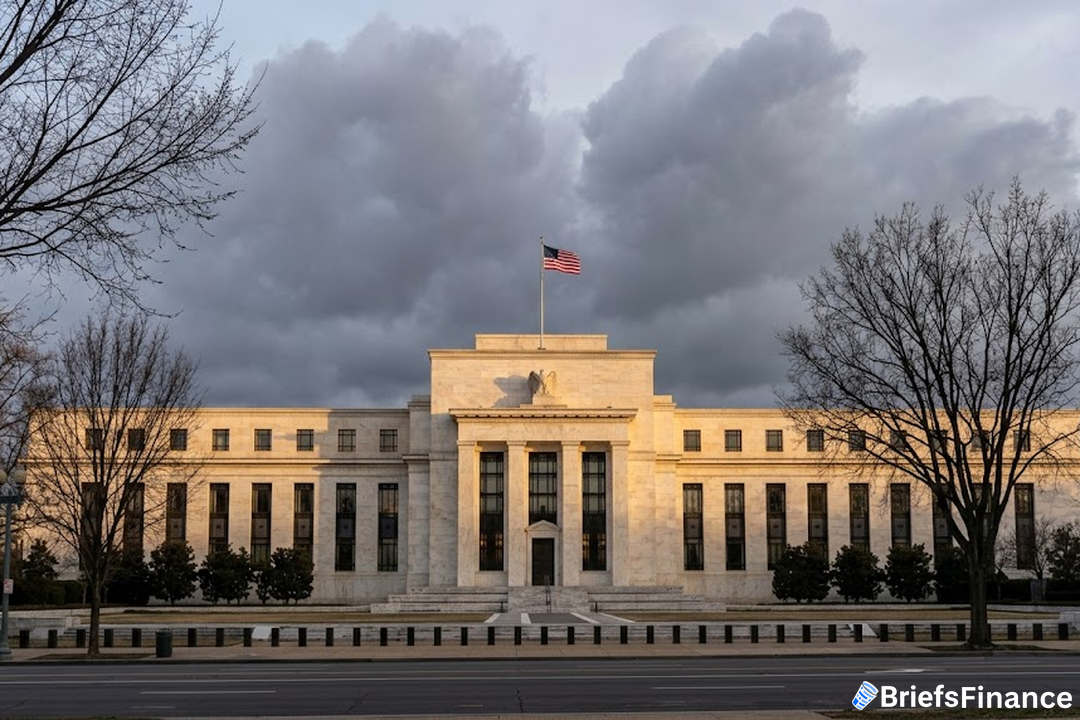
The Fed just raised interest rates for the first time in three years, and the vote was unanimous. Rates are set by the FOMC, the committee of Fed governors that normally argues over every move, and this time everyone agreed.
The reason is the dollar. The Fed's rate is what banks pay to borrow from the government, and when borrowing is easy, more dollars flood the system and each one is worth less.
That's behind the talk of de-dollarization, the idea that countries are moving away from the dollar. With $40 trillion of national debt, investors have been asking whether it can keep its status as the world's reserve currency.
Raising rates is the Fed's way of protecting it. The cost is downward pressure on the stock market and the economy, which Jackson says the Fed treats as separate from its real job, getting inflation down.
Adjustable-rate loans reset higher, and new loans get harder to qualify for. Companies expand with borrowed money, so pricier borrowing means fewer factories, less hiring, and fewer mergers and public offerings.
Why Low Rates Make the Average Investor Poorer
Most people want low rates because they want a cheap mortgage. Jackson argues that's only one side of the coin.
Low rates weaken the dollar, which feeds inflation and sends asset prices booming. Investors get richer while everyone else's dollars quietly shrink.
He compares it to working out. Low rates are a bulk: the economy grows and companies hire, but the dollars people hold lose value, like adding fat along with the muscle.
High rates are a cut, where growth slows but inflation comes down and your dollar is protected. That's better for anyone spending and saving dollars rather than owning assets, even if jobs and raises come easier when rates are low.
A Fed Governor Sees No Path Back to 2% Inflation
Jaspreet recently met with Fed Governor Michael Barr, who sits on the FOMC. Barr told him he sees no path to the Fed's 2% target within a reasonable amount of time at current rates.
Inflation is a little over 3%, around 3.4%, which is 50% to 75% above where the Fed wants it. Part of the problem is that raising interest rates can't lower the price of a barrel of oil, and scarce oil drags natural gas and coal up with it.
Treasury Yields Are Pulling Money Out of Stocks
The government borrows too, by issuing bonds. A bond is a loan investors make in exchange for interest, and a Treasury bond is simply a loan to the US government.
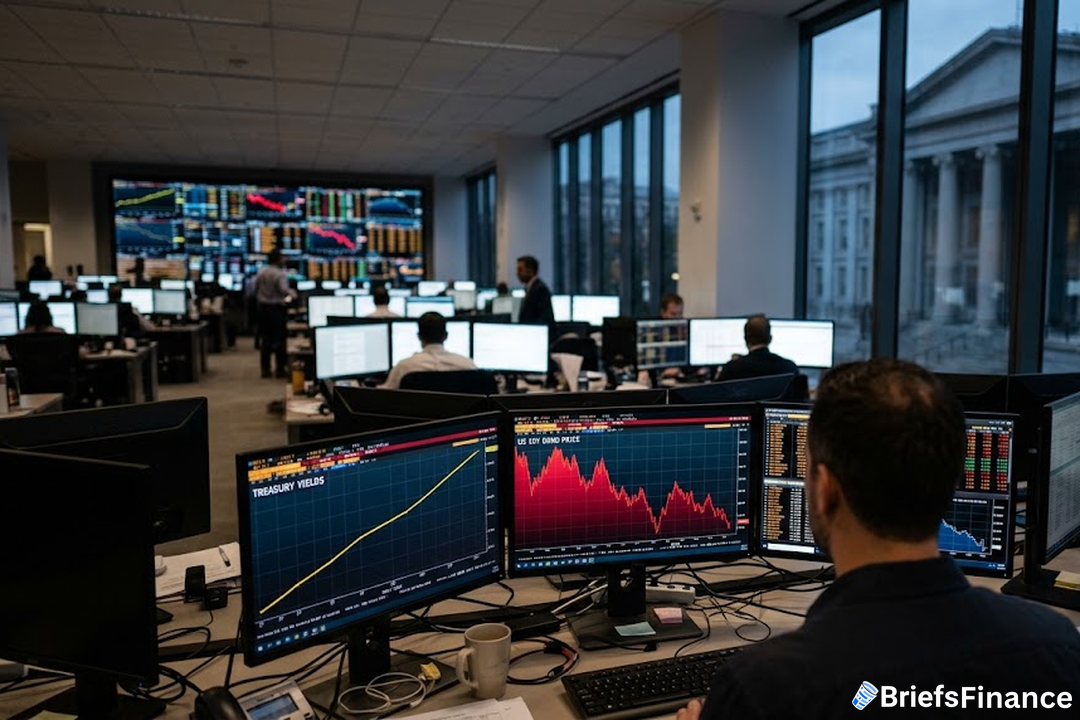
Treasury yields have been climbing because the government needs a lot of money and its debt keeps rising. As the dollar loses value, Washington has had a harder time finding lenders, so it pays more.
A stock is worth whatever the next buyer will pay. Fewer buyers show up when the government is offering history's safest investment at a higher return than normal.
Stocks vs Bonds When the Safe Option Pays 5%
At the time of recording, a 10-year Treasury paid around 5.2%. Not long ago it didn't pay 5%, and it didn't even pay 4%.
The S&P 500, the benchmark every analyst tries to beat, returns about 10% a year over a long span of time.
| S&P 500 | 10-year Treasury | |
|---|---|---|
| Long-run return | About 10% a year | Around 5.2% at the time of recording |
| Risk | Can go up fast or down fast | Viewed as risk free |
| What sets the price | Whatever the next buyer will pay | The government's promise to pay you back |
Jackson's question: if you're worried about an AI bubble or the dollar, wouldn't you take more than half of the stock market's return with what's viewed as zero risk? More investors are answering yes, and that's what is tilting stocks vs bonds right now, even if nobody can promise bonds stay the safest thing on earth.
The 7% to 9% Bonds Guaranteed by US Taxpayers
Every government issues bonds, called sovereign bonds, and many are considered far less safe than Treasuries. Bonds from East Asia, sub-Saharan Africa, or Ukraine, places with less stable governments, pay 7% to 9% instead of 4% or 5% to make up for the risk.
Look closely and you'll find some are guaranteed by a trust at the World Bank that is funded by the United States. In Jackson's words, that's a fancy way of saying you and I are guaranteeing them with tax dollars.
The category is called emerging market bonds. Buying them directly is hard unless you're an accredited investor, which means you have a lot of money and are registered with the government.
For everyone else there are ETFs, funds you buy through your broker that hold a basket of these bonds and pay out the interest, many of them in US dollars. Jaspreet and Jackson have done this themselves, though the higher yield exists because the risk is real.
Inflation Is Sticking Because of Oil
Everyone Jaspreet asks says they feel the pinch, whether they make minimum wage or a lot of money. Prices have gone up a lot in 2026, and Jackson says the biggest reason is energy.
You feel oil first at the pump. But manufacturing is an energy-hungry business, so your electricity bill climbs when oil does, and natural gas and coal follow it higher.
The CPI, the consumer price index that tracks the cost of living, shows energy sticking the most, with shelter, meaning rent and the affordability of a home, rising right alongside it.
The Government Is Fueling the Inflation the Fed Is Fighting
Inflation is really the value of the dollar, or how many dollars it takes to buy anything. Mass money printing puts more dollars into circulation, and each one buys less.
Money gets printed because the government keeps spending money it doesn't have. The national debt is now well past $40 trillion, which is money spent that was never collected in taxes.
To print less, the government would have to cut spending or raise taxes, and it's doing neither. In 2025 the One Big Beautiful Bill Act cut taxes across the board, spending keeps rising, and the war in the Middle East has to be paid for every day it continues.
The debt itself is also getting pricier, since the government doesn't have a 30-year fixed mortgage and a big chunk of that $40 trillion is readjusting at 2026 rates. The gap gets funded with more debt, some of it printed by the Fed, which means more inflation.
So the Fed is raising rates to fight inflation while the government keeps feeding it. As Jackson puts it, the two are actively competing against each other.
The $40 Trillion Question
Cutting spending would cause a recession, because the economy has become addicted to it. Raising taxes would make everyone angry.
Other countries have always helped by buying US debt, but that's gotten harder. Japan, one of the largest buyers, has its own economy and currency problems and recently needed US help to bail out the yen.
So the Trump administration has leaned on tariffs and trade deals. Last year the US told Japan it would face an enormous tariff unless it made massive investments in the American economy.
Japan couldn't afford it, so it relied on SoftBank, which made a massive investment in Intel.
The US owes about $40 trillion on an economy of about $32.5 trillion, a debt-to-GDP ratio of roughly 125%. Jackson's analogy: a $500,000 house with a $400,000 mortgage has equity, and the same house with a $600,000 mortgage is underwater, which is where the country is now.
Paying the debt off is never going to happen, so the plan is to pull in foreign investment and grow the economy so fast that $40 trillion feels like nothing. It was a popular theory in the 1980s and has never been pulled off at this scale.
Are We in a Recession? Not Yet, and AI Is the Reason
The US economy is heavily reliant on AI to keep GDP growing. Jackson says that without AI, we might be in a recession right now.
That's why so much money and legislation is flowing into it: the government wants to beat China and to grow the economy faster than the national debt.
The risk isn't that AI fails. It's that AI growth slows, which Jackson thinks could be enough to crash the market.
AI is holding up more than tech. Data center real estate has done extremely well this year, and data centers, hardware makers, and chip factories are the biggest new buyers of energy.
If AI weren't growing this strongly, Jackson says about half of all US stocks would be deep in the red.
What Happens If the AI Bubble Bursts
Higher rates put downward pressure on stocks, and historically they also act like a needle when there's a bubble. Jaspreet's take is that the market is almost always in some kind of bubble; the real question is how big the catalyst is that pops it.
With the country relying on AI to fix its debt and dollar problems, investors are getting nervous about an AI bubble. Jackson says it's hard to call, because AI has been earning so much money that it ignores the normal rules of the economy.
Even before the 2026 hike, when rates were already high, Nvidia took out a $500 billion loan from private equity to expand. That's also the biggest difference from the dot-com bubble everyone compares it to, when the internet was revolutionary and nobody had revenue to justify the valuations.
AI is already making money, and the chipmakers sitting on physical bottlenecks are making more than anyone ever has. But AI is also the most energy-hungry industry in the country, and available energy is already one of its biggest constraints.
In an energy shock, Jackson sees two outcomes: AI costs go up, or AI growth slows. Energy and higher rates become a double competing force against the same industry.
AI valuations aren't priced on the money Nvidia makes this quarter; they're priced on next quarter. If energy keeps pushing up the cost of producing chips, those companies can't grow their profit margins, and that mismatch is where bubble behavior starts.
When It Shows Up in Earnings
Wall Street has a saying: when oil goes up, you feel it at the pump four weeks later and in manufacturing four months later. Jackson worked in manufacturing for a long time, and he says companies use the books to hold those costs off for 8 to 12 months.
We're in that window now. Jackson expects it to surface as lower production or higher costs in the Q4 and annual reports due in the next couple of months, or 3 to 6 by Jaspreet's count.
Either way, costs rise in 2027 and 2028, when many of the 5 and 10-year contracts companies like Nvidia and Taiwan Semiconductor signed for energy, wiring, and land come up for renewal. With how much money AI is generating, Jackson expects suppliers to charge more.
The UK Is a Preview of What Happens Next
The United Kingdom is facing higher interest rates than the US and real pain in its economy. When the US 10-year hit around 5.2%, that was abnormally high; the UK gilt, Britain's version of a Treasury, has been hovering around 7%.
Its inflation is very high because the trade routes it relies on have all been threatened. The UK doesn't produce much itself, a model that dates to the British Empire pulling resources from everyone else by force and diplomacy.
That works until shipping gets expensive and trade routes are threatened, and then prices rise with no way to control them. The US has taken a page from the same playbook, since American manufacturing has been declining for a long time.
Bringing factories back is a big part of the president's platform, but that takes time the US doesn't have. For now, its economy operates closer to the UK's than most investors think.
Where the Money Is Moving
So what does an investor do with all of this? Jackson sees a few big opportunities, most of them outside the dollar.
Diversify away from the dollar. Jackson looks at countries isolated from the dollar but still in the global market and on the rise, like Brazil and Indonesia. If the US struggles, it has less impact on Brazil, which recently saw a huge bump in its economy, and he's been bullish on it for a long time.
US-guaranteed emerging market bonds. The ones the US has already guaranteed are safe, because the money to back them is already sitting in an account. The US may guarantee fewer going forward, Jackson says, so there are fewer of the backed ones on the open market.
The AI trade. AI has been beating expectations, not just meeting them. For investors who want a piece of the growth the US does have, the AI trade and what's connected to it has done well.
Jaspreet calls this a market shift, and he's clear that he doesn't recommend what he does to anyone else. His baseline is ABB, always be buying: buying into the market every week, every two weeks, or every month.
With a higher cost of living that may not be enough, and two things can accelerate it. One is a market crash, which nobody can time, but if the AI bubble bursts and the market falls 80%, the panic creates a great buying opportunity for long-term wealth.
The other is a market shift, which exists in every economy at every stage and comes from finding where money is moving. It's more work and more risk, but also more opportunity for return.
Finding where the money is moving is also what Market Briefs does, tracking those shifts across stocks, housing, crypto, and the global economy for hundreds of thousands of investors every morning. The key, in Jackson's words, is to not feel overwhelmed and just get started.
The Good News
There's a lot of fear out there. Jackson's reminder is that the market will crash again, the way it always has, and recover, the way it always has.
A crash means money got imbalanced and fear pushed people out, and in the long run that works out. Money is shifting, out of fear, war, oil, debt, and currencies getting out of control, and every time it does, it creates opportunity.
Anytime money shifts in a major way, it creates the chance to build generational wealth. Those opportunities don't come around every day, and Jackson thinks we're seeing one right now, with several more coming in the years ahead.