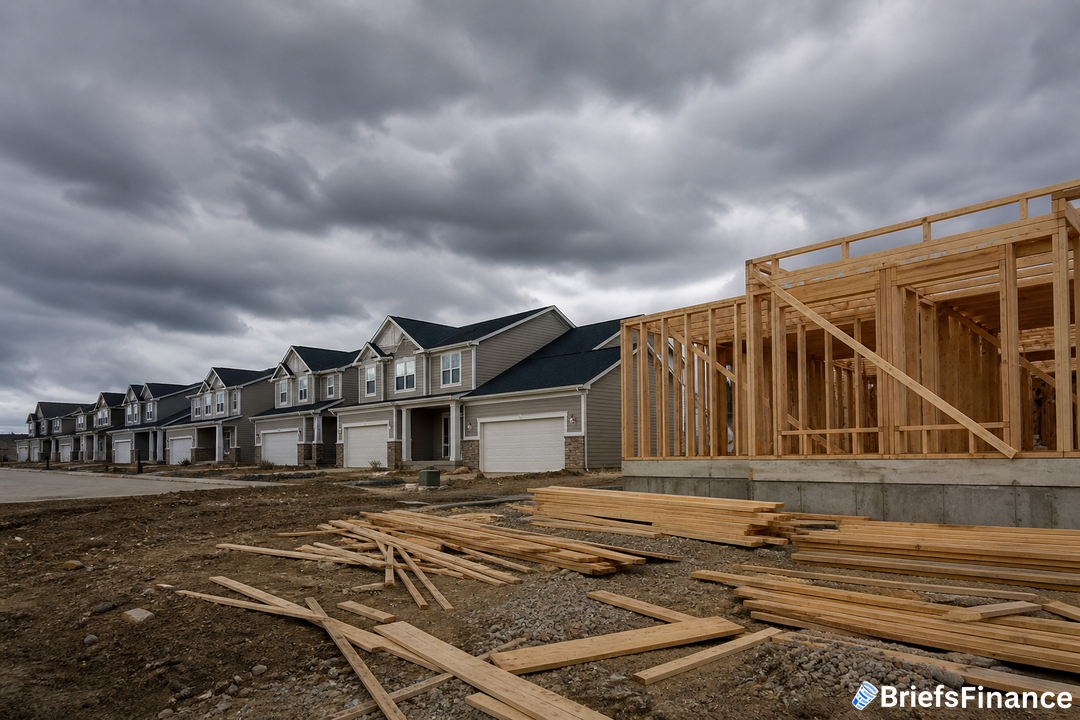
The S&P Composite 1500 Homebuilding Index has dropped 16% since mid-February while the S&P 500 rose 5.3%, and it is down 0.9% year to date, putting builders on pace for a third straight annual loss for the first time since 2008.
Inflation and higher oil are lifting input costs, mortgage rates remain elevated, and demand is soft, with gross margins for Meritage Homes Corp., Lennar Corp., and NVR Inc. projected to reach multiyear lows in 2027.
The SPDR S&P Homebuilders ETF is on track for a second consecutive year of outflows, the longest stretch since 2018, as analysts flag rising labor costs, longer build times, and bigger buyer incentives.
What happened to homebuilder stocks
Homebuilder shares are staring at a rare three-peat of annual declines. Since a mid-February top, the S&P Composite 1500 Homebuilding Index has slid 16%, even as the broader S&P 500 gained 5.3%.
Money is also drifting away from the sector's big fund. The State Street SPDR S&P Homebuilders ETF is on track to notch annual outflows for a second year, marking the longest run since 2018.
Why margins and demand look weak
The cost side is getting heavier. Persistent inflation and pricier oil are filtering into materials like cement, aluminum, and paint. To keep sales moving, builders are dangling larger incentives even as those bills rise.
Demand has cooled. Pending sales of existing US homes reached a record low in October as higher borrowing costs pinched activity, and homebuilder sentiment fell to a new 14-year trough this month. As Roundhill Investments CEO Dave Mazza put it, "Three down years in a row tells you investors have stopped waiting for the rate relief trade and started pricing homebuilders for what they are right now: companies paying buyers to show up." He added, "Homebuilders do not need lower rates to rally, they need buyers to believe lower rates are coming, and until then this group is a value trap wearing a cyclical's jersey."
Bloomberg's estimates point to gross margins at Meritage Homes, Lennar, and NVR dipping to multiyear lows in 2027. Evercore ISI analyst Stephen Kim said labor costs are climbing as the artificial intelligence buildout and stepped-up Immigration and Customs Enforcement activity shrink the pool of workers. That is stretching construction timelines, pushing up carrying costs, and prompting more speculative starts.
Because housing can influence broader financial plans, stay on top of developments with the free Market Briefs newsletter every morning.
The path to a turnaround
Analysts say a steadier rate backdrop is a prerequisite for demand to return and for incentives to roll off. "The single biggest catalyst would be a sustained drop in rates driven by cooling inflation rather than a deteriorating economic outlook," said Bloomberg Intelligence analyst Drew Reading. The risk list is not short: rates that stay higher for longer, weaker consumer confidence, tariff driven cost increases, or labor shortages.
Policy is not easing the pressure. In December, the Federal Reserve is anticipated to deliver a second rate increase this year, and several officials recently said the central bank still has "work to do" on inflation.
Evercore's Kim laid out two roads ahead. If builders trim production to match demand, margins could trough in the second quarter, opening the door to a brighter 2028. The alternative is rougher - a round of impairments, which tend to emerge when margins slip to the low single digits, a level some builders are nearing.
What it means for your portfolio
This is not 2008. As Mazza noted, "The stocks are losing because most cannot afford a 7% mortgage, not because the system is broken, and that is a much more fixable problem than the last one." Luxury names such as PulteGroup Inc. and Toll Brothers Inc. may be cushioned in a K-shaped economy, yet pressures tied to labor, land, and materials touch every corner of the industry. One accounting wrinkle to keep in mind: Lennar closes its fiscal year on Nov. 30, while the others finish on Dec. 31.
The bottom line: builders are being valued for slower demand, higher costs, and bigger incentives, and a durable recovery likely depends on cooling inflation and a convincing slide in rates rather than a weakening economy.
Markets move for many reasons, so get clear, concise context about housing and finance from our free Market Briefs.
Anthropic has gone public at a valuation of about $1.5 trillion, while Amazon went public in 1997 at around $440 million. Anthropic has about $33 billion in revenue this year and no profit, and investors are paying more than 40 times its sales, against about 3 times for Amazon. Briefs Finance CEO Jaspreet Singh says nobody knows what comes next, and that long-term investors use downturns to buy instead of panic selling.
Tech stocks are selling off because investors don't know who will lead Nvidia, the company that has been funding the AI industry and selling it chips.
Inflation has the Federal Reserve planning to raise interest rates, with a hike expected in December, and that puts pressure on homebuyers, private equity and the $40 trillion national debt.
Briefs Finance CEO Jaspreet Singh says nobody has a crystal ball, so his rules are to buy when markets are low, hold long term and invest only what you're willing to lose.
The national debt is above $40 trillion, and the Federal Reserve has gone from sending Washington its profits to losing money.
President Trump's four-part plan leans on shorter-term debt, stablecoin companies buying Treasuries, a bigger balance sheet and government stakes in private companies.
The goal is to outgrow the debt, not pay it off, so Jaspreet Singh points investors to the seven industries where Washington wants growth.
The Fed makes its next rate decision on December 9 and is now talking about jumbo interest rate hikes of 0.5%, though one in December looks unlikely.
Washington will pay a record $1.05 trillion in interest this year on $40 trillion of debt, and that debt resets at higher rates as the Fed hikes.
Jaspreet Singh's five moves are to pay down variable-rate debt, earn interest on your savings, know which stocks feel the pressure, look at value and hedge.
Margin debt, the money investors borrow to buy stocks, is at a record of around 4.6% of GDP, up from 3.9% in 2021.
ETF money has more than tripled in five years to 7% of GDP, while corporate buybacks and 401(k) money sit below their earlier peaks.
Margin calls and panic selling can make the next downturn deeper, so Jaspreet Singh keeps buying broad market funds and says most investors should skip margin debt.
Jensen Huang is out at Nvidia over affairs with multiple people, and the company he founded has been the bank of American AI, with about $30 billion into OpenAI and $10 billion into Anthropic.
A hotter-than-expected inflation report has Fed officials talking about a possible 0.5% hike in December, and gold, silver, and bitcoin fell on the news.
President Trump said the US may not need a deal with Iran, keeping oil prices and inflation risk high. Jaspreet Singh breaks down what it all means for AI stocks and your portfolio.
Stocks are booming at the fastest pace in years, jobless claims just hit a 57-year low, and most investors still feel like nobody is hiring.
The Fed is protecting the dollar over the economy, oil swings on every Iran headline, and a few AI companies are carrying an S&P 500 where four of five stocks sit in a correction.
Jaspreet Singh explains why circular financing between Nvidia, OpenAI, Anthropic, and SpaceX rhymes with 2008's house of cards, and how his three investing pillars handle a stock market bubble.
The Fed has raised rates, cut them, then raised them again only twice in the last 60 years, and both times the economy fell into a recession and stocks crashed.
The same stop-and-go cycle is playing out now, with one big difference: US debt is 125% of GDP today versus about 30% in 1980.
In the 1970s gold rose roughly 24x, real estate 157%, stocks lagged, and cash lost half its value. Jaspreet Singh lays out five assets to consider before the next flip.
The IRS 2027 tax plan keeps the same seven rates but widens every bracket and lifts the married-filing-jointly standard deduction to $33,200.
The 0% long-term capital gains bracket rises to $102,100, so a household living on $135,300 of investment income could owe $0 in federal income tax.
C corporations still pay 21%, small businesses keep the 20% QBI deduction, and the 401(k) limit climbs to $25,500 with an $8,500 catch-up for investors over 50.
Make sure to check your inbox for the first email.
Before you go
We’re hosting our first ever livestream on how investors can use ChatGPT & Claude to invest like a pro. It’s on 11/17 and is hosted by our CEO Jaspreet Singh.