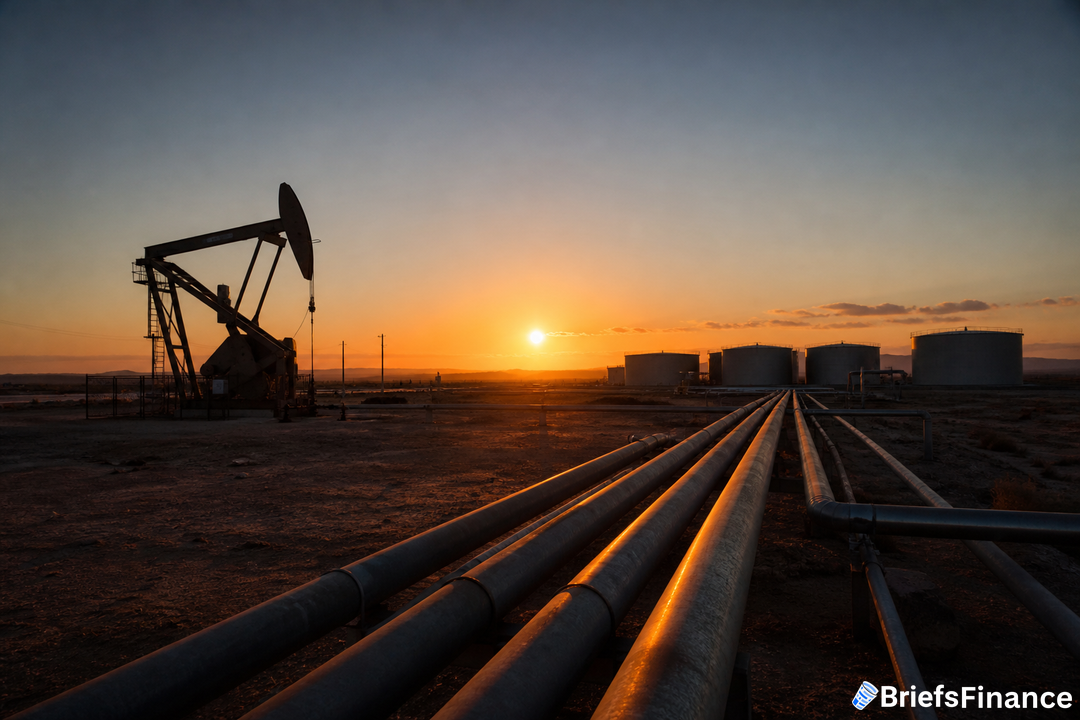
OPEC+ ministers convene Sunday to map 2027 supply, weighing a just-finished capacity audit and the potential endgame of the Iran war.
A DeGolyer and MacNaughton review delivered member-by-member capacity figures this month to serve as new baselines for quotas set to begin in January.
Prices are volatile and politics are messy: Brent is down almost 25% this month but up about 40% year over year, the UAE has walked away, and Iraq is pressing for a bigger allocation.
What is on the table Sunday
Ministers from the Organization of the Petroleum Exporting Countries and their allies meet at month-end with an unusually high-stakes task: sketching a production framework for 2027. They will try to position the group for a scenario where the Iran war subsides while also managing fractures within the alliance after years of quota disputes.
A key input is fresh. Dallas-based DeGolyer and MacNaughton completed an independent review this month to estimate each member's maximum sustainable output. Those numbers are intended to anchor the next round of national targets from January, though delegates say the exact formula for translating capacities into quotas is still to be decided.
The rollout has been opaque. Countries were told only their own results, and no master list of every member's capacity was circulated, according to delegates. That leaves many capitals heading into the meeting without a clear read on how they stack up against peers.
Inside the audit and the process so far
On Nov. 16, OPEC's Vienna secretariat and several national representatives held an online session marking the audit's completion and shared individual results. Delegates described the call as brief, with little room to discuss the capacity figures, and one said they were surprised there was no groupwide table of the numbers. OPEC's secretariat did not respond to a request for comment.
The group must also account for earlier policy moves. From April 2025 through September 2026, a subset of members formally brought back two layers of supply halted in 2023 via pre-set monthly hikes, even as war-time disruptions turned those increases into mostly symbolic steps. One more chunk of output sidelined in 2022 is still technically out of play, and folding it into 2027 planning is complicated by capacity erosion in several countries tied to limited investment and sanctions.
In practice, the review may only open the door for a few producers to lift output. Many members are close to their ceilings, while others - notably Saudi Arabia - are still expected to hold spare capacity. Ahead of the meeting, both Riyadh and Baghdad said they had restored war-hit production to levels exceeding their current OPEC+ quotas.
When energy decisions affect many people, staying informed matters, so sign up for the free Market Briefs newsletter today
Friction points: Iraq's push, UAE's exit, and past fallouts
If anyone is lobbying hardest for a bigger slice, it is Iraq. In June, the oil ministry floated - then retracted - the possibility of determining "whether to remain in or withdraw" from the group if its calculated capacity was judged too low. In September, Baghdad was seeking a 6 million barrel a day baseline, according to people familiar with the matter.
The politics got tougher after the United Arab Emirates quit following long-running frustration with curbs that limited the use of new projects. The International Energy Agency estimates Abu Dhabi's production has since pushed past 5 million barrels a day, marking fresh record highs. OPEC has seen this movie before: a 2023 capacity review prompted Angola to leave after 16 years in the cartel.
Markets, war risk, and why it matters for your portfolio
The price backdrop is noisy. Brent has slumped almost 25% this month as Persian Gulf exporters managed to ship at pre-war rates despite hostilities, leaving physical markets looking well supplied. Yet futures are still roughly 40% higher than a year ago, reducing the pressure for immediate, large quota changes.
Big unknowns hang over 2027 strategy. Will global supply outpace demand next year, as groups like the IEA project? Do the US and Guyana keep building output? If the conflict cools, does demand rebound into 2027 and do consumer governments try to refill stockpiles drained by the war?
War dynamics could outweigh paperwork. Attacks by Iran on vessels transiting Hormuz have not stopped recent flows, even as the US maintains a strict blockade on Iran's shipping. According to Jorge Leon of Rystad Energy, "OPEC+ faces an extremely difficult call for 2027," with key variables including how quickly traffic normalizes in the Strait of Hormuz, the trajectory of the US-Iran war, and whether returning barrels create a surplus. Helima Croft at RBC Capital Markets added, "Given Iran's stated objective to break the blockade by any means necessary, the actual live fire in the region could still be more consequential in the near term than any rhetorical fireworks over production targets even with the recent rise in Hormuz transits."
In plain English: if conflict flares again, quotas risk becoming academic as Gulf output gets curtailed; if improving traffic persists, the new baselines and 2027 targets gain importance. For portfolios exposed to energy beta, watch three things out of Sunday's meeting: whether the audit baselines are embraced as-is, any hints on how 2027 quotas will be calculated, and signals about how the still-parked 2022 tranche might be treated if capacity and logistics allow.
Because policy meetings shape longer term planning, get clear, concise updates in the free Market Briefs every morning
Anthropic has gone public at a valuation of about $1.5 trillion, while Amazon went public in 1997 at around $440 million. Anthropic has about $33 billion in revenue this year and no profit, and investors are paying more than 40 times its sales, against about 3 times for Amazon. Briefs Finance CEO Jaspreet Singh says nobody knows what comes next, and that long-term investors use downturns to buy instead of panic selling.
Tech stocks are selling off because investors don't know who will lead Nvidia, the company that has been funding the AI industry and selling it chips.
Inflation has the Federal Reserve planning to raise interest rates, with a hike expected in December, and that puts pressure on homebuyers, private equity and the $40 trillion national debt.
Briefs Finance CEO Jaspreet Singh says nobody has a crystal ball, so his rules are to buy when markets are low, hold long term and invest only what you're willing to lose.
The national debt is above $40 trillion, and the Federal Reserve has gone from sending Washington its profits to losing money.
President Trump's four-part plan leans on shorter-term debt, stablecoin companies buying Treasuries, a bigger balance sheet and government stakes in private companies.
The goal is to outgrow the debt, not pay it off, so Jaspreet Singh points investors to the seven industries where Washington wants growth.
The Fed makes its next rate decision on December 9 and is now talking about jumbo interest rate hikes of 0.5%, though one in December looks unlikely.
Washington will pay a record $1.05 trillion in interest this year on $40 trillion of debt, and that debt resets at higher rates as the Fed hikes.
Jaspreet Singh's five moves are to pay down variable-rate debt, earn interest on your savings, know which stocks feel the pressure, look at value and hedge.
Margin debt, the money investors borrow to buy stocks, is at a record of around 4.6% of GDP, up from 3.9% in 2021.
ETF money has more than tripled in five years to 7% of GDP, while corporate buybacks and 401(k) money sit below their earlier peaks.
Margin calls and panic selling can make the next downturn deeper, so Jaspreet Singh keeps buying broad market funds and says most investors should skip margin debt.
Jensen Huang is out at Nvidia over affairs with multiple people, and the company he founded has been the bank of American AI, with about $30 billion into OpenAI and $10 billion into Anthropic.
A hotter-than-expected inflation report has Fed officials talking about a possible 0.5% hike in December, and gold, silver, and bitcoin fell on the news.
President Trump said the US may not need a deal with Iran, keeping oil prices and inflation risk high. Jaspreet Singh breaks down what it all means for AI stocks and your portfolio.
Stocks are booming at the fastest pace in years, jobless claims just hit a 57-year low, and most investors still feel like nobody is hiring.
The Fed is protecting the dollar over the economy, oil swings on every Iran headline, and a few AI companies are carrying an S&P 500 where four of five stocks sit in a correction.
Jaspreet Singh explains why circular financing between Nvidia, OpenAI, Anthropic, and SpaceX rhymes with 2008's house of cards, and how his three investing pillars handle a stock market bubble.
The Fed has raised rates, cut them, then raised them again only twice in the last 60 years, and both times the economy fell into a recession and stocks crashed.
The same stop-and-go cycle is playing out now, with one big difference: US debt is 125% of GDP today versus about 30% in 1980.
In the 1970s gold rose roughly 24x, real estate 157%, stocks lagged, and cash lost half its value. Jaspreet Singh lays out five assets to consider before the next flip.
The IRS 2027 tax plan keeps the same seven rates but widens every bracket and lifts the married-filing-jointly standard deduction to $33,200.
The 0% long-term capital gains bracket rises to $102,100, so a household living on $135,300 of investment income could owe $0 in federal income tax.
C corporations still pay 21%, small businesses keep the 20% QBI deduction, and the 401(k) limit climbs to $25,500 with an $8,500 catch-up for investors over 50.
Make sure to check your inbox for the first email.
Before you go
We’re hosting our first ever livestream on how investors can use ChatGPT & Claude to invest like a pro. It’s on 11/17 and is hosted by our CEO Jaspreet Singh.