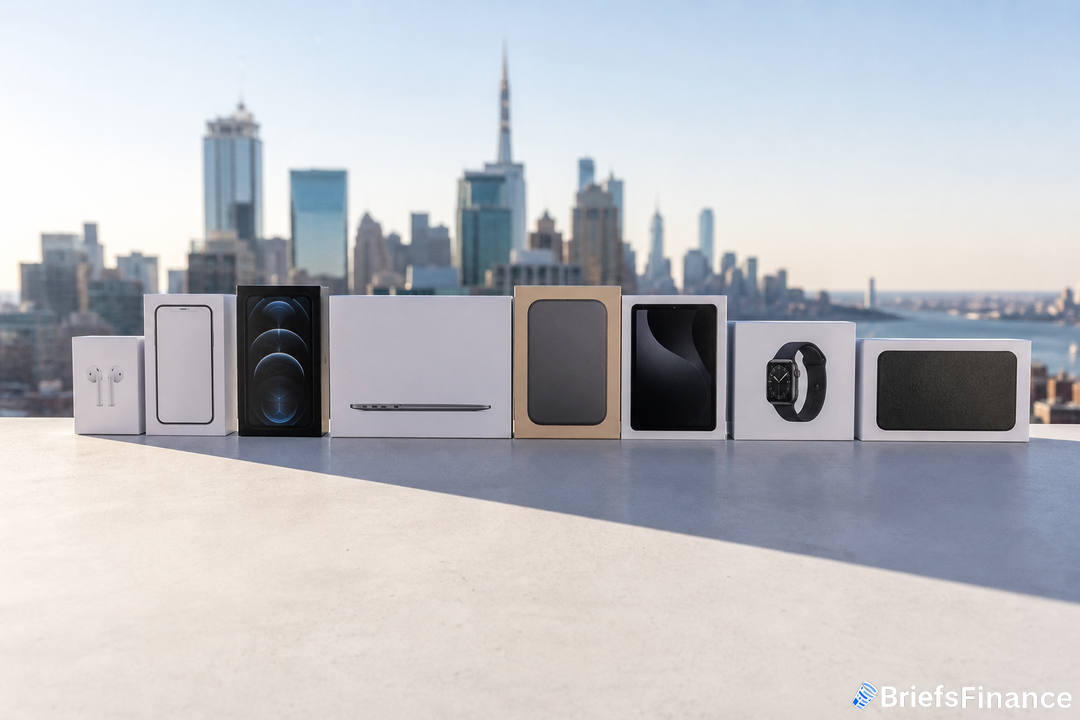
At a Tuesday smart-home event, Apple unveiled HomeView and an upgraded Apple TV 4K; later this month, the company expects to debut a touchscreen MacBook alongside a new iPad mini, and pre-orders for the foldable iPhone Duo begin Friday.
The iPhone Duo marks the most significant redesign in Apple's most profitable device's history and carries a steep price; the shares trade at 36 times next year's earnings, the highest since 2007.
Opinions split: some see limited near-term impact while others highlight Apple's AI distribution edge; year to date, the stock has risen 27%, and Apple is projected to post a 15% revenue increase for the fiscal year ended Sept. 30.
What Apple announced this week
Apple packed the week with hardware news. At a Tuesday home-focused event, it debuted a screen dubbed HomeView and an updated Apple TV 4K streaming box. The company plans to ship a touchscreen MacBook plus a new iPad mini later this month.
Pre-orders for the foldable iPhone Duo begin Friday. The handset represents the biggest redesign ever for Apple's most profitable device, and its price tag is steep.
How the stock is setting up
Apple shares hit a record in late July on buzz about its smart-home push and doubts about the heavy AI spending it has mostly sidestepped. Since then, the stock has been basically flat. On Monday, it rose 1.7%, set an intraday record, and topped $5 trillion in market value.
Year to date, the shares have climbed 27%, leading the Magnificent Seven. At 36 times next year's projected earnings - the richest multiple since 2007 - the stock stands well above the 10-year average of 24, putting Apple among the 50 priciest S&P 500 constituents while the index as a whole sits at 19 times forward earnings.
Some of that premium ties to Apple's spot in the AI trade: it is seen as a beneficiary of the technology's rollout without the same spending risk. Expectations are also high for new Chief Executive Officer John Ternus to spur growth by upgrading and expanding the device lineup.
There are real risks. A Bloomberg Intelligence report last week said Apple reduced component orders for certain iPhone models after demand fell short of expectations. Consumers are also dealing with persistent inflation, and Apple has raised prices as parts like memory chips get more expensive.
Peter Andersen, overseeing $5.5 billion as chief investment officer at Andersen Capital Management, said, "For a company of this size, you need super-hit products to move the needle on growth." "I'm just not sure anything we're getting is exciting enough to lead to an inflection." Andersen - who avoids holding the shares because, in his view, innovation has lagged - added, "Apple executes its products flawlessly, but it's hard to expect these will really take off," pointing to entrenched home-market competitors and pressured consumers.
Lu Zhang - the founder and managing partner at Fusion Fund and a shareholder in her personal account - said, "Apple's product path seems promising, but I don't think the first generation of new products will mean much for overall revenue." "It remains to be seen whether we will see the kind of new use cases (for the foldable Duo) that will contribute to a broad upgrade cycle." She added, "All the AI companies are competing with each other, but whenever they launch a new model they need Apple as a key distribution channel, and that's an area where it essentially has no competitor," and, "Even if Duo adoption isn't high right out of the gate, so long as Apple continues to execute on its hardware, it will warrant a premiere multiple."
Wall Street hasn't shifted much. Over the past three months, estimates for Apple's fiscal 2027 net income slipped 0.6%, while revenue expectations edged up 0.7%. Apple's growth rate is also trailing Big Tech peers.
The company's fiscal year ended Sept. 30, and projections indicate a 15% rise in revenue to be revealed with earnings in a few weeks, followed by slower growth expected at 10% for fiscal 2027 and 7.8% for fiscal 2028. More broadly, tech sales are expected to decelerate off higher levels, with S&P 500 information technology sector revenue projected to rise 37% in 2026 and 29% in 2027, per Bloomberg Intelligence.
What this means for your portfolio
You're getting a fresh batch of hardware, lofty expectations, and a valuation near peak levels, all at once. The real tell will be whether demand for the Duo and the new home gear shows up in Apple's next few updates, especially against forecasts calling for slower growth beyond this year. If adoption is solid and the AI ecosystem keeps running through Apple devices, that premium multiple will have something sturdier under it.
Anthropic has gone public at a valuation of about $1.5 trillion, while Amazon went public in 1997 at around $440 million. Anthropic has about $33 billion in revenue this year and no profit, and investors are paying more than 40 times its sales, against about 3 times for Amazon. Briefs Finance CEO Jaspreet Singh says nobody knows what comes next, and that long-term investors use downturns to buy instead of panic selling.
Tech stocks are selling off because investors don't know who will lead Nvidia, the company that has been funding the AI industry and selling it chips.
Inflation has the Federal Reserve planning to raise interest rates, with a hike expected in December, and that puts pressure on homebuyers, private equity and the $40 trillion national debt.
Briefs Finance CEO Jaspreet Singh says nobody has a crystal ball, so his rules are to buy when markets are low, hold long term and invest only what you're willing to lose.
The national debt is above $40 trillion, and the Federal Reserve has gone from sending Washington its profits to losing money.
President Trump's four-part plan leans on shorter-term debt, stablecoin companies buying Treasuries, a bigger balance sheet and government stakes in private companies.
The goal is to outgrow the debt, not pay it off, so Jaspreet Singh points investors to the seven industries where Washington wants growth.
The Fed makes its next rate decision on December 9 and is now talking about jumbo interest rate hikes of 0.5%, though one in December looks unlikely.
Washington will pay a record $1.05 trillion in interest this year on $40 trillion of debt, and that debt resets at higher rates as the Fed hikes.
Jaspreet Singh's five moves are to pay down variable-rate debt, earn interest on your savings, know which stocks feel the pressure, look at value and hedge.
Margin debt, the money investors borrow to buy stocks, is at a record of around 4.6% of GDP, up from 3.9% in 2021.
ETF money has more than tripled in five years to 7% of GDP, while corporate buybacks and 401(k) money sit below their earlier peaks.
Margin calls and panic selling can make the next downturn deeper, so Jaspreet Singh keeps buying broad market funds and says most investors should skip margin debt.
Jensen Huang is out at Nvidia over affairs with multiple people, and the company he founded has been the bank of American AI, with about $30 billion into OpenAI and $10 billion into Anthropic.
A hotter-than-expected inflation report has Fed officials talking about a possible 0.5% hike in December, and gold, silver, and bitcoin fell on the news.
President Trump said the US may not need a deal with Iran, keeping oil prices and inflation risk high. Jaspreet Singh breaks down what it all means for AI stocks and your portfolio.
Stocks are booming at the fastest pace in years, jobless claims just hit a 57-year low, and most investors still feel like nobody is hiring.
The Fed is protecting the dollar over the economy, oil swings on every Iran headline, and a few AI companies are carrying an S&P 500 where four of five stocks sit in a correction.
Jaspreet Singh explains why circular financing between Nvidia, OpenAI, Anthropic, and SpaceX rhymes with 2008's house of cards, and how his three investing pillars handle a stock market bubble.
The Fed has raised rates, cut them, then raised them again only twice in the last 60 years, and both times the economy fell into a recession and stocks crashed.
The same stop-and-go cycle is playing out now, with one big difference: US debt is 125% of GDP today versus about 30% in 1980.
In the 1970s gold rose roughly 24x, real estate 157%, stocks lagged, and cash lost half its value. Jaspreet Singh lays out five assets to consider before the next flip.
The IRS 2027 tax plan keeps the same seven rates but widens every bracket and lifts the married-filing-jointly standard deduction to $33,200.
The 0% long-term capital gains bracket rises to $102,100, so a household living on $135,300 of investment income could owe $0 in federal income tax.
C corporations still pay 21%, small businesses keep the 20% QBI deduction, and the 401(k) limit climbs to $25,500 with an $8,500 catch-up for investors over 50.
Make sure to check your inbox for the first email.
Before you go
We’re hosting our first ever livestream on how investors can use ChatGPT & Claude to invest like a pro. It’s on 11/17 and is hosted by our CEO Jaspreet Singh.