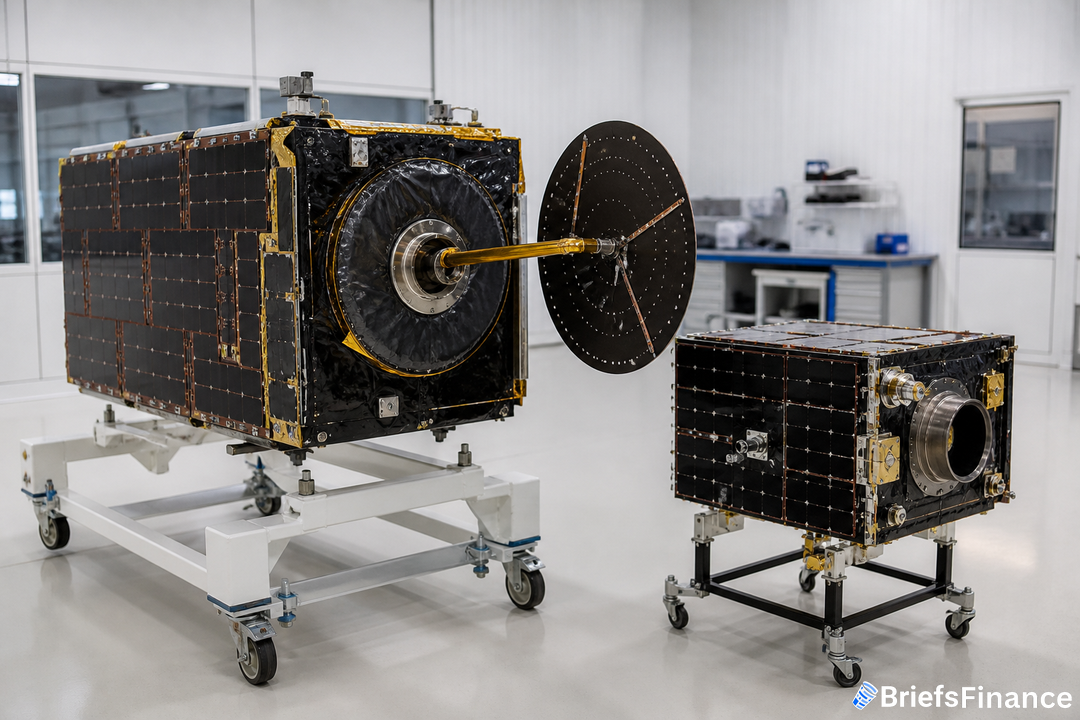
Fortastra, founded last year in Torrance by CEO and founder Mike Smayda, who spent five years at SpaceX, raised $30 million to build maneuverable spacecraft that protect civilian and defense satellites.
On Oct. 1, two Watchdog V0 prototypes launched on SpaceX's Transporter-18 out of Vandenberg Space Force Base, marking the startup's first spacecraft to reach space.
First In led the round; PitchBook pegs US VC for space and defense at $32.6 billion in 2026 through Oct. 6, with about 40% landing in Southern California.
What Fortastra is building and why it matters
Fortastra is designing nimble satellites to help shield the orbital infrastructure used by the US and its allies, a concept it frames as "bodyguards in space" for both commercial and defense systems. The raise comes after last month's revelation that the US has a space-based weapon intended to deter Russia, China and other would-be adversaries, amid growing concern that guidance, communications and other systems are at risk.
"There's an acknowledgment that space, while it was a fairly peaceful domain at one point, is actually fairly contested," Chief Executive Officer and founder Mike Smayda said. He added that there are "hundreds of billions, if not trillions, of dollars' worth of value in space. And generally things that go to space are launched unprotected."
Hardware progress and the plan to scale
Two Fortastra prototypes, called Watchdog V0, lifted off Oct. 1 on Space Exploration Technologies Corp.'s Transporter-18 from Vandenberg Space Force Base; they were the startup's first spacecraft to reach space. According to Smayda, the new funding will enable Fortastra - currently a team of only 18 employees - to accelerate manufacturing. He declined to disclose a valuation for the round.
Smayda said the ambition is to move past a "bodyguard-type framework" toward "more zone defense, where we're building a lot of these and they're massively proliferated across different orbits and orbital regimes," adding, "We're talking hundreds, if not thousands, of more satellites." He did not detail potential defensive capabilities, but compared the concept to a bodyguard responding when "someone pulls a knife": intercept, assess, deter, and, if needed, "handle it."
First In, a venture fund focused on security tech and advanced manufacturing, led the $30 million raise. Other investors include Upfront Ventures, Space Capital, Rsquared, Side Door Ventures and ATX Venture Partners. In December, the company said it had secured an initial $8 million raise, with Upfront as lead and Generational Partners, Forward Deployed Venture Capital, Wave Function Ventures, and Bloomberg Beta participating - a venture firm financed by Bloomberg LP, the parent of Bloomberg News.
Southern California's aerospace scene is resurgent on the back of growing government and commercial spending and a deep pool of engineering talent that dates to World War II. Anduril Industries Inc., Rocket Lab Corp. and Relativity Space Inc. all sprang up in the region over the past decade. Many former SpaceX employees stayed in California after Elon Musk relocated the company to Texas, launching new ventures that benefit from local manufacturing know-how and Silicon Valley capital nearby.
Venture data backs it up. PitchBook estimates that US venture investment in space and defense startups has reached $32.6 billion year-to-date, rising from $16.8 billion across all of 2025. More than $13 billion, about 40%, has gone to Southern California. Note: 2026 figures are as of Oct. 6.
The founder's chops and what it could mean for your money
Smayda spent five years at SpaceX in Hawthorne, California, working on entry, descent and landing capabilities for Falcon 9 and Falcon Heavy. In 2018, he co-founded the hypersonic aircraft company Hermeus, serving as chief product officer. Fortastra itself opened last year in Torrance, just outside Los Angeles.
The upshot for your wallet: Washington's interest in space security is growing, Southern California is capturing a big chunk of the capital, and Fortastra is pitching a model built for scale. If its prototypes evolve into a proliferated "zone defense" network, that ties directly to national security spending cycles and the kind of durable demand that can support young companies over time.
Anthropic has gone public at a valuation of about $1.5 trillion, while Amazon went public in 1997 at around $440 million. Anthropic has about $33 billion in revenue this year and no profit, and investors are paying more than 40 times its sales, against about 3 times for Amazon. Briefs Finance CEO Jaspreet Singh says nobody knows what comes next, and that long-term investors use downturns to buy instead of panic selling.
Tech stocks are selling off because investors don't know who will lead Nvidia, the company that has been funding the AI industry and selling it chips.
Inflation has the Federal Reserve planning to raise interest rates, with a hike expected in December, and that puts pressure on homebuyers, private equity and the $40 trillion national debt.
Briefs Finance CEO Jaspreet Singh says nobody has a crystal ball, so his rules are to buy when markets are low, hold long term and invest only what you're willing to lose.
The national debt is above $40 trillion, and the Federal Reserve has gone from sending Washington its profits to losing money.
President Trump's four-part plan leans on shorter-term debt, stablecoin companies buying Treasuries, a bigger balance sheet and government stakes in private companies.
The goal is to outgrow the debt, not pay it off, so Jaspreet Singh points investors to the seven industries where Washington wants growth.
The Fed makes its next rate decision on December 9 and is now talking about jumbo interest rate hikes of 0.5%, though one in December looks unlikely.
Washington will pay a record $1.05 trillion in interest this year on $40 trillion of debt, and that debt resets at higher rates as the Fed hikes.
Jaspreet Singh's five moves are to pay down variable-rate debt, earn interest on your savings, know which stocks feel the pressure, look at value and hedge.
Margin debt, the money investors borrow to buy stocks, is at a record of around 4.6% of GDP, up from 3.9% in 2021.
ETF money has more than tripled in five years to 7% of GDP, while corporate buybacks and 401(k) money sit below their earlier peaks.
Margin calls and panic selling can make the next downturn deeper, so Jaspreet Singh keeps buying broad market funds and says most investors should skip margin debt.
Jensen Huang is out at Nvidia over affairs with multiple people, and the company he founded has been the bank of American AI, with about $30 billion into OpenAI and $10 billion into Anthropic.
A hotter-than-expected inflation report has Fed officials talking about a possible 0.5% hike in December, and gold, silver, and bitcoin fell on the news.
President Trump said the US may not need a deal with Iran, keeping oil prices and inflation risk high. Jaspreet Singh breaks down what it all means for AI stocks and your portfolio.
Stocks are booming at the fastest pace in years, jobless claims just hit a 57-year low, and most investors still feel like nobody is hiring.
The Fed is protecting the dollar over the economy, oil swings on every Iran headline, and a few AI companies are carrying an S&P 500 where four of five stocks sit in a correction.
Jaspreet Singh explains why circular financing between Nvidia, OpenAI, Anthropic, and SpaceX rhymes with 2008's house of cards, and how his three investing pillars handle a stock market bubble.
The Fed has raised rates, cut them, then raised them again only twice in the last 60 years, and both times the economy fell into a recession and stocks crashed.
The same stop-and-go cycle is playing out now, with one big difference: US debt is 125% of GDP today versus about 30% in 1980.
In the 1970s gold rose roughly 24x, real estate 157%, stocks lagged, and cash lost half its value. Jaspreet Singh lays out five assets to consider before the next flip.
The IRS 2027 tax plan keeps the same seven rates but widens every bracket and lifts the married-filing-jointly standard deduction to $33,200.
The 0% long-term capital gains bracket rises to $102,100, so a household living on $135,300 of investment income could owe $0 in federal income tax.
C corporations still pay 21%, small businesses keep the 20% QBI deduction, and the 401(k) limit climbs to $25,500 with an $8,500 catch-up for investors over 50.
Make sure to check your inbox for the first email.
Before you go
We’re hosting our first ever livestream on how investors can use ChatGPT & Claude to invest like a pro. It’s on 11/17 and is hosted by our CEO Jaspreet Singh.