Free NewsletterPro Login

Warning: Undefined variable $stocks in /var/www/briefs.co/htdocs/wp-content/plugins/oxygen/component-framework/components/classes/code-block.class.php(133) : eval()'d code on line 448

Warning: foreach() argument must be of type array|object, null given in /var/www/briefs.co/htdocs/wp-content/plugins/oxygen/component-framework/components/classes/code-block.class.php(133) : eval()'d code on line 448

Warning: Undefined variable $funds in /var/www/briefs.co/htdocs/wp-content/plugins/oxygen/component-framework/components/classes/code-block.class.php(133) : eval()'d code on line 472

Warning: foreach() argument must be of type array|object, null given in /var/www/briefs.co/htdocs/wp-content/plugins/oxygen/component-framework/components/classes/code-block.class.php(133) : eval()'d code on line 472
/* the link was here */
×
Free investor livestream — Nov 17

How To Use ChatGPT & Claude To Research Stocks Like A Pro

01
The prompt we use to break down any stock
02
How to fact-check what AI tells you
03
How to compare two stocks in minutes

Aging U.S. Homes Need More Money Than Many Owners Have

Published Oct 3, 2026
Share:
Summary:
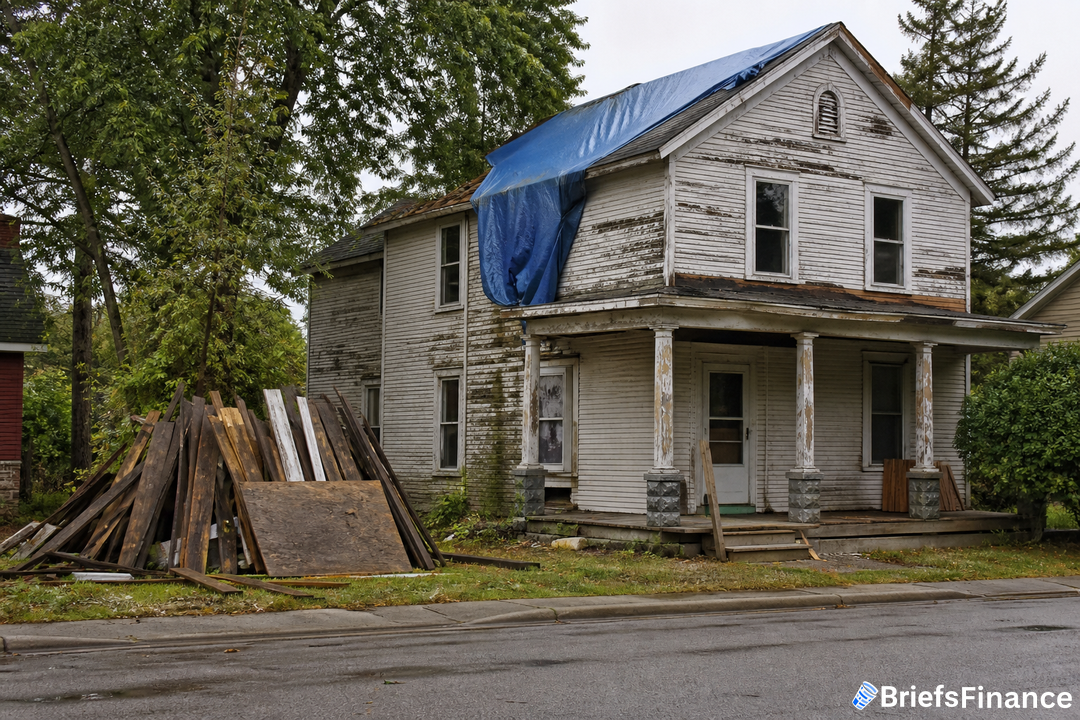
  • America's houses are the oldest they have ever been, and upkeep needs climb as homes age while the ability to pay varies widely by income.
  • For 2023, people owning pre-1960 houses put an average of $6,000 into improvements and upkeep - about 35 percent above the $4,500 typical outlay for homes constructed in 2010 or later.
  • Older homes show higher rates of inadequacy and larger repair needs, with 22 million homeowners living in pre-1960 homes and many lower-income owners carrying the heaviest burden.

Why the housing stock is getting older

As of 2023, the median age of a U.S. home reached 44 years; in 2013 it was 39, and in 1993 it was 28. A building slump during the Great Recession added far fewer new units than prior decades, so fewer young homes rotated into the stock. At the same time, tougher codes and better materials and construction techniques have kept existing houses serviceable for longer, lifting the overall age of the inventory. By 2023, roughly one-quarter of homeowners - 22 million households - occupied dwellings built before 1960.

How spending shifts as homes age

Once houses get past two decades, spending steps up and stays elevated as major systems time out. In 2023, replacements like roofs, siding, windows, insulation, and HVAC took a 39 percent share of spending for homes built before 1960, well above the 24 percent share for those built in 2010 or later. Routine upkeep made up 22 percent of remodeling and repair outlays on the oldest homes, compared with 16 percent on the newest ones.

Newer properties leaned harder into outdoor projects such as fencing, landscaping, and sheds or pools, which captured about one third of spending, while pre-1960 homes devoted just 10 percent to those outside improvements. Additions and exterior attachments like porches were also a bigger slice for newer homes at 15 percent, versus 8 percent for older stock.

Deferred maintenance is a balance sheet problem that shows up years later, all at once. Market Briefs covers the economics of homeownership free every morning.

Who pays and who can't

The bill gets bigger as homes age, but the wallet size varies. In 2023, owners of pre-1960 homes averaged $6,000 on improvements and maintenance compared with $4,500 for owners of homes built in 2010 or later, a gap of about 35 percent that holds across income groups. Among residents of the oldest properties, households in the top income quintile had average 2023 improvement and repair spending of $12,700, versus $3,400 for the bottom quintile.

No matter the age of the home, higher earners spend more than lower earners. In fact, higher-income owners put an average of $7,400 into homes built since 2010, more than twice what lower-income owners spent on homes built before 1960. For context, the lowest income quintile is under $37,500 and the highest is over $172,000.

Repairs, risks, and what it means for you

Years of underinvestment have left many homes in rough shape. In 2023, about 2.9 million homeowner households, or 3.3 percent, lived in places HUD classifies as moderately or severely inadequate, meaning multiple structural issues like water leaks, large cracks, or floor holes, or serious problems with plumbing, electrical, or heating. The inadequacy rate hit 5.4 percent for pre-1960 homes, compared with 1.3 percent for owner-occupied properties constructed in 2010 or later.

A 2025 analysis from the Federal Reserve Bank of Philadelphia estimated that in 2024, 48 percent of owner-occupied dwellings built before 1940 required at least one repair, versus 26 percent for those built in 2000 or later. The same report put average estimated repair costs at $5,200 per older home and $3,600 per newer home, with a total repair tab of $23.9 billion for owner-occupied homes built before 1940.

Keeping older homes in shape matters for affordability, too. Lower-value, older properties make up a big share of the options for lower-income buyers. In 2023, among the lowest income quintile, 29 percent owned homes built before 1960. Falling behind on repairs can snowball into emergencies, dent home values, and expose residents to hazards like lead exposure, mold, fire hazards from faulty wiring, structural injuries, and unsafe indoor temperatures.

There is some policy movement. In 2023, Pennsylvania's Whole-Home Repairs Program emerged as the first statewide program to provide repair funding to lower-income homeowners and to rental property owners. Federally, the 21st Century ROAD to Housing Act creates a pilot program that provides grants to income-eligible homeowners to address habitability, safety, accessibility, and weatherization improvements. Still, today's funding is small next to the scale of needs, which for the oldest homes alone amounts to tens of billions of dollars.

What does this mean for your money? Older houses generally pull more of your budget into maintenance and replacements as systems age, while the benefits of timely fixes show up in fewer emergencies and steadier home values. Big picture, widespread deferred maintenance shapes neighborhood values and the supply of entry-level homes.

An older housing stock changes what buyers, owners, and insurers are all paying for. Get the free Market Briefs daily newsletter and follow the trend.

Disclosure

Recent News

1 2 3 … 130

Get Market Briefs delivered to your inbox every morning for free!

No fluff. No noise. No politics. Just finance news you can read in 5 minutes.

Blogs

November 17, 2026
Is the Stock Market Going to Crash? Why Nvidia and the Fed Have Investors on Edge
  • Tech stocks are selling off because investors don't know who will lead Nvidia, the company that has been funding the AI industry and selling it chips.
  • Inflation has the Federal Reserve planning to raise interest rates, with a hike expected in December, and that puts pressure on homebuyers, private equity and the $40 trillion national debt.
  • Briefs Finance CEO Jaspreet Singh says nobody has a crystal ball, so his rules are to buy when markets are low, hold long term and invest only what you're willing to lose.
Read More
November 16, 2026
The $40 Trillion National Debt: Trump's 4-Part Plan to Make It Feel Smaller
  • The national debt is above $40 trillion, and the Federal Reserve has gone from sending Washington its profits to losing money.
  • President Trump's four-part plan leans on shorter-term debt, stablecoin companies buying Treasuries, a bigger balance sheet and government stakes in private companies.
  • The goal is to outgrow the debt, not pay it off, so Jaspreet Singh points investors to the seven industries where Washington wants growth.
Read More
November 16, 2026
The Fed Is Talking About a Jumbo Interest Rate Hike. It Has No Easy Way Out
  • The Fed makes its next rate decision on December 9 and is now talking about jumbo interest rate hikes of 0.5%, though one in December looks unlikely.
  • Washington will pay a record $1.05 trillion in interest this year on $40 trillion of debt, and that debt resets at higher rates as the Fed hikes.
  • Jaspreet Singh's five moves are to pay down variable-rate debt, earn interest on your savings, know which stocks feel the pressure, look at value and hedge.
Read More
November 16, 2026
Buying on Margin Is at a Record High. Here's the Risk for the Stock Market
  • Margin debt, the money investors borrow to buy stocks, is at a record of around 4.6% of GDP, up from 3.9% in 2021.
  • ETF money has more than tripled in five years to 7% of GDP, while corporate buybacks and 401(k) money sit below their earlier peaks.
  • Margin calls and panic selling can make the next downturn deeper, so Jaspreet Singh keeps buying broad market funds and says most investors should skip margin debt.
Read More
November 16, 2026
Housing Prices Are Falling. Buying a House Still Isn't Cheaper
  • Housing prices have fallen for four straight weeks, but mortgage rates around 7.2% keep the monthly payment about where it was in 2023.
  • Talk of a jumbo Fed rate hike and a plan to sell Fannie Mae and Freddie Mac on the stock market could both push mortgage rates higher.
  • Briefs Finance CEO Jaspreet Singh treats a house as a liability: buy within your budget and let your investments build the wealth.
Read More
November 14, 2026
Nvidia News: Jensen Huang Is Out, and the "Bank" Behind American AI Just Lost Its Founder
  • Jensen Huang is out at Nvidia over affairs with multiple people, and the company he founded has been the bank of American AI, with about $30 billion into OpenAI and $10 billion into Anthropic.
  • A hotter-than-expected inflation report has Fed officials talking about a possible 0.5% hike in December, and gold, silver, and bitcoin fell on the news.
  • President Trump said the US may not need a deal with Iran, keeping oil prices and inflation risk high. Jaspreet Singh breaks down what it all means for AI stocks and your portfolio.
Read More
November 14, 2026
Record Highs, a 57-Year Low in Jobless Claims, and a Stock Market Bubble: Inside the Weirdest Market in History
  • Stocks are booming at the fastest pace in years, jobless claims just hit a 57-year low, and most investors still feel like nobody is hiring.
  • The Fed is protecting the dollar over the economy, oil swings on every Iran headline, and a few AI companies are carrying an S&P 500 where four of five stocks sit in a correction.
  • Jaspreet Singh explains why circular financing between Nvidia, OpenAI, Anthropic, and SpaceX rhymes with 2008's house of cards, and how his three investing pillars handle a stock market bubble.
Read More
November 14, 2026
Is a Recession Coming? The Fed Just Made a U-Turn It Has Only Made Twice in 60 Years
  • The Fed has raised rates, cut them, then raised them again only twice in the last 60 years, and both times the economy fell into a recession and stocks crashed.
  • The same stop-and-go cycle is playing out now, with one big difference: US debt is 125% of GDP today versus about 30% in 1980.
  • In the 1970s gold rose roughly 24x, real estate 157%, stocks lagged, and cash lost half its value. Jaspreet Singh lays out five assets to consider before the next flip.
Read More
November 14, 2026
The 2027 Tax Brackets Are Out: How Some Investors Can Earn $135,300 and Pay $0
  • The IRS 2027 tax plan keeps the same seven rates but widens every bracket and lifts the married-filing-jointly standard deduction to $33,200.
  • The 0% long-term capital gains bracket rises to $102,100, so a household living on $135,300 of investment income could owe $0 in federal income tax.
  • C corporations still pay 21%, small businesses keep the 20% QBI deduction, and the 401(k) limit climbs to $25,500 with an $8,500 catch-up for investors over 50.
Read More
November 14, 2026
Rare Earth Stocks: Why China's January 2027 Ban Could Be the Opportunity of the Decade
  • China plans to block rare earth exports to the US on January 10, 2027, and the US produces effectively zero of the 17 metals that go into phones, cars, dishwashers, and missiles.
  • When China cut off Japan in 2010 and squeezed Germany from 2015, some rare earth prices jumped 18x and 15x, and one rare earth company went bankrupt while another soared.
  • Washington is already putting billions into MP Materials, Vulcan, and a stockpile called Project Vault, and Jaspreet Singh walks through how investors can get exposure to rare earth stocks and ETFs.
Read More
1 2 3 … 33
Share via
Copy link