Free NewsletterPro Login

Warning: Undefined variable $stocks in /var/www/briefs.co/htdocs/wp-content/plugins/oxygen/component-framework/components/classes/code-block.class.php(133) : eval()'d code on line 448

Warning: foreach() argument must be of type array|object, null given in /var/www/briefs.co/htdocs/wp-content/plugins/oxygen/component-framework/components/classes/code-block.class.php(133) : eval()'d code on line 448

Warning: Undefined variable $funds in /var/www/briefs.co/htdocs/wp-content/plugins/oxygen/component-framework/components/classes/code-block.class.php(133) : eval()'d code on line 472

Warning: foreach() argument must be of type array|object, null given in /var/www/briefs.co/htdocs/wp-content/plugins/oxygen/component-framework/components/classes/code-block.class.php(133) : eval()'d code on line 472
/* the link was here */

Alphabet's AI chips are heading to orbit. Space computing just got real

Published Oct 1, 2026
Share:
Summary:
  • Liftoff from Vandenberg Air Force Base in Santa Barbara County is set for 11:15 am PT on Thursday, as Alphabet sends its custom AI chips into orbit aboard a SpaceX Falcon 9.
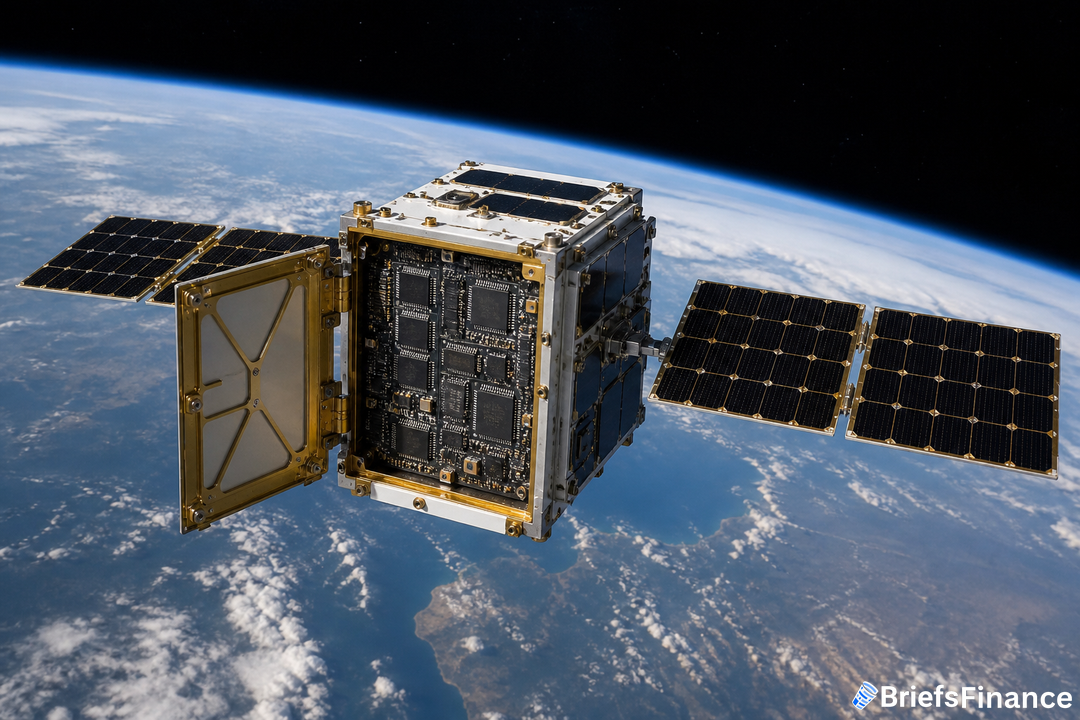
  • On the uncrewed Transporter-18 flight, Planet Labs hardware is aboard, among them a solar-powered prototype fitted with Google tensor processing units for Project Suncatcher.
  • It's the first in-orbit test for Suncatcher, a moonshot unveiled in November 2025 to probe always-on, solar-powered AI compute and explore "whether space could one day host scalable machine learning infrastructure."

The launch and the hardware

Alphabet is set to put its own AI silicon into low Earth orbit on Thursday, hitching a ride on SpaceX's Falcon 9. As part of SpaceX's uncrewed Transporter-18 mission, liftoff from Vandenberg Air Force Base in California's Santa Barbara County is set for 11:15 am PT.

The manifest features satellites from Planet Labs, one of which is a solar-powered prototype that carries Google's TPUs. Alphabet says this is the first in-space experiment for Project Suncatcher, the company's moonshot effort first disclosed in November 2025.

What Project Suncatcher aims to test

Suncatcher's goal is to prove out dependable AI computing that can run continuously in orbit using sunlight alone. In announcing the plan, Alphabet framed the effort as "exploring whether space could one day host scalable machine learning infrastructure."

According to the company, low Earth orbit offers almost continuous sunshine, yielding as much as eight times the solar power available on the ground. Over time, Alphabet envisions linking multiple satellite constellations so they can take on larger AI workloads while still in orbit. Prior to this mission, Google's TPUs were exercised on AI workloads at the University of California at Davis facility, yet the team still must understand how the chips handle the harsher conditions of low Earth orbit.

When innovation catches the spotlight, disciplined saving and investing pay off over time, get the free Always Be Buying E-Book

The players and the road ahead

Alphabet is a major SpaceX backer, and the two work closely even as their AI groups compete. In June, SpaceX went public in a record IPO; Alphabet's stake is valued at over $82 billion. SpaceX has pitched "supercomputers in space" as the next AI buildout, calling orbit "infinite real estate" that avoids the pushback facing data centers on the ground.

Led by Elon Musk, SpaceX has also outlined plans for proprietary orbital data centers: fleets of satellites to be built in Redmond, Washington, carrying graphics processing units and solar arrays that the company aims to produce with Tesla. Earlier this year, Musk said training AI in space would be the cheapest route "and that will be true within two years, maybe three at the latest." In September, COO Gwynne Shotwell said the company will deploy "supercompute in space" in 2027.

Experts say there are stiff hurdles: limited and costly launch capacity, the need for cooling in vacuum, chip resilience to extreme temperatures, radiation shielding, and growing orbital debris. Even so, Thursday could be a packed day for SpaceX. If schedules hold, Transporter-18 would be the second potentially historic launch, alongside a NASA mission from Florida's Space Coast carrying astronauts to the International Space Station for a six-month stay.

Why it matters for your money

Alphabet and SpaceX are testing whether the next wave of AI infrastructure grows off-planet, where sunlight is plentiful and real estate is, well, orbital. If the tech holds up and costs slide, it could shift where and how the most powerful AI systems get built. If not, the center of gravity stays on Earth. Either way, the experiment is about turning long-shot engineering into a platform regular investors can actually size up.

Even amid technological excitement, steady contributions matter more than timing; claim your free Always Be Buying E-Book

Disclosure

Recent News

1 2 3 … 90

Get Market Briefs delivered to your inbox every morning for free!

No fluff. No noise. No politics. Just finance news you can read in 5 minutes.

Blogs

October 1, 2026
Housing Market 2026: Why Office Buildings Are Cracking Before Houses Do
  • Office buildings are selling for 80% to 95% off because their five-year loans are resetting at much higher rates while half-empty floors have gutted the income those buildings are valued on.
  • Housing is under pressure, not cracking: a $400,000 mortgage costs $975 more a month than at 3%, but six of every seven mortgages are still under 6% and those owners are staying put.
  • Whether pressure turns into cracks is a race between unaffordability and the economy, and either way Jaspreet's rule is to treat your house as a liability and buy only what you can afford.
Read More
September 30, 2026
Dividend Investing vs. Growth Investing: Why the Slower Portfolio Can End Up Bigger
  • "What stock should I buy?" is the wrong first question. Growth, income, or wealth preservation comes first, and the goal changes which stocks even make sense.
  • At $500 a month for 30 years, 13% growth builds about $1.75 million. 10% growth plus a reinvested 4% dividend builds a little more than $2.2 million and pays a little more than $80,000 a year.
  • Income investors have US dividend ETFs, REITs, and international dividend funds to study. Growth investors have the Nasdaq 100, AI and chip funds, and small caps. None of it is a recommendation.
Read More
September 29, 2026
Why Is Gold Going Down? A 5.2% Treasury Yield Just Took Its Job
  • President Trump rejected Iran's deal to reopen the Strait of Hormuz, oil prices jumped back up, and gold fell instead of rising.
  • Treasury yields hit their highest level in more than 20 years, so investors sold gold and bought Treasuries that pay interest.
  • Higher Treasury yields make the national debt, mortgages, car loans, and credit cards more expensive, with the Fed's next rate decision due October 28.
Read More
September 28, 2026
The Strategic Bitcoin Reserve: Why the Government Wants Bitcoin to Explode
  • The US government holds about 328,000 Bitcoin, worth roughly $25 billion, and since a 2025 executive order it keeps seized coins instead of selling them.
  • Washington wants a bigger pile of assets so its $40 trillion national debt looks smaller next to them, which lets it keep borrowing and spending.
  • Bitcoin's wild price swings, and a government holding a coin built to escape governments, are the two risks investors need to watch.
Read More
September 25, 2026
BRIEFS EXCLUSIVE: 43% Of Respondents Say Bills Outran Their Income Over Past Two Years
  • 43% of the 494 Market Briefs readers surveyed said their bills grew faster than their income over the past two years, even though 79% could cover a surprise $5,000 expense tomorrow.
  • Half of readers own gold or crypto, the two classic bets against a weaker dollar, and only 13% bought nothing at all in the last 12 months.
  • The median reader says it takes $150,000 a year to feel financially secure, about $62,000 above the U.S. median household income.
Read More
September 25, 2026
The Economy Is Booming. So Why Did Stocks and Bonds Fall Together?
  • S&P Global says the US economy is growing at its fastest rate since 2021, with corporate profits up 28.9% in a year, almost four times the historical average.
  • Stocks and bonds fell at the same time, which is not how the two markets normally behave, because Treasury yields above 5% now compete with stocks for investors' money.
  • Jaspreet Singh lays out three ways to invest through a shift like this: always be buying, buy the crash, or follow the money before it hits the headlines.
Read More
September 24, 2026
The 2026 Economic Reset Is Starting: Are We in a Recession, or Is the Pain Still Ahead?
  • The Federal Reserve has flipped from stimulating the economy to fighting inflation with higher interest rates, while the White House still wants growth at almost any cost.
  • The national debt tops $40 trillion, has outgrown the entire U.S. economy, and its interest payments are now the government's fastest-growing expense.
  • Higher rates bring pain for private equity, private credit, and speculative assets, but they open opportunities for investors holding cash, treasuries, and value assets.
Read More
September 23, 2026
Are We in a Recession? Without AI, America Might Already Be in One - and Washington Knows It
  • The White House attributes about three quarters of U.S. economic growth to AI, and many believe the economy would already be in a recession without it.
  • Washington has three reasons it cannot let the AI boom slow down: staying the world's superpower, outgrowing $40 trillion in national debt, and protecting a government stock portfolio worth billions.
  • Every market goes through booms and busts, and investors who understand the cycle get to buy the downturn instead of panic-selling with the crowd.
Read More
September 22, 2026
Will Interest Rates Go Down in 2026? Where the Money Moves Either Way
  • The Fed is leaning toward higher rates to fight 4% inflation, while the White House and a cracking job market push the other way.
  • If rates rise, money has tended to move toward short-term Treasuries, floating-rate loans, energy, banks and dividend payers.
  • If rates fall, it has tended to move toward gold, silver and Bitcoin, real estate, small caps, the S&P 500 and speculative bets.
Read More
September 21, 2026
How the Federal Reserve Makes Money - and Why It Just Posted Its Biggest Loss Ever
  • For 109 years the Federal Reserve created money, lent it to the U.S. government and handed the interest it collected back to Washington - almost $1 trillion in the decade starting in 2011.
  • Pandemic-era lending locked the Fed into earning about 2% on trillions of dollars while it now pays banks around 4%, producing a record loss of hundreds of billions in 2026.
  • The Fed covers its losses by creating money and the government covers its lost revenue by borrowing, and both feed the inflation that eats at the dollars in your account.
Read More
1 2 3 … 28
Share via
Copy link










