Free NewsletterPro Login

Why Oil Prices Dropped So Much On Monday

A stylized illustration of a cylindrical cup with blue arrows and lines indicating a swirling or rotational motion inside the cup.
Published Mar 9, 2026
Share:
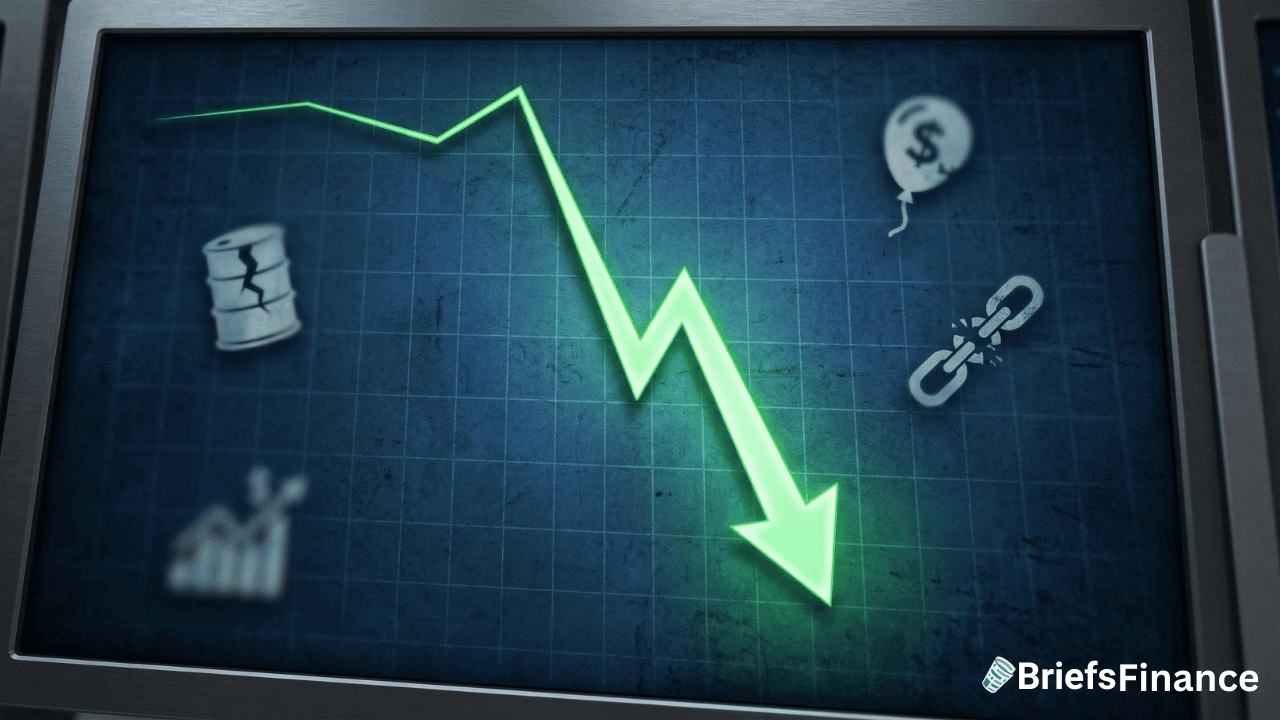
A green downward arrow on a digital screen indicates a financial decline, with icons of oil, inflation, and weak links in the background, highlighting the recent oil price drop.
Summary:

  • WTI crude surged to nearly $120 overnight before plunging more than 25% by end of day.
  • Two things turned it around: a G7 emergency meeting on reserves, and a Trump phone call.
  • Gas prices still sit at $3.49/gallon nationally — up 50 cents since the war started.

Oil has had a wild two weeks. Monday was the wildest day yet.

How It Got to $120

When futures opened Sunday night, crude was already trading above $100 per barrel for the first time since Russia invaded Ukraine in 2022. It kept climbing. WTI briefly touched $119.48 overnight — a roughly 32% spike in a matter of hours. The cause: Gulf Arab nations were cutting production because tankers had stopped moving through the Strait of Hormuz. With nowhere to send the oil, storage was filling up. Ships weren't willing to risk Iranian missile attacks to transit the waterway. Iran's foreign ministry made it worse Monday morning, warning that tankers in the Strait "must be very careful."

What Knocked It Down

Two things happened in quick succession. First, the Financial Times reported that G7 finance ministers were meeting to discuss a coordinated release of strategic oil reserves — potentially covering more than 400 million barrels. Oil fell from $120 to around $110 on that headline alone.

Then, just after 3:15 p.m. ET, CBS News reporter Weijia Jiang posted on X that Trump told her in a phone interview: "I think the war is very complete, pretty much. They have no navy, no communications, they've got no Air Force." WTI fell another 6%, dropping to a session low near $83.89 before settling at $94.77.

Where Things Stand

Ed Yardeni of Yardeni Research said it plainly: "This oil shock won't end until ships can sail freely through the Strait." G7 energy ministers were set to meet Tuesday morning. No reserve release was announced Monday — France said they're "not there yet." And after the close, Iran struck Bahrain's Bapco refinery for the second time in 24 hours.

Trump's words moved markets. The war isn't over yet.
Disclosure

Get Market Briefs delivered to your inbox every morning for free!

No fluff. No noise. No politics. Just finance news you can read in 5 minutes.

Blogs

June 16, 2026
Tech Stocks: A Simple Guide for New Investors
  • Tech stocks are companies in the information technology and related sectors, from software to chips to the internet giants.
  • They've driven much of the market's growth, but they can be volatile and richly valued.
  • The smart approach is to understand what you own and not let one sector run your whole portfolio.
Read More
June 16, 2026
What Is a Joint Stock Company? A Simple Guide
  • A joint stock company is a business owned by many people, each holding shares of stock that represent a slice of ownership.
  • It's the basic idea behind every public company you can buy on the stock market today.
  • Owning a share makes you a part-owner, entitled to a piece of the profits and growth.
Read More
June 16, 2026
Capital Gains Tax in California: A Simple Guide
  • Capital gains tax is what you owe when you sell an investment for more than you paid for it.
  • How long you held it matters: long-term gains are taxed more gently than short-term gains at the federal level.
  • Smart investors lower the bill with tools like tax-loss harvesting and holding for the long run.
Read More
June 15, 2026
Top Covered Call ETFs: How to Compare Them
  • Top covered call ETFs are income funds that own stocks and sell call options against them to generate steady cash.
  • The best one for you is the fund whose income, holdings, and fees fit your goals, not simply the one with the flashiest yield.
  • They all share one trade-off: more income today, less upside in a big rally.
Read More
June 15, 2026
What Are Stock Options? A Plain-English Guide
  • Stock options are contracts that give you the right, but not the obligation, to buy or sell a stock at a set price by a set date.
  • There are two kinds: calls (the right to buy) and puts (the right to sell).
  • Options can multiply gains or wipe out your money fast, so they suit investors who already know the basics.
Read More
June 15, 2026
EBITDA Margin: What It Is and How to Calculate It
  • EBITDA margin measures how much core profit a company keeps from each dollar of sales, before interest, taxes, and accounting deductions.
  • The formula is EBITDA divided by revenue, shown as a percent.
  • A higher, steadier EBITDA margin usually signals a more efficient, more durable business.
Read More
June 15, 2026
What Is Taxable Income? A Simple Guide for Investors
  • Taxable income is the portion of your money the government can tax after deductions are applied.
  • Not all income is taxed the same: job income, investment income, and passive income face different rates.
  • Investors and business owners get more tools to legally lower their taxable income, which is a big edge over time.
Read More
June 15, 2026
What Is a Covered Call? How the Strategy Works
  • A covered call is an options strategy where you own a stock and sell someone the right to buy it from you at a higher price.
  • You collect cash, called the premium, up front, and keep it no matter what happens.
  • The trade-off: if the stock soars, your shares get sold at the set price and you miss the extra upside.
Read More
June 15, 2026
What Is Gross Margin? A Simple Guide for Investors
  • Gross margin is the share of each sales dollar a company keeps after paying the direct cost of whatever it sold.
  • The formula is simple: revenue minus cost of goods sold, divided by revenue, shown as a percent.
  • A steady or rising gross margin points to pricing power, and it is one of the first things smart investors check.
Read More
June 15, 2026
What Is a Dividend? A Plain-English Guide for Investors
  • A dividend is a cash payment a company sends you just for owning its stock, usually every three months.
  • Dividends are one of two ways stocks pay you, the other being the share price going up.
  • Dividends are never guaranteed, so the strength of the business behind the payment matters more than the size of the payment.
Read More
1 2 3 23
Share via
Copy link










