Free NewsletterPro Login

Walmart Is Stocking More Local Goods To Pull Shoppers Back Into Stores

Published Apr 30, 2026
Share:
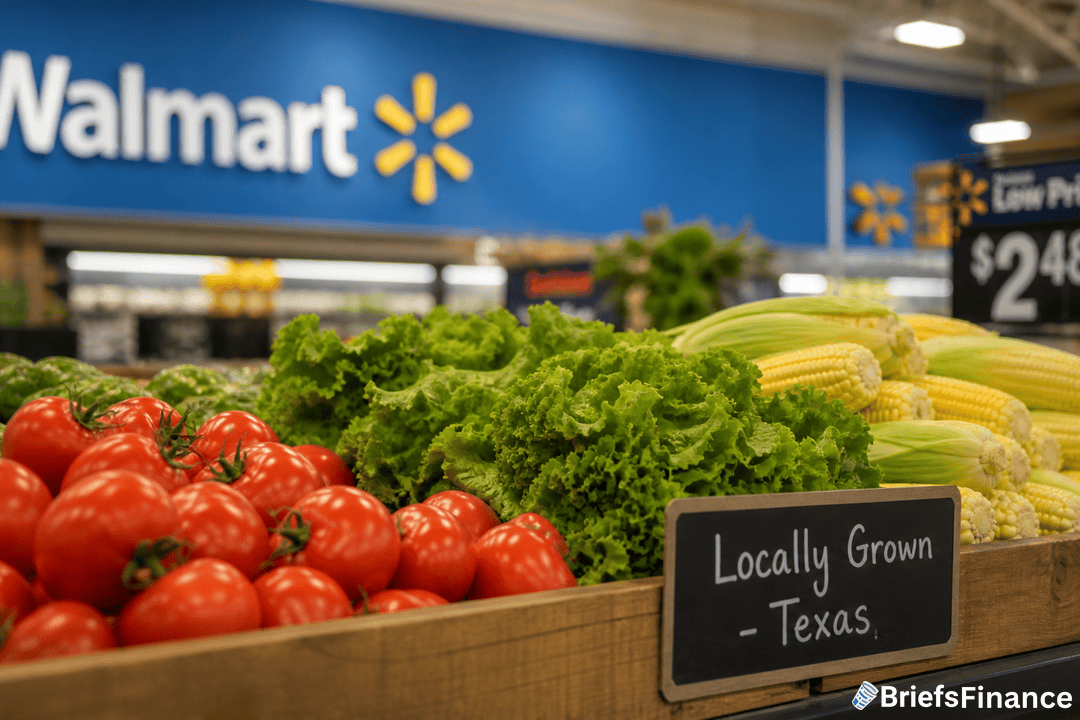
Fresh tomatoes, lettuce, and corn displayed in a Walmart produce section with a "Locally Grown - Texas" sign in front.
Summary:
  • Walmart is leaning harder on local goods to lift store traffic and higher-margin sales.
  • More than two-thirds of its U.S. spend already goes to items made or grown in America.
  • The retailer plans 650-plus store remodels and around 20 new stores by early 2027.

The biggest store chain in the country is making a small bet on something old.

Walmart wants its shelves to look different in every town. The retailer is pushing more local goods into its stores. The goal is to lift foot traffic and lift sales of items that pay better margins.

That's the opposite of what most chains are doing. Most are cutting costs by making every store look the same.

The bet has a clear logic. A shopper in Texas wants something different than a shopper in Florida. Bigger stores rarely pull that off.

Local Means Different Shelves By State

Walmart has been quietly building this for years.

Its newer "Store of the Future" sites are leading the push. The Cypress, Texas store has a Spanish-language bakery. It also has an in-store tortilla maker.

Other markets are getting bigger deli counters. Some are getting fresh produce from local farms. Others are getting dairy from nearby ranches.

Each store is built to feel like its own town's version of Walmart.

The dairy push got bigger this week. Walmart opened its third milk plant on April 29.

The new plant sits in Robinson, Texas. It sources from Texas dairy farmers. It supplies more than 650 stores in the South Central U.S. The plant also adds 400 jobs.

Walmart has done the same with greens. The chain has a deal with Plenty, an indoor farm firm. Plenty supplies fresh greens to 250 California stores from a farm in Compton.

The Bigger Bet

Local sourcing is part of a much bigger play.

Walmart has pledged to spend $350 billion on items made or grown in the U.S. by 2031. Two-thirds of its U.S. spend already meets that bar.

Over 60% of its U.S. suppliers are small firms. The chain runs a "Grow with US" program to help those firms scale up.

Walmart is also remodeling more than 650 of its stores this year. It plans about 20 new store openings by early 2027.

The new layouts come with wider aisles and bigger fresh sections. They also have more pickup areas, plus updated pharmacy and vision rooms. The goal is to make each store feel local while still moving online orders fast.

Around 280 million shoppers visit Walmart stores each week. The chain runs more than 10,900 stores in 19 countries. Even small shifts on the shelf show up fast in the numbers.

Worth Noting

Walmart's U.S. comp sales rose 4.6% in its most recent quarter. Grocery did most of the heavy lifting. Online grocery sales grew at a double-digit rate.

Fresh and local items pay higher margins than canned goods. That means trading shoppers up at the produce aisle could lift profit faster than it lifts traffic.

The local push also helps with a softer trend. Foot traffic at big-box chains has been pressured by online shopping for years. Carts get bigger. Trips get fewer.

A custom mix on the shelf is one way to bring those trips back. It's hard for an online cart to replace a store that feels like home.

The chain pulled in $713 billion of revenue in fiscal 2026. A retailer this big rarely needs new tricks.

It has one anyway.

Disclosure

Get Market Briefs delivered to your inbox every morning for free!

No fluff. No noise. No politics. Just finance news you can read in 5 minutes.

Blogs

April 29, 2026
What Is Blockchain? A Plain English Guide For Investors
  • Blockchain is a digital ledger that records every transaction on a public network.
  • Once a transaction is recorded, it cannot be changed or deleted.
  • It is the foundation of Bitcoin, Ethereum, and thousands of other cryptocurrencies.

Read More
April 29, 2026
How To Negotiate Bills: The Script That Saves You Hundreds A Year
  • Most monthly bills are negotiable, even though most Americans never try.
  • A simple phone call with the right script can lower your phone, internet, and utility bills.
  • The key rule is to be nice. Customer service reps have more flexibility than most people realize.
Read More
April 29, 2026
75 15 10 Rule: The Budget That Builds Wealth On Autopilot
  • The 75 15 10 rule is a budgeting plan: spend at most 75% of your income, invest at least 15%, and save at least 10%.
  • It works by making sure you pay yourself before you spend.
  • Once your savings target is hit, you shift the 10% over to investing, becoming a 75/25 plan.
Read More
April 29, 2026
How To Rebalance Portfolio: The Strategy That Forces You To Buy Low And Sell High
  • Rebalancing means adjusting your portfolio back to your target allocation when it drifts too far.
  • The two main methods are time-based (rebalance once a year) and threshold-based (rebalance when allocation drifts more than 5%).
  • If you are still adding money, you can rebalance by directing new money instead of selling.
Read More
April 29, 2026
How To Buy Treasury Bonds: A Beginner's Guide
  • Treasury bonds are loans you make to the U.S. government. They are considered the safest investment in the world.
  • You can buy them at TreasuryDirect.gov directly or through any major brokerage.
  • There are three main types: T-Bills, Treasury Notes, and Treasury Bonds. The longer the term, the higher the interest rate.
Read More
April 29, 2026
Forward Vs Futures Contracts: What's The Real Difference?
  • Both forward and futures contracts are deals to buy or sell something at a set price on a future date.
  • Futures trade on exchanges. Forwards are private deals between two parties.
  • Most regular investors do not use either. They are mostly tools for businesses and big institutions.
Read More
April 29, 2026
Alternative Investments Explained: What They Are And Why They Matter
  • Alternative investments are anything that is not a regular stock or bond.
  • The most common types are precious metals, crypto, real estate, commodities, and collectibles.
  • Most investors should hold 5% to 25% of their portfolio in alternatives, depending on risk tolerance.
Read More
April 29, 2026
How To Buy Bitcoin For Beginners: 3 Simple Ways
  • There are three main ways to buy Bitcoin: directly on an exchange, through a Bitcoin ETF, or through a Bitcoin miner stock.
  • Each has its own pros, cons, and tax setup.
  • Most beginners do best starting small and using dollar cost averaging.
Read More
April 29, 2026
How To Follow Smart Money: The 5 Market Shifts Framework
  • "Smart money" means big investors with deep research teams and fast information.
  • You can follow them by watching for 5 types of market shifts.
  • The goal is to spot where money is moving before it shows up on CNBC.
Read More
April 29, 2026
Insider Trading Meaning: What It Really Is (And Why Some Of It Is Legal)
  • Insider trading means buying or selling a stock based on facts the public does not know yet.
  • Some insider trading is legal. Some is a federal crime that can send people to prison.
  • The SEC tracks every legal insider trade in a public file called Form 4.
Read More
1 2 3 19
Share via
Copy link