Free NewsletterPro Login

The World's First Industrial-Scale Green Fertilizer Plant Just Got A $665 Million Greenlight

Published Apr 29, 2026
Share:
Summary:
  • Atome PLC reached a final investment decision on a 260,000-ton-per-year low-carbon fertilizer plant in Paraguay.
  • Total cost is $665 million, with $420 million in debt financing led by IDB Invest and the IFC.
  • Atome's CEO says war-driven supply shocks are making green fertilizer competitive for the first time.

Green fertilizer has long been the kind of project that pencils out on paper but never gets built at scale. That just changed - and a war helped push it across the line.

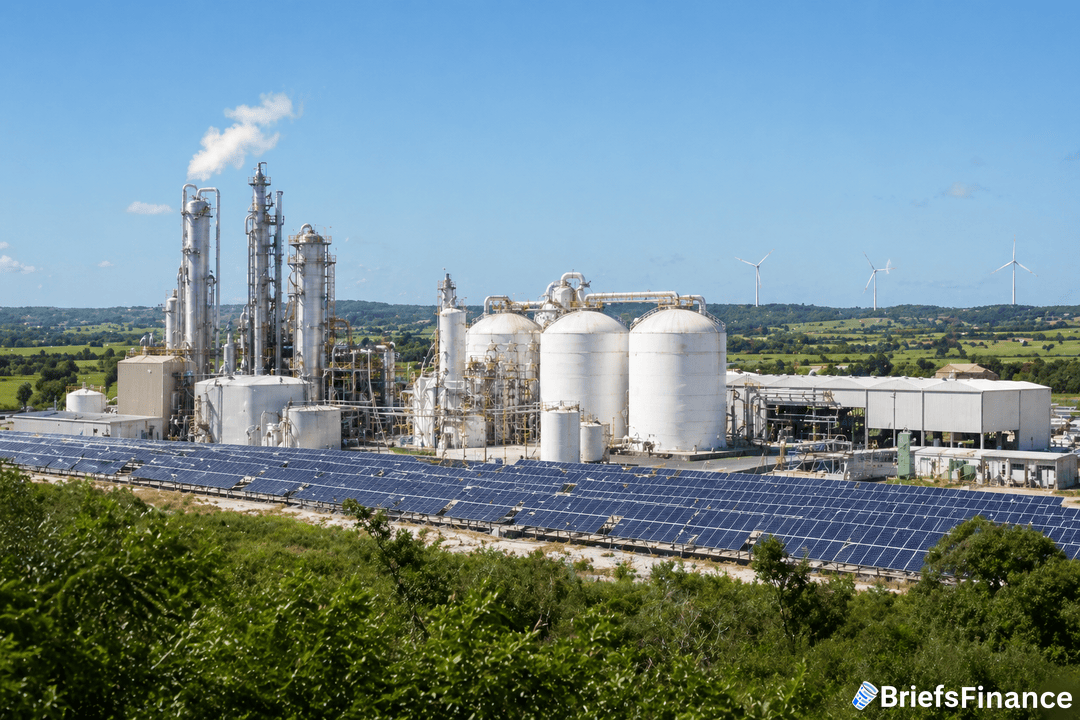
Atome PLC said this week it's reached a final investment decision on a 260,000-ton-per-year fertilizer plant in Villeta, Paraguay, with construction starting soon and full production targeted by October 2029.

The Project

The Villeta plant will run on 100% renewable power and produce calcium ammonium nitrate, which is the same fertilizer farms use today, just made without the carbon emissions tied to natural-gas-based production.

Atome has already locked in a 10-year buyer in Yara International, the Norwegian fertilizer giant, which has agreed to take the plant's full output for the duration.

The total project cost is $665 million, with $420 million of that coming as debt from international development banks led by IDB Invest and the International Finance Corp.

That makes Villeta the first industrial-scale plant of its kind anywhere in the world to clear a final investment decision.

Why The War Is The Real Story

Green fertilizer usually loses on price. Russia and its neighbors supply close to a third of the world's fertilizer at low cost, and roughly half of all fertilizer cargo passes through the Strait of Hormuz at some point in its journey to market.

Both of those numbers got harder to ignore this year as Iran's grip on the strait cut off Middle East exports and pushed spot fertilizer prices up about 50% over a recent three-week stretch.

That changes the math, since a green plant in Paraguay - far from any war zone - now looks like a hedge as much as a sustainability play.

"Supply chain disruption makes this as much a food security story as a green energy one," Atome CEO Olivier Mussat said in a recent interview with Proactive.

The Money Trail

The $420 million debt package is a big tell, since development finance institutions don't underwrite projects that can't service their debt at market terms.

That suggests the lenders are betting fertilizer prices stay high long enough to make the plant work - and Yara's 10-year offtake deal locks that view in.

For investors, it's a useful read on what supply-chain risk pricing looks like inside the global food system. Atome also signed a partnership with Casale, a Swiss engineering firm, to support future expansion - which means more plants like Villeta could be in the pipeline.

The Villeta facility is projected to displace 500,000 tons of CO2-equivalent emissions per year, which is the volume that helped unlock financing from climate-focused institutions.

What To Watch

Construction begins shortly, with full production set for October 2029 or earlier.

The swing factor is fertilizer prices. If they hold, more projects like this one clear the bar fast - if they fall, Villeta could end up being the only one of its size for years.

The London-listed Atome trades on the AIM market, and shares have been a small-cap watch for hydrogen and clean-fuel investors since the company first laid out the Villeta plan.

Disclosure

Get Market Briefs delivered to your inbox every morning for free!

No fluff. No noise. No politics. Just finance news you can read in 5 minutes.

Blogs

April 29, 2026
What Is Blockchain? A Plain English Guide For Investors
  • Blockchain is a digital ledger that records every transaction on a public network.
  • Once a transaction is recorded, it cannot be changed or deleted.
  • It is the foundation of Bitcoin, Ethereum, and thousands of other cryptocurrencies.

Read More
April 29, 2026
How To Negotiate Bills: The Script That Saves You Hundreds A Year
  • Most monthly bills are negotiable, even though most Americans never try.
  • A simple phone call with the right script can lower your phone, internet, and utility bills.
  • The key rule is to be nice. Customer service reps have more flexibility than most people realize.
Read More
April 29, 2026
75 15 10 Rule: The Budget That Builds Wealth On Autopilot
  • The 75 15 10 rule is a budgeting plan: spend at most 75% of your income, invest at least 15%, and save at least 10%.
  • It works by making sure you pay yourself before you spend.
  • Once your savings target is hit, you shift the 10% over to investing, becoming a 75/25 plan.
Read More
April 29, 2026
How To Rebalance Portfolio: The Strategy That Forces You To Buy Low And Sell High
  • Rebalancing means adjusting your portfolio back to your target allocation when it drifts too far.
  • The two main methods are time-based (rebalance once a year) and threshold-based (rebalance when allocation drifts more than 5%).
  • If you are still adding money, you can rebalance by directing new money instead of selling.
Read More
April 29, 2026
How To Buy Treasury Bonds: A Beginner's Guide
  • Treasury bonds are loans you make to the U.S. government. They are considered the safest investment in the world.
  • You can buy them at TreasuryDirect.gov directly or through any major brokerage.
  • There are three main types: T-Bills, Treasury Notes, and Treasury Bonds. The longer the term, the higher the interest rate.
Read More
April 29, 2026
Forward Vs Futures Contracts: What's The Real Difference?
  • Both forward and futures contracts are deals to buy or sell something at a set price on a future date.
  • Futures trade on exchanges. Forwards are private deals between two parties.
  • Most regular investors do not use either. They are mostly tools for businesses and big institutions.
Read More
April 29, 2026
Alternative Investments Explained: What They Are And Why They Matter
  • Alternative investments are anything that is not a regular stock or bond.
  • The most common types are precious metals, crypto, real estate, commodities, and collectibles.
  • Most investors should hold 5% to 25% of their portfolio in alternatives, depending on risk tolerance.
Read More
April 29, 2026
How To Buy Bitcoin For Beginners: 3 Simple Ways
  • There are three main ways to buy Bitcoin: directly on an exchange, through a Bitcoin ETF, or through a Bitcoin miner stock.
  • Each has its own pros, cons, and tax setup.
  • Most beginners do best starting small and using dollar cost averaging.
Read More
April 29, 2026
How To Follow Smart Money: The 5 Market Shifts Framework
  • "Smart money" means big investors with deep research teams and fast information.
  • You can follow them by watching for 5 types of market shifts.
  • The goal is to spot where money is moving before it shows up on CNBC.
Read More
April 29, 2026
Insider Trading Meaning: What It Really Is (And Why Some Of It Is Legal)
  • Insider trading means buying or selling a stock based on facts the public does not know yet.
  • Some insider trading is legal. Some is a federal crime that can send people to prison.
  • The SEC tracks every legal insider trade in a public file called Form 4.
Read More
1 2 3 19
Share via
Copy link