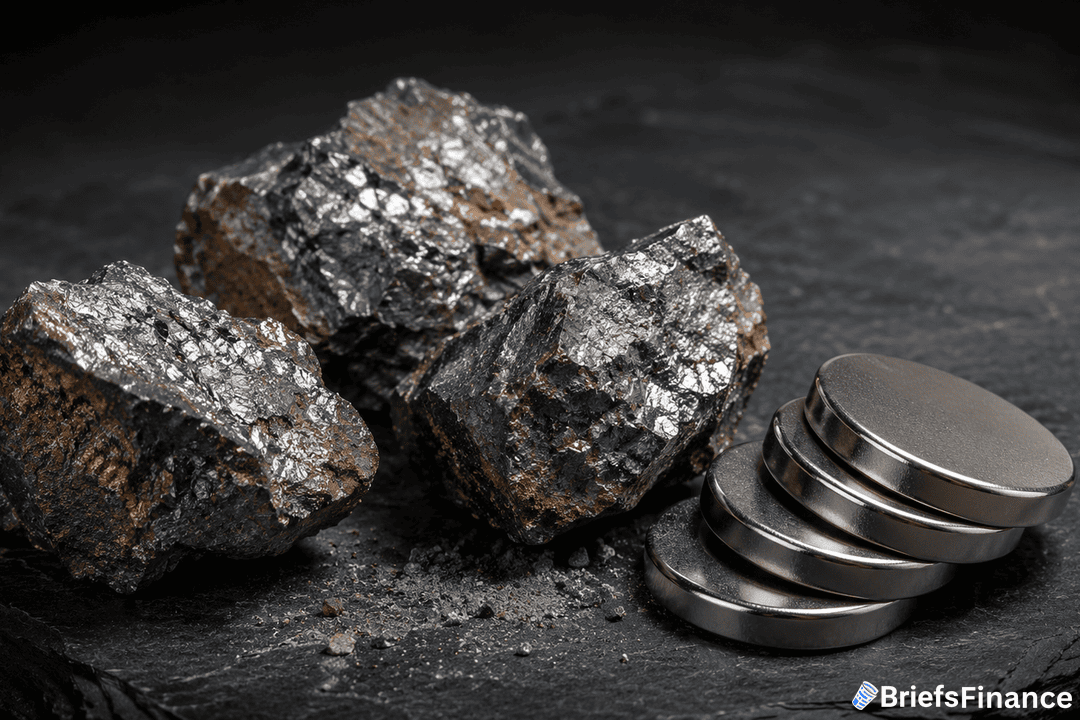
The U.S. defense industry runs on magnets, and the magnets run on rare earths. China runs the rare earth supply chain.
A clock is ticking on a six-month reprieve from Beijing, and the U.S. is not going to be ready when it expires.
The Chokepoint
China dominates every step of the rare earth chain, mining about 70% of the world's supply, processing 90% of it, and making 93% of the finished magnets that go into F-35 fighter jets, Virginia-class submarines, electric vehicles, and wind turbines.
In April 2025, China added export controls on seven categories of heavy and medium rare earths, including dysprosium and terbium, which are the elements that keep magnets stable at high heat.
The April rule also covered specific permanent magnet materials like samarium-cobalt magnets and high-performance NdFeB magnets containing terbium or dysprosium.
An October 2025 expansion went further, blocking foreign defense buyers entirely and tightening rules for foreign producers using Chinese materials or equipment.
If you want this kind of read on the supply chain stories that actually move markets, Market Briefs sends it every morning in five minutes, plus a free investing masterclass when you join.
The Pause Is Temporary
The October escalation got suspended as part of a late-2025 U.S.-China trade arrangement, with the freeze running through November 10, 2026.
The April 2025 licensing regime is still in force, with foreign defense buyers still being denied licenses for the seven rare earth categories.
That gives the U.S. about six months before Beijing decides whether to extend, tighten, or fully snap back the controls.
The U.S. Build-Out Is Behind
The government and the private sector poured $6.3 billion into non-China rare earth projects last year, with more than 60% coming from the U.S. government. Another $2.8 billion followed in the first quarter of 2026.
New magnet capacity is supposed to start coming online this summer, but the big U.S. projects are not ready. MP Materials' Northlake campus in Texas is aiming at 2028 commissioning, and USA Rare Earth's Round Top project is also targeting late 2028.
Apple-linked deliveries from MP Materials are slated to start in 2027, but the defense department's deadline arrives even earlier.
Starting in January 2027, U.S. defense systems are barred from using any Chinese-origin rare earth materials, which means contractors building F-35s or submarines need a verified non-China supply chain by then.
What To Watch
The November 10 deadline is the next pressure point. If Beijing extends the pause, supply stays open for civilian buyers but stays closed to defense.
If it doesn't, the squeeze gets worse fast for U.S. and allied defense contractors that still rely on Chinese-processed materials.
The U.S. defense system has to find magnets somewhere by 2027.
If you want this kind of read on the geopolitics moving markets every morning, join the 350,000+ investors reading Market Briefs - you also get a 45-minute course on finding investments thrown in.