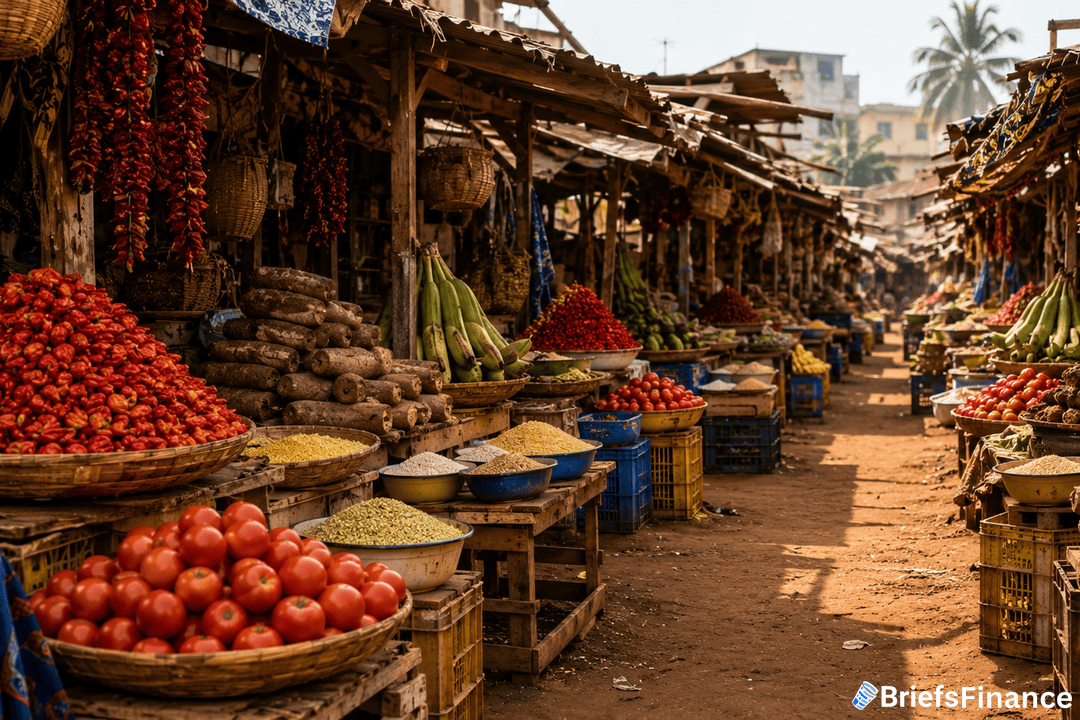
Nigeria's inflation problem is not going away.
Headline inflation rose for a second straight month in April.
It came in at 15.69%, per the National Bureau of Statistics on Friday.
The Central Bank meets next week to decide what to do.
What's Driving Prices Up
Food was the biggest contributor.
It added 6.40 points to the headline number. Restaurants and lodging added 3.56. Transport added 1.70.
Annual food inflation hit 16.06%. That is up from 14.31% in March.
The monthly food rate eased slightly. It went from 4.17% to 3.63%.
So prices are still climbing. Just a step slower.
This is the first inflation print to fully capture the U.S.-Iran war. Petrol inside Nigeria now hovers near N1,250 a liter.
That is up from N800 before the conflict began.
We translate global shocks like this into plain English every morning in Market Briefs - five minutes a day, with a free investing masterclass when you join.
What The Central Bank Does Next
The Central Bank cut its rate by 50 basis points in February to 26.5%.
That was its first cut of 2026. The timing now looks rough.
Analysts at Meristem and FMDA expect the bank to hold rates steady at the May 19-20 meeting. Bismarck Rewane of Financial Derivatives Company sees the same.
The case for another cut got harder this morning.
The Twist
Nigeria's oil money is surging at the same time consumer prices are climbing.
Bonny Light crude is trading near $110 a barrel, after spiking as high as $134 earlier this month.
The Federal Government has booked a roughly N5.13 trillion oil windfall in March and April.
The naira has also helped. It rose to an average of about N1,361 to the dollar in April, up from N1,381 in March.
That softens the cost of imports.
The State Picture
Inflation also varies sharply by state.
Bayelsa posted the highest year-on-year rate in the March release at 27.37%. Sokoto and Bauchi came in next.
Osun, by contrast, ran near 5%. The gap reflects how much each state spends on food, fuel, and transport.
The April data is expected to show the same wide spread.
What Analysts Expect
Meristem and FMDA both pointed to high food and energy costs ahead of today's release.
Their forecasts came in close to the actual print.
Bismarck Rewane of Financial Derivatives Company called for inflation near 16% in April. The headline came in just under that.
Even with the rise, inflation is still within the Central Bank's 2026 tolerance band of 14.5% to 18.5%.
So the CBN has room to hold rates without missing its target.
The World Bank had warned that oil at $80 a barrel could add 3.1 points to Nigeria's inflation.
Crude is now well above that mark.
Worth Noting
Higher oil money on one side. Higher fuel prices on the other.
Same shock, cutting both ways.
The MPC decision lands Tuesday.
Join Market Briefs here for the daily read on where global money is moving - plus a free 45-minute course on how to invest.