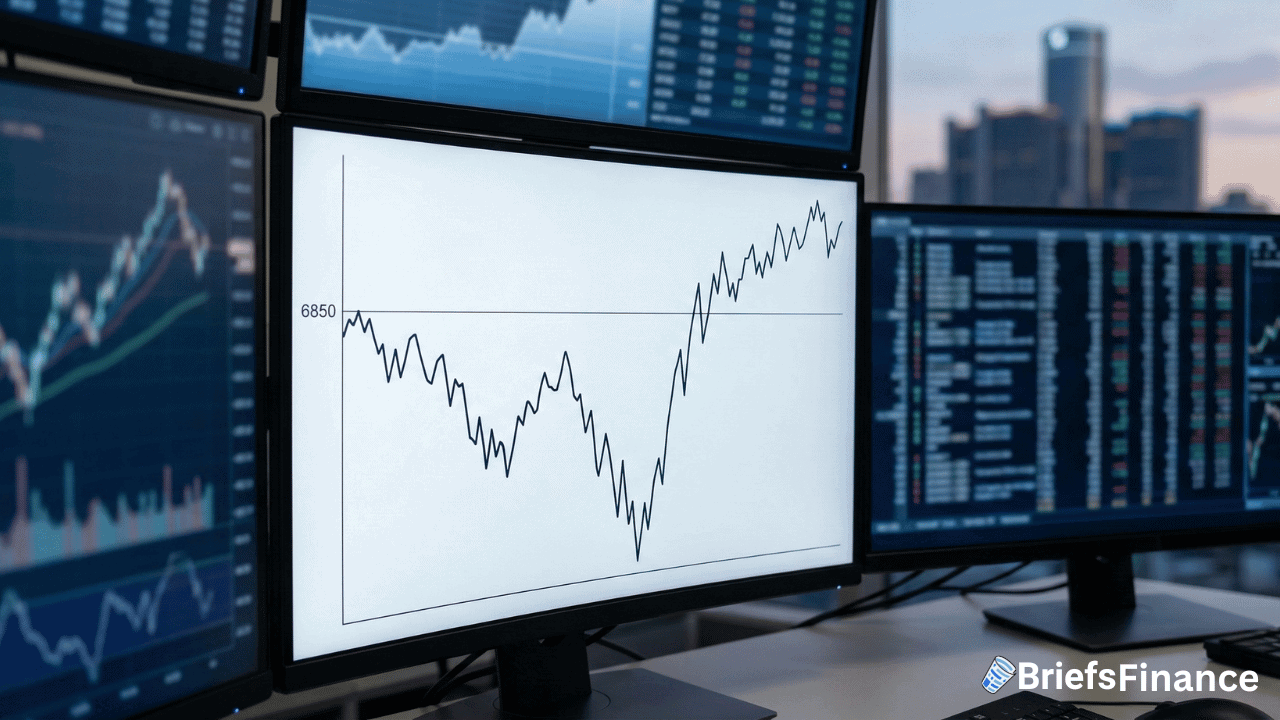
The S&P 500 closed up 0.83% Monday. That number doesn't tell you much. The full day does.
How Big Was This Move
At its session low, the S&P 500 was down 1.5% and the Dow had shed 886 points. By the close, the Dow had gained 239 points. That's a bottom-to-close swing of over 1,100 points — roughly 2.3% on the S&P 500 in a single afternoon. The VIX, Wall Street's fear gauge, crossed 30 for the first time since last April's tariff panic before retreating sharply.
For context, moves like this — where markets open near multi-percent lows and close positive — have historically occurred only during extreme events: the COVID crash in March 2020, the tariff shock in April 2025. Monday's reversal wasn't quite in that company, but it wasn't far off either.
What Actually Drove It
The reversal came in two waves. First, the Financial Times reported that G7 finance ministers were weighing a coordinated release of strategic oil reserves — enough to take WTI from $119 to around $100. Then, just after 3:15 p.m. ET, Trump told CBS News the war was "very complete, pretty much," and oil cratered further. The S&P 500 finished at 6,795.99, and the Nasdaq closed up 1.38%. The Russell 2000 — which is most sensitive to rate expectations — climbed 1.12% back into positive territory for the year.
What It Signals
Strategist Warren Pies of 3Fourteen Research flagged something worth watching: "Once bonds start rallying with oil, you'll know it is turning from an inflation trade to a recession trade." That flip hasn't happened yet — the 10-year Treasury yield is sitting at 4.13%, near a one-month high. But it's what investors are watching for next.
A monster intraday reversal on low-quality news — a phone call, no signed ceasefire — is exactly the kind of move that can reverse just as fast.