Free NewsletterPro Login

The S&P 500 Just Had One of Its Biggest Single-Day Reversals in Years

A stylized illustration of a cylindrical cup with blue arrows and lines indicating a swirling or rotational motion inside the cup.
Published Mar 9, 2026
Share:
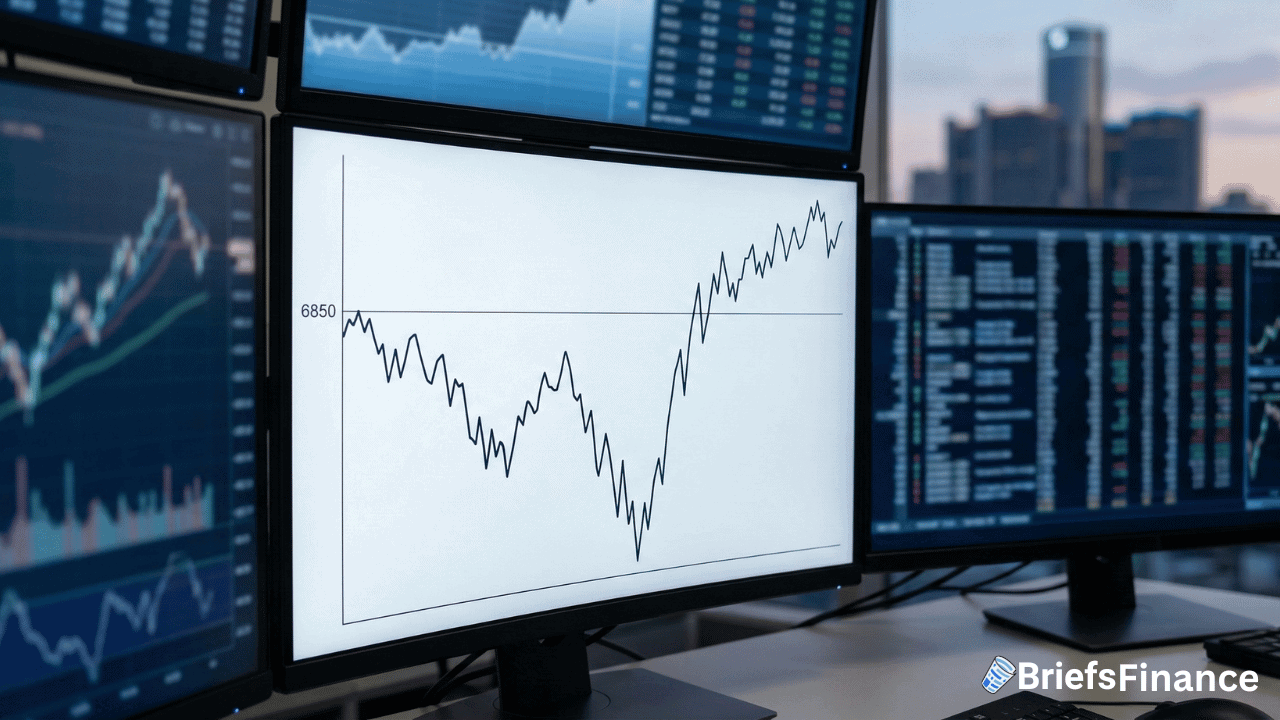
Computer monitors display financial charts and S&P 500 stock market data in an office setting, with the BriefsFinance logo visible in the lower right corner.
Summary:
  • Monday's S&P 500 swung from -1.5% to +0.83% — a roughly 2.3% intraday move, bottom to close.
  • The Dow went from -886 points at its low to +239 at the close, a 1,100-point reversal.
  • It's the kind of move that's only happened a handful of times since the 2008 financial crisis.

The S&P 500 closed up 0.83% Monday. That number doesn't tell you much. The full day does.

How Big Was This Move

At its session low, the S&P 500 was down 1.5% and the Dow had shed 886 points. By the close, the Dow had gained 239 points. That's a bottom-to-close swing of over 1,100 points — roughly 2.3% on the S&P 500 in a single afternoon. The VIX, Wall Street's fear gauge, crossed 30 for the first time since last April's tariff panic before retreating sharply.

For context, moves like this — where markets open near multi-percent lows and close positive — have historically occurred only during extreme events: the COVID crash in March 2020, the tariff shock in April 2025. Monday's reversal wasn't quite in that company, but it wasn't far off either.

What Actually Drove It

The reversal came in two waves. First, the Financial Times reported that G7 finance ministers were weighing a coordinated release of strategic oil reserves — enough to take WTI from $119 to around $100. Then, just after 3:15 p.m. ET, Trump told CBS News the war was "very complete, pretty much," and oil cratered further. The S&P 500 finished at 6,795.99, and the Nasdaq closed up 1.38%. The Russell 2000 — which is most sensitive to rate expectations — climbed 1.12% back into positive territory for the year.

What It Signals

Strategist Warren Pies of 3Fourteen Research flagged something worth watching: "Once bonds start rallying with oil, you'll know it is turning from an inflation trade to a recession trade." That flip hasn't happened yet — the 10-year Treasury yield is sitting at 4.13%, near a one-month high. But it's what investors are watching for next.

A monster intraday reversal on low-quality news — a phone call, no signed ceasefire — is exactly the kind of move that can reverse just as fast.

Disclosure

Get Market Briefs delivered to your inbox every morning for free!

No fluff. No noise. No politics. Just finance news you can read in 5 minutes.

Blogs

April 15, 2026
What Is a Put Option? A Simple Guide for Investors
  • A put option is a contract that gives you the right to sell a stock at a set price before a set date.
  • Investors use put options to protect their portfolio against losses or to profit when they think a stock will drop.
  • The most you can lose when buying a put option is the premium you paid for the contract.
Read More
April 13, 2026
What Is Free Cash Flow? How To Find It & Why It's Important
  • Free cash flow is the cash a company has left after paying its bills and putting money back into the business.
  • Investors use free cash flow to figure out what a company is really worth - and if the stock is a good deal.
  • You can find free cash flow on a company's cash flow report, one of three key reports every public company files.
Read More
April 13, 2026
Non Taxable Income: What It Is and Why Investors Care

Non taxable income is money you earn that the IRS does not tax - like Roth IRA cash, muni bond interest, and certain investment gains. The U.S. tax code taxes workers, investors, and business owners at very different rates. Tools like Roth accounts, muni bonds, and real estate write-offs can help you keep more of what you earn.

Read More
April 11, 2026
Nasdaq Index Fund: A Beginner's Guide to Investing in the Nasdaq 100
  • A Nasdaq index fund lets you invest in the 100 biggest non-bank companies on the stock market all at once.
  • You can access the Nasdaq through index funds, mutual funds, or ETFs like QQQ - each with its own fees, trading rules, and style.
  • Picking the right Nasdaq index fund comes down to three things: who runs it, what is in it, and what it costs.
Read More
April 11, 2026
What Is Wealth? It's Not What Most People Think
  • Wealth is about owning assets that grow and pay you - not just earning a high salary.
  • In a capitalist system, there are two ways to get paid: from your labor and from your capital.
  • Building wealth takes a shift in mindset, a money system, and the habit of investing before you spend.
Read More
April 10, 2026
Micron Stock: The AI Memory Play Most Investors Are Missing
  • Micron (MU) is the only U.S. company that makes HBM chips - the short-term memory layer that AI systems need to run.
  • By early 2026, data centers were using about 70% of all memory chips made in the world, creating an 18-month backlog for new orders.
  • Micron's DRAM - or short-term memory chip - revenue jumped 69% year over year, and the company shifted away from consumer products to focus almost entirely on AI.
Read More
April 10, 2026
What Is Working Capital? What Investors Need To Know
  • Working capital is current assets minus current liabilities - it shows if a business can pay its short-term bills.
  • You find it on a company's balance sheet inside its 10-K report.
  • Changes in working capital show up on the cash flow statement and affect how much cash a business really makes.
Read More
April 9, 2026
What Is a Meme Stock? A Simple Guide for New Investors

You've probably heard the term "meme stock" thrown around on […]

Read More
April 9, 2026
Enterprise Value Formula: What It Is and How to Calculate It
  • Enterprise value (EV) shows what a company is really worth - debt and cash included - not just its stock price
  • The enterprise value formula is: Market Cap + Total Debt - Cash and Cash Equivalents
  • Investors use EV with metrics like EBITDA to compare stocks more fairly than market cap alone
Read More
April 8, 2026
Return on Equity: What It Is and How to Use It
  • Return on equity (ROE) measures how much profit a company earns for every dollar of shareholder equity
  • The formula is simple: net income divided by shareholder equity
  • A higher ROE can signal a company that is good at turning investor money into profit - but it is not the full picture
Read More
1 2 3 17
Share via
Copy link









