Free NewsletterPro Login
S&P 500 6,287 +0.42%
DOW 44,521 -0.18%
NASDAQ 21,103 +0.71%

Warning: Undefined variable $funds in /var/www/briefs.co/htdocs/wp-content/plugins/oxygen/component-framework/components/classes/code-block.class.php(133) : eval()'d code on line 491

Warning: foreach() argument must be of type array|object, null given in /var/www/briefs.co/htdocs/wp-content/plugins/oxygen/component-framework/components/classes/code-block.class.php(133) : eval()'d code on line 491
/* the link was here */

Refinery Shortages Could Keep Fall Fuel Prices High

Published Aug 6, 2026
[tts_player]
Share:
Refinery Shortages Could Keep Fall Fuel Prices High
Summary:
  • Wars involving Iran and Ukraine have knocked out roughly 5 million daily barrels of refining capacity.
  • Refiners are posting huge profit jumps, while Exxon's CEO says usable refining capacity is lower than it has ever been.
  • Drivers are paying around $4.06 a gallon, down from a 2026 peak of $4.56 but 36% above the Feb. 27 price.

When Oil Drops but Gas Doesn't

Oil prices are falling. Your gas bill may not have gotten the memo.

U.S. crude dropped about 10% this week to around $76 a barrel after President Donald Trump hinted at a possible deal with Iran over the Strait of Hormuz. Since the conflict began, crude is still up about 14%.

ExxonMobil CEO Darren Woods called that gap a "disconnect between crude prices and pump prices" on Friday's CNBC "Squawk Box." He said refining constraints are now driving gasoline prices more than oil costs. If you have oil but no refinery, the oil does not help anyone at the pump.

Refineries Are Offline, and That's the Problem

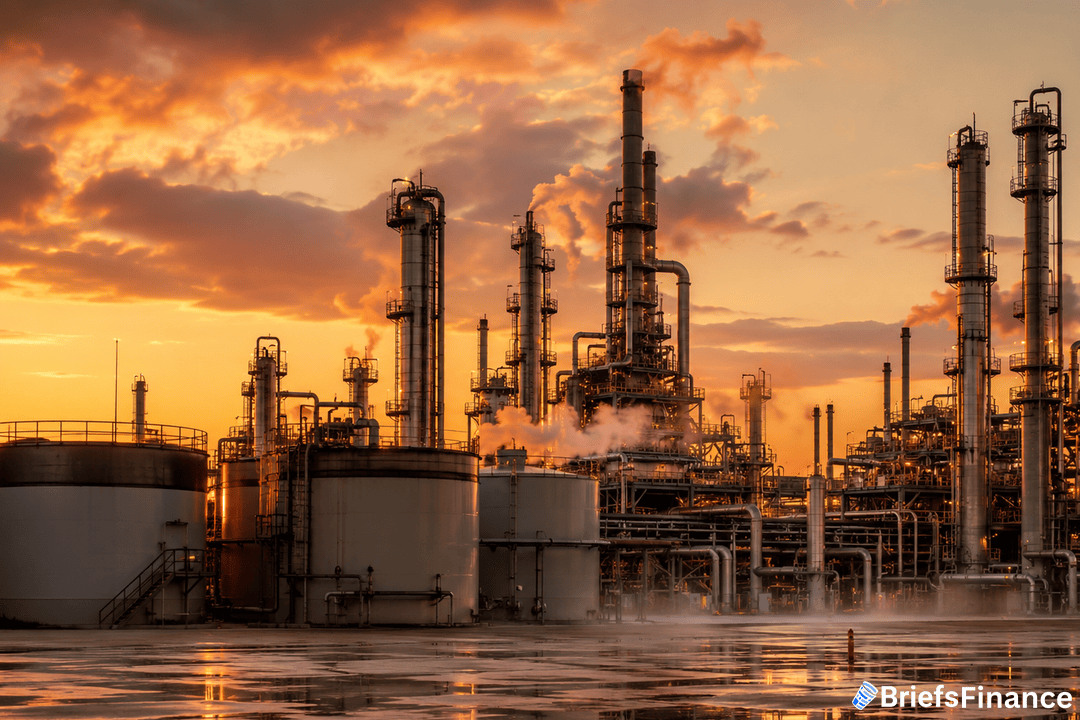
The shortage comes from wars in Europe and the Middle East.

Exxon's Woods said about 3 million barrels a day of Middle East capacity is unavailable because of the Hormuz disruption. Ukrainian drone strikes have knocked out roughly one million more barrels per day of Russian refining capacity, prompting Russia to ban diesel exports. China has also stopped exporting, pulling another couple of million barrels a day out of the market.

Get the free Always Be Buying eBook and learn the simple system for building wealth on any income

Phillips 66 executive vice president Brian Mandell put the shortage in wider terms: Asia and the Middle East have 7 million barrels per day of refining capacity offline, while Russia has 1.4 million barrels per day offline. "Refining fundamentals are very tight and getting tighter with the issues in Russia and the Mideast," he said.

Marathon Petroleum CEO Maryann Mannen said, "Middle East refineries have really been slow to come back online." "Any further disruption in the region could cause further supply constraints to evolve," she added.

These outages are why crude prices and pump prices have diverged. Refineries convert crude into gasoline, and when millions of barrels of refining capacity are offline, cheaper oil cannot quickly become cheaper fuel.

Refiners Are Cashing In

The shortage hurts at the pump, but it is good for companies that own refineries. "If you've got the refinery, you run it absolutely as hard as you can," said Patrick De Haan, GasBuddy's head of petroleum analysis. He says some refiners are delaying maintenance to keep earning high margins.

The crack spread, the gap between what refiners pay for crude and what they get for fuel, topped $70 in late July.

Valero's second-quarter earnings rose more than 400% to $3.7 billion from a year earlier. Marathon Petroleum's profit surged over 300%, to $5.1 billion, while Phillips 66's profit also climbed over 300%, reaching $3.8 billion.

Gulf Coast refiners are in a strong spot. De Haan said facilities on the Louisiana and Texas coasts have the most options in the world, helped by Venezuelan crude imports and a Jones Act waiver. "There's not a better place to be a refinery in the world. The world is your oyster," he said.

What This Means at the Pump

Fall usually brings some cheaper gas as driving cools, and De Haan expects easing. But he warns that unless Washington and Tehran reach a stable deal on the Strait of Hormuz, U.S. drivers could see a record-high pump price on Labor Day. The previous Labor Day record was $3.83 a gallon, set in 2012, and drivers are already paying more than that.

Even if oil headlines calm down, fuel has its own problem. Mandell said that if the Strait of Hormuz reopens, crude supply will come back faster than fuel supply. "The refineries, depending on the damage and ability to get spare parts, are going to take a good long time to get back online," he said.

For your wallet, the price at the pump is no longer only about oil. It is about who can actually turn oil into fuel. Until those refineries come back, autumn gasoline prices could stay high, and the relief you are hoping for may have to wait.

Download the free Always Be Buying eBook and start putting your money to work today
Disclosure

Recent News

1 2 3 50

Get Market Briefs delivered to your inbox every morning for free!

No fluff. No noise. No politics. Just finance news you can read in 5 minutes.

Blogs

June 29, 2026
Portfolio Diversification: Why Putting All Your Eggs in One Basket Destroys Wealth
  • Real diversification means spreading investments across all 11 economic sectors plus bonds, alternatives, and cash so no single bet can sink the portfolio.
  • Different sectors perform at different times, so a diversified portfolio captures upswings while smoothing the brutal drawdowns that wipe out concentrated bets.
  • Total market index funds offer the simplest path to diversification, and annual rebalancing is what keeps the structure working over time.
Read More
June 29, 2026
Non Taxable Income: What It Is and Why It Matters
  • Non taxable income is money you receive that you don't owe income tax on.
  • The tax code treats workers, investors, and business owners very differently, and investors often come out ahead.
  • Learning how income is taxed is a quiet superpower for keeping more of what you earn.
Read More
June 29, 2026
Semiconductor Stocks: A Simple Guide for Investors
  • Semiconductor stocks are companies that design and make computer chips, the brains inside nearly every modern device.
  • The AI boom has turned chips into one of the market's most important and most watched groups.
  • They offer big growth potential, but come with high valuations and a notoriously cyclical history.
Read More
June 25, 2026
How Stocks Work: A Simple Guide for Beginners
  • A stock is a slice of ownership in a company - buy one, and you own a piece of the business.
  • You make money two ways: the share price rising over time, and dividends paid to shareholders.
  • The simplest path for most beginners is buying into the whole market through a low-cost index fund.
Read More
June 25, 2026
Stop Loss vs Stop Limit: What's the Difference?
  • A stop loss order sells your stock once it hits a trigger price, prioritizing getting you out.
  • A stop limit order only sells within a price range you set, prioritizing price over a guaranteed exit.
  • The trade-off: a stop loss almost always executes; a stop limit might not if the price moves too fast.
Read More
June 25, 2026
Energy Stocks: A Simple Guide for Investors
  • Energy stocks are companies that produce and supply the power the world runs on, from oil and gas to newer sources.
  • They make up one of the 11 sectors of the market and tend to move with energy prices and big-picture shifts.
  • Like any sector, the key is diversification and understanding the forces driving demand.
Read More
June 18, 2026
What Is a Stop Loss Order? A Simple Guide
  • A stop loss order automatically sells a stock once it falls to a price you set.
  • It's a tool to cap losses or lock in gains without watching the market all day.
  • It works best for active strategies, and can backfire if used carelessly on long-term holdings.
Read More
June 18, 2026
Best S&P 500 Index Fund: How to Choose One
  • The best S&P 500 index fund for most investors is simply the cheapest, most established one that tracks the index well.
  • Funds like VOO, IVV, and SPY all hold the same 500 companies, so the biggest difference is the fee.
  • Pick one, automate your buys, and let time do the heavy lifting.
Read More
June 17, 2026
What Are Penny Stocks? Risks and Rewards Explained
  • Penny stocks are very low-priced shares of very small companies, often trading for just a few dollars or less.
  • They promise huge gains but carry huge risks: low liquidity, high failure rates, and wild price swings.
  • Most investors are better served by quality companies and funds than by chasing cheap shares.
Read More
June 17, 2026
Best Stocks for Beginners With Little Money
  • The best stocks for beginners with little money usually aren't individual stocks at all - they're low-cost index funds.
  • You can start with $100 or less and use small, regular investments to build wealth over time.
  • Focus on diversification and consistency, not on picking the next big winner.
Read More
1 2 3 24
Share via
Copy link












