Free NewsletterPro Login

Reese's Changed the Recipe. The Founder's Grandson Is Not Happy About It.

A stylized illustration of a cylindrical cup with blue arrows and lines indicating a swirling or rotational motion inside the cup.
Published Mar 3, 2026
Share:
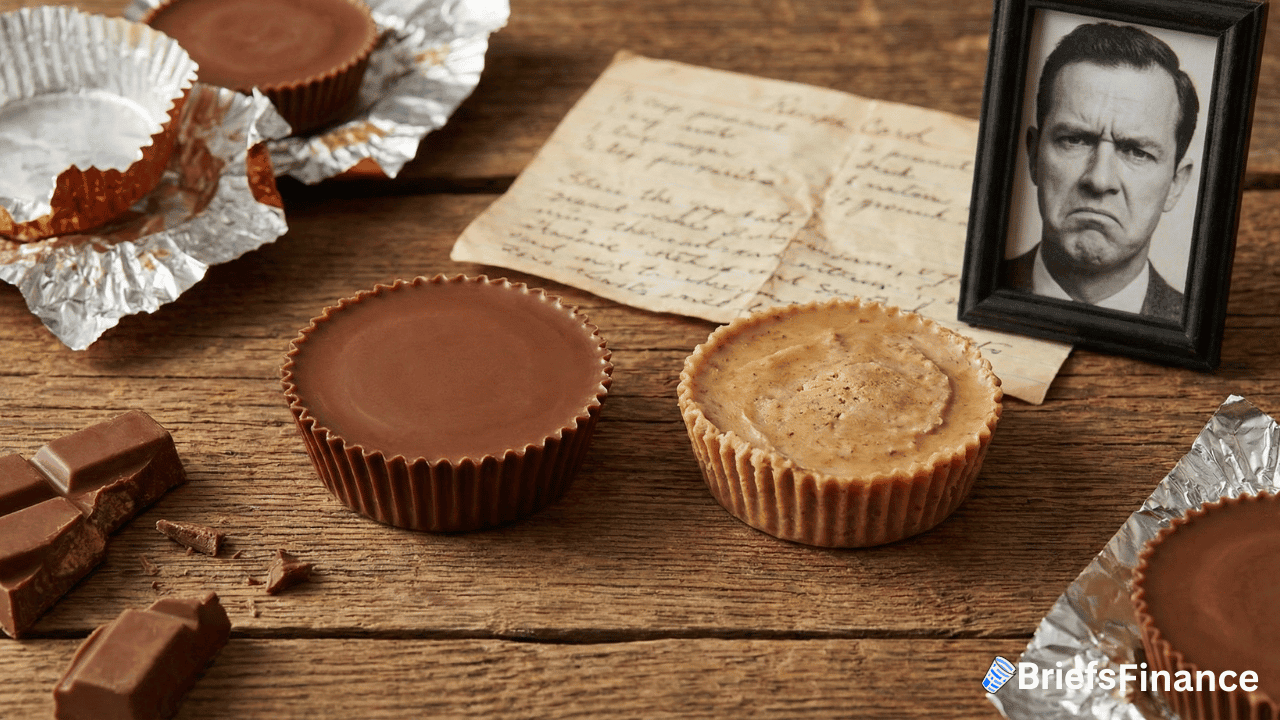
Two Reese's peanut butter cups, chocolate and caramel, sit on a wooden table with chocolate pieces, foil wrappers, a handwritten note about a recipe change, and a black-and-white photo of the founder's grandson frowning.
Summary:

  • Brad Reese, grandson of the Reese's Peanut Butter Cup creator, is publicly calling out Hershey for swapping real chocolate and peanut butter for cheaper substitutes.
  • It's a textbook example of skimpflation — quietly cutting ingredient quality instead of raising prices.
  • A 2024 study found shrinkflation and skimpflation accounted for as much as 10% of inflation in some product categories.

Brad Reese bought a bag of Reese's Mini Hearts for Valentine's Day. One bite in, he knew something was wrong.

What Hershey Did

The mini hearts weren't made with milk chocolate and peanut butter — the ingredients that made Reese's famous. Instead, the label listed "chocolate candy" and "peanut butter creme." Those are cheaper formulations that don't meet the FDA's standards to be called the real thing.

Reese, whose grandfather H.B. Reese invented Reese's Peanut Butter Cups, went public with his outrage — open letter, media appearances, a revamped website declaring him the defender of "Reese's Brand Integrity," and an orange baseball cap that says "Make Reese's Great Again."

Hershey's response? They called it an innovation.

Why This Is Bigger Than Candy

What Brad Reese is describing has a name: skimpflation. It's what happens when a company faces rising costs and, instead of raising prices or shrinking the package, quietly downgrades the product itself — and hopes no one notices.

Lindsay Owens, executive director of the Groundwork Collaborative, found that shrinkflation alone accounted for as much as 10% of inflation in certain product categories in 2024, including snacks, paper towels, and toilet paper. She argues these reformulations often mean more processed ingredients — which carries real health implications, not just taste ones.

Hershey had real cost pressures to deal with. Cocoa prices hit record highs in late 2024, driven by climate-related crop failures in West Africa, where about 70% of the world's cocoa is grown. The Trump administration's tariffs on cocoa-producing nations made things worse — though cocoa was eventually exempted in November.

The cost crunch is real. But so is the swap.

Disclosure

Get Market Briefs delivered to your inbox every morning for free!

No fluff. No noise. No politics. Just finance news you can read in 5 minutes.

Blogs

April 29, 2026
What Is Blockchain? A Plain English Guide For Investors
  • Blockchain is a digital ledger that records every transaction on a public network.
  • Once a transaction is recorded, it cannot be changed or deleted.
  • It is the foundation of Bitcoin, Ethereum, and thousands of other cryptocurrencies.

Read More
April 29, 2026
How To Negotiate Bills: The Script That Saves You Hundreds A Year
  • Most monthly bills are negotiable, even though most Americans never try.
  • A simple phone call with the right script can lower your phone, internet, and utility bills.
  • The key rule is to be nice. Customer service reps have more flexibility than most people realize.
Read More
April 29, 2026
75 15 10 Rule: The Budget That Builds Wealth On Autopilot
  • The 75 15 10 rule is a budgeting plan: spend at most 75% of your income, invest at least 15%, and save at least 10%.
  • It works by making sure you pay yourself before you spend.
  • Once your savings target is hit, you shift the 10% over to investing, becoming a 75/25 plan.
Read More
April 29, 2026
How To Rebalance Portfolio: The Strategy That Forces You To Buy Low And Sell High
  • Rebalancing means adjusting your portfolio back to your target allocation when it drifts too far.
  • The two main methods are time-based (rebalance once a year) and threshold-based (rebalance when allocation drifts more than 5%).
  • If you are still adding money, you can rebalance by directing new money instead of selling.
Read More
April 29, 2026
How To Buy Treasury Bonds: A Beginner's Guide
  • Treasury bonds are loans you make to the U.S. government. They are considered the safest investment in the world.
  • You can buy them at TreasuryDirect.gov directly or through any major brokerage.
  • There are three main types: T-Bills, Treasury Notes, and Treasury Bonds. The longer the term, the higher the interest rate.
Read More
April 29, 2026
Forward Vs Futures Contracts: What's The Real Difference?
  • Both forward and futures contracts are deals to buy or sell something at a set price on a future date.
  • Futures trade on exchanges. Forwards are private deals between two parties.
  • Most regular investors do not use either. They are mostly tools for businesses and big institutions.
Read More
April 29, 2026
Alternative Investments Explained: What They Are And Why They Matter
  • Alternative investments are anything that is not a regular stock or bond.
  • The most common types are precious metals, crypto, real estate, commodities, and collectibles.
  • Most investors should hold 5% to 25% of their portfolio in alternatives, depending on risk tolerance.
Read More
April 29, 2026
How To Buy Bitcoin For Beginners: 3 Simple Ways
  • There are three main ways to buy Bitcoin: directly on an exchange, through a Bitcoin ETF, or through a Bitcoin miner stock.
  • Each has its own pros, cons, and tax setup.
  • Most beginners do best starting small and using dollar cost averaging.
Read More
April 29, 2026
How To Follow Smart Money: The 5 Market Shifts Framework
  • "Smart money" means big investors with deep research teams and fast information.
  • You can follow them by watching for 5 types of market shifts.
  • The goal is to spot where money is moving before it shows up on CNBC.
Read More
April 29, 2026
Insider Trading Meaning: What It Really Is (And Why Some Of It Is Legal)
  • Insider trading means buying or selling a stock based on facts the public does not know yet.
  • Some insider trading is legal. Some is a federal crime that can send people to prison.
  • The SEC tracks every legal insider trade in a public file called Form 4.
Read More
1 2 3 19
Share via
Copy link