Pro Login

Oil Prices Climb as Trump Considers Strikes on Iran

A stylized illustration of a cylindrical cup with blue arrows and lines indicating a swirling or rotational motion inside the cup.
Published Jan 29, 2026
Share:
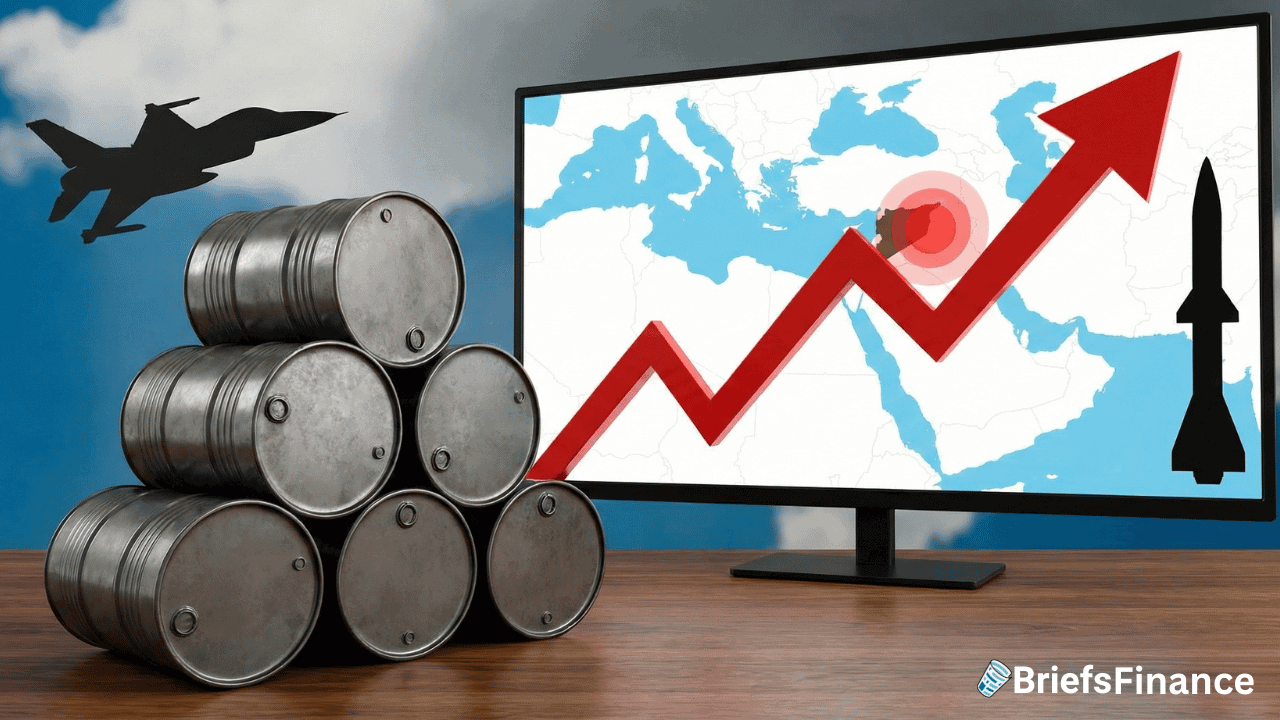
A stack of oil barrels, a rising red graph over a Middle East map on a screen, a fighter jet, and a missile silhouette highlight oil price growth linked to Iran and escalating geopolitical tensions.
Summary:

  • Crude oil prices increased over 2% on Thursday, U.S. crude rising to $64.77 per barrel.
  • Global benchmark Brent crude rose to $69.99 per barrel, reflecting market reactions to geopolitical tensions.
  • President Trump has deployed the Abraham Lincoln Carrier Strike Group to the Middle East amid tensions with Iran.

Crude Oil Prices Surge

On Thursday, crude oil prices experienced a significant rise, with U.S. crude increasing by $1.56, or 2.5%, to $64.77 per barrel.

The global benchmark, Brent crude, also saw an uptick of $1.59, or 2.3%, reaching $69.99 per barrel. This surge in oil prices is attributed to growing geopolitical tensions in the Middle East, particularly regarding Iran.

Trump's Military Posture

President Donald Trump has taken a decisive military stance by deploying the Abraham Lincoln Carrier Strike Group to the Middle East.

This move comes as tensions escalate between the U.S. and Iran, particularly concerning Iran's nuclear program. Trump has issued a warning to Iran, stating that time is running out for the country to negotiate a deal regarding its nuclear ambitions.

Threats of Military Action

In a recent statement, Trump threatened Iran with larger military strikes than those that took place in June 2025. He emphasized that the next attack would be more severe, urging Tehran not to provoke further military action.

His comments were shared in a post on Truth Social, where he warned, "The next attack will be far worse! Don't make that happen again." This rhetoric indicates a potential escalation in U.S.-Iran relations.

Concerns Over Oil Supply

The oil market is closely watching the unrest in Iran, particularly following a recent government crackdown on protests that has resulted in thousands of deaths. Multiple sources have reported that Trump is considering targeted strikes on Iranian security forces.

The intention behind these potential strikes is to inspire anti-government protests within Iran. Market analysts are concerned that any military intervention by the U.S. could disrupt crude oil supplies in the region, affecting global oil prices.

Implications for Investors

As the situation develops, investors are advised to monitor the oil market closely. The potential for military action and the ongoing unrest in Iran may create volatility in oil prices.

The situation underscores the interconnectedness of geopolitical events and financial markets, making it crucial for investors to stay informed about developments in the region.

Disclosure

Get Market Briefs delivered to your inbox every morning for free!

No fluff. No noise. No politics. Just finance news you can read in 5 minutes.

Blogs

April 13, 2026
What Is Free Cash Flow? How To Find It & Why It's Important
  • Free cash flow is the cash a company has left after paying its bills and putting money back into the business.
  • Investors use free cash flow to figure out what a company is really worth - and if the stock is a good deal.
  • You can find free cash flow on a company's cash flow report, one of three key reports every public company files.
Read More
April 13, 2026
Non Taxable Income: What It Is and Why Investors Care

Non taxable income is money you earn that the IRS does not tax - like Roth IRA cash, muni bond interest, and certain investment gains. The U.S. tax code taxes workers, investors, and business owners at very different rates. Tools like Roth accounts, muni bonds, and real estate write-offs can help you keep more of what you earn.

Read More
April 11, 2026
Nasdaq Index Fund: A Beginner's Guide to Investing in the Nasdaq 100
  • A Nasdaq index fund lets you invest in the 100 biggest non-bank companies on the stock market all at once.
  • You can access the Nasdaq through index funds, mutual funds, or ETFs like QQQ - each with its own fees, trading rules, and style.
  • Picking the right Nasdaq index fund comes down to three things: who runs it, what is in it, and what it costs.
Read More
April 11, 2026
What Is Wealth? It's Not What Most People Think
  • Wealth is about owning assets that grow and pay you - not just earning a high salary.
  • In a capitalist system, there are two ways to get paid: from your labor and from your capital.
  • Building wealth takes a shift in mindset, a money system, and the habit of investing before you spend.
Read More
April 10, 2026
Micron Stock: The AI Memory Play Most Investors Are Missing
  • Micron (MU) is the only U.S. company that makes HBM chips - the short-term memory layer that AI systems need to run.
  • By early 2026, data centers were using about 70% of all memory chips made in the world, creating an 18-month backlog for new orders.
  • Micron's DRAM - or short-term memory chip - revenue jumped 69% year over year, and the company shifted away from consumer products to focus almost entirely on AI.
Read More
April 10, 2026
What Is Working Capital? What Investors Need To Know
  • Working capital is current assets minus current liabilities - it shows if a business can pay its short-term bills.
  • You find it on a company's balance sheet inside its 10-K report.
  • Changes in working capital show up on the cash flow statement and affect how much cash a business really makes.
Read More
April 9, 2026
What Is a Meme Stock? A Simple Guide for New Investors

You've probably heard the term "meme stock" thrown around on […]

Read More
April 9, 2026
Enterprise Value Formula: What It Is and How to Calculate It
  • Enterprise value (EV) shows what a company is really worth - debt and cash included - not just its stock price
  • The enterprise value formula is: Market Cap + Total Debt - Cash and Cash Equivalents
  • Investors use EV with metrics like EBITDA to compare stocks more fairly than market cap alone
Read More
April 8, 2026
Return on Equity: What It Is and How to Use It
  • Return on equity (ROE) measures how much profit a company earns for every dollar of shareholder equity
  • The formula is simple: net income divided by shareholder equity
  • A higher ROE can signal a company that is good at turning investor money into profit - but it is not the full picture
Read More
April 4, 2026
Personal Finance Books That Actually Teach You to Build Wealth

Most investors grow up hearing the same financial advice. Study […]

Read More
1 2 3 17
Share via
Copy link